
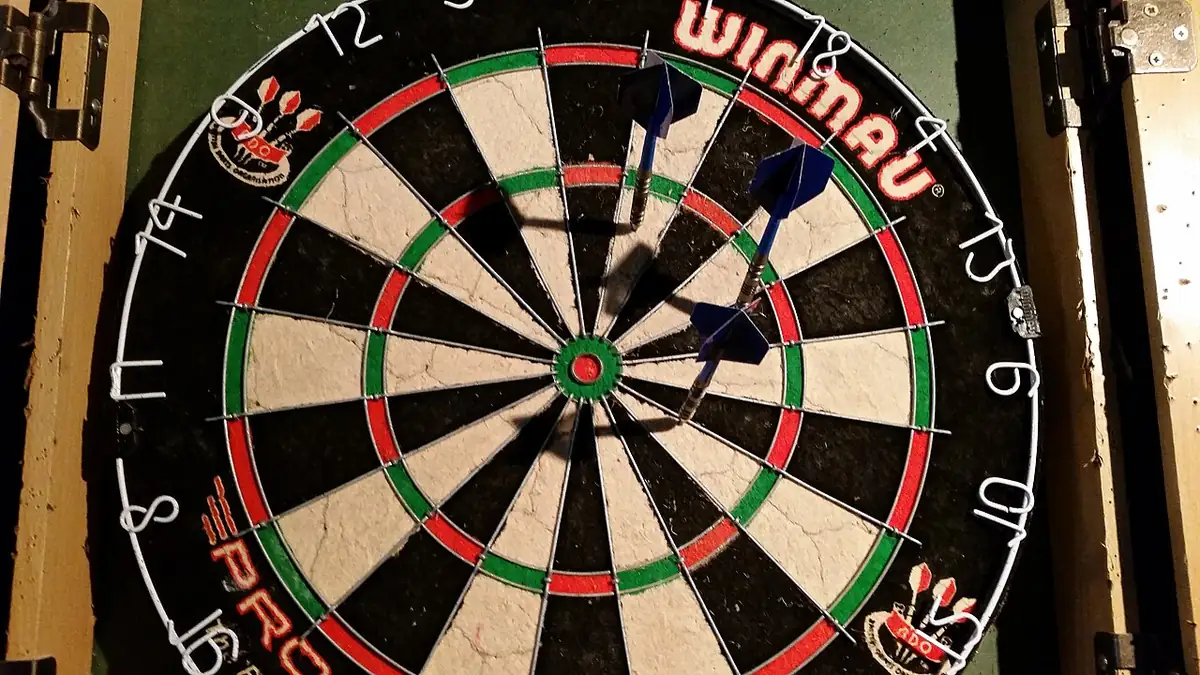
Some sporting moments need no introduction at all. Fans just call this one the leg. On 3 January 2023, inside a packed Alexandra Palace in London, Michael Smith produced a nine-dart finish in the PDC World Darts Championship final. His opponent, Michael van Gerwen, had missed double 12 for a nine-darter seconds earlier in the same leg. Smith then stepped up and finished the job himself. The arena exploded, and the clip raced around the world within hours.
That single leg lasted barely a minute of playing time. Yet it decided far more than one leg of darts. Smith went on to beat van Gerwen 7-4, lifting his first world title at the third attempt. He also became world number one on the same night. This feature looks back at how the perfect leg happened, why a nine-darter is so hard, and how the moment has aged since that famous night at Ally Pally.
Why does this one leg still get replayed so often?
Perfection is rare in any sport, and it almost never arrives under maximum pressure. Here, though, perfection arrived twice in one leg, almost. First, van Gerwen threw eight flawless darts and left himself double 12 for the nine-darter. His final dart missed, and the crowd gasped at how close he had come. Then Smith, throwing second in the leg, completed his own nine-dart finish without a flicker of doubt.
That sequence is why broadcasters labelled it the greatest leg of darts ever played. The PDC itself posted the clip with the words the best leg of all time. Commentator Wayne Mardle, on Sky Sports duty that night, lost his voice celebrating it. His stunned reaction, built around the line that he could not speak, became part of the moment itself. Years later, fans still quote those words back at him.
Sport thrives on shared moments like these, the kind whole communities organise their memories around. A deep look at Montana professional sports teams and Big Sky athletic culture shows the same pattern in a very different setting. One game, one play, or one leg can define a place for decades.
What had Smith endured before that final?
Smith arrived at this final carrying real scar tissue. The St Helens thrower, nicknamed Bully Boy, had already lost two World Championship finals. Van Gerwen beat him in the 2019 final, and Peter Wright beat him in the 2022 final. A third defeat would have cemented an unwanted reputation as the nearly man of Alexandra Palace.
His run to the 2023 final was not smooth either. In the third round, for example, he trailed Germany’s Martin Schindler 3-1 before fighting back to win 4-3. That comeback kept his tournament alive and showed the resilience he would need later. Still, few people made him favourite for the final itself.
Van Gerwen, by contrast, looked like the man to beat all tournament. The Dutchman, already a three-time world champion, was chasing a fourth title that night. Reports from the event described him as the heavy favourite after a brilliant season. He had also averaged over 100 in every round before the final, according to match reports. In short, Smith had to beat the dominant player of his era, on the biggest stage, to change his story.
What exactly is a nine-dart finish?
New fans often ask a fair question here. How can nine darts be perfect when each player throws hundreds of darts in a match? The answer sits in the scoring system of the standard game, called 501. Each leg starts at 501 points, and players subtract exactly what they score. The leg must end on a double or the bullseye, with the final dart landing exactly on zero.
Nine darts is the mathematical minimum for finishing 501. No player can legally complete a leg in fewer throws, so a nine-darter equals perfection by definition. The standard route runs 180, then another 180, then a 141 checkout. That last visit usually goes treble 20, treble 19, and double 12. Smith followed exactly that classic path in the final.
Why is the nine-darter so difficult?
Every single dart has to land in a tiny scoring bed. Seven of the nine darts typically need the treble 20 segment, the narrowest high-value target on the board. One slip into the single 20 or the neighbouring treble ends the dream instantly. The final dart brings a different kind of pressure, because a missed double leaves the leg unfinished and the chance gone.
Context makes the feat harder still. A player must do it live, on television, with a crowd roaring after every visit. In this case, Smith had to do it in a world final, straight after his opponent had nearly done it first. Darts history is full of nine-darters in early rounds, but finals are a different sport altogether. Before Smith, only Adrian Lewis had hit one in a PDC World Championship final, back in 2011.
How did the greatest leg unfold, dart by dart?
The leg came early, in the third leg of the second set. Van Gerwen had taken the opening set, and the pair had shared the first two legs of the second. So the score stood at 1-0 in sets and 1-1 in legs when the magic started. Both men opened with six perfect darts, trading maximum scores visit for visit.
Van Gerwen threw first, so he reached the finish line first. He left himself 144 after two visits, then found two more treble 20s. Suddenly one dart stood between him and a nine-darter of his own. The dart at double 12 missed by the smallest of margins. Ally Pally groaned, because everyone inside knew how rare that chance was.
Smith had quietly matched him dart for dart. He had hit back-to-back 180s, leaving himself the classic 141 checkout. Treble 20 went in first, keeping the perfect leg alive. Treble 19 followed, and the whole building held its breath. Then double 12 landed clean, and the Michael Smith nine dart finish was real. Smith had done what van Gerwen could not, in the very same leg.
The PDC later noted a striking first in that sequence. Smith became the first player to complete a nine-dart finish in a leg where his opponent had also missed a dart for one. No scriptwriter would dare pitch that plot for a world final. Reality, on this occasion, beat fiction comfortably.
How did the rest of the final play out?
A perfect leg can fade quickly if the player cannot back it up. Smith, crucially, backed it up all night. He took the second set to level the match at 1-1, and the contest stayed tight through the middle sets. Van Gerwen edged ahead again at 3-2, helped by a superb 10-dart leg of his own. At that point, the final could easily have slipped away from Smith.
Instead, the Englishman produced the strongest spell of the match. He won four sets in a row to move 6-3 ahead and within one set of the title. Van Gerwen refused to fold, and he took the tenth set to keep the final alive at 6-4. The Dutchman then led the eleventh set 2-0 in legs, and the pressure flipped back onto Smith.
The finish, when it came, was pure nerve. Smith checked out 106 to stay in the set, then broke throw to force a deciding leg. Back-to-back 180s put him in control of that final leg. Double eight sealed a 7-4 victory, the Sid Waddell Trophy, and the biggest win of his life.
What do the match numbers tell us?
The statistics underline how high the standard was that night. Smith finished with a match average of 100.87 and hit 22 maximum 180s. Van Gerwen averaged 99.58 and added 15 maximums of his own. Between them, the finalists produced 37 scores of 180 across 46 legs. Smith won 26 of those legs, a measure of how consistently he applied pressure.
His nine-darter was also the only one of the entire tournament. Nobody else managed a perfect leg at that championship, which sharpens the story further. The one nine-darter of the event arrived in its biggest match, in its most dramatic leg.
Why did that leg matter beyond the scoreboard?
Momentum in darts is hard to measure, but players talk about it constantly. Smith had watched his opponent come within one dart of perfection in his own leg. Rather than shrinking from that moment, he answered it with perfection of his own. That response sent a message to everyone watching, including van Gerwen. The nearly man of two previous finals suddenly looked like the man of the moment.
The leg also changed how the wider world saw the sport. Big sporting moments now live or die by how powerfully they travel online, and this clip travelled everywhere. Bodies that run sport watch those numbers closely, because attention shapes money and influence across the industry. The debate covered in the report on the European Court of Justice scrutiny of FIFA and UEFA shows how high the stakes around modern sport have become. For darts, one viral leg was worth more than any advertising campaign.
What can everyday players take from a perfect leg?
Most club players will never hit a nine-darter, and that is fine. The real lesson sits in the routine behind the romance. Smith repeated the same simple pattern under pressure: treble 20, treble 20, treble 20, visit after visit. His success came from thousands of hours of structured practice, not from chasing highlights.
Good practice needs good spaces, and local sport depends on them. A purpose-built hall like the A4One indoor sports facility shows how the right setting helps players train seriously all year. Community venues matter just as much, and the Penberthy Rec Sports Complex is a good example of a hub that keeps local players active.
Fans need their homes from home as well. Dedicated venues such as Rinkside Sports in Wesley Chapel are built around shared nights exactly like that Ally Pally final. School sport feeds the same pipeline from below, which is why the guide to California physical education standards and lifelong fitness matters for the next generation of players. Every champion starts as a beginner in a local hall somewhere.
How has the moment aged since 2023?
Time has been kind to that January night. The leg still tops lists of the greatest moments in darts history whenever broadcasters compile them. Sporting Life, reviewing every World Championship nine-darter, calls Smith’s effort the best of all time in its history of the perfect leg. That judgement has hardened into consensus across the sport.
The context around Smith has grown richer too. He finally owns the Sid Waddell Trophy, the prize named after the sport’s most famous commentator. He reached world number one by winning that final, completing the sport’s ultimate double in one evening. For a player who had lost finals in 2019 and 2022, the redemption arc could hardly be cleaner.
Van Gerwen’s role in the story deserves respect as well. Without his eight perfect darts and that near miss at double 12, the leg is merely excellent. His failure by millimetres created the stage for Smith’s success seconds later. Great sporting theatre needs two actors, and the Dutchman played his part superbly even in defeat. The greatest leg of darts ever is, in truth, a duet.
What makes the Alexandra Palace stage so special?
Venue matters in sport, and Alexandra Palace has become the spiritual home of world darts. The championship ran there from 15 December 2022 to 3 January 2023, across the festive season. That timing gives the event a unique place in the British sporting calendar. Fans treat a night at Ally Pally as part celebration, part sporting pilgrimage.
The 2023 event was the thirtieth World Championship organised by the Professional Darts Corporation. Its total prize fund stood at 2.5 million pounds, with 500,000 pounds reserved for the winner. So Smith’s perfect leg was not just theatre for the crowd. It formed part of a performance that carried the richest prize in the sport and the famous Sid Waddell Trophy.
Other routes to a nine-darter do exist on paper, built around different treble combinations. Players still favour the 180, 180, 141 path because it keeps the counting simple under pressure. Smith’s choice of that classic route adds to the leg’s neatness. Nothing about it was improvised or scrappy. It was the textbook perfect leg, delivered in the least textbook moment imaginable.
Frequently asked questions
When did Michael Smith hit his nine-dart finish?
Smith hit the nine-darter on 3 January 2023, during the PDC World Darts Championship final at Alexandra Palace in London. It came in the third leg of the second set against Michael van Gerwen.
What was the final score of the 2023 world final?
Smith beat van Gerwen 7-4 in sets. The win gave him his first world title, the Sid Waddell Trophy, and the world number one ranking on the same night.
Which darts did Smith throw for the nine-darter?
He scored 180, then another 180, then took out a 141 checkout. The final visit went treble 20, treble 19, and double 12, which is the classic route for a nine-dart finish.
Had anyone hit a nine-darter in a world final before?
Yes, but only once. Adrian Lewis hit a nine-dart finish in the 2011 PDC World Championship final. Smith became just the second player to achieve the feat in a final.
Why is the leg called the greatest ever?
Both players were on for a nine-darter in the same leg, something never seen at that level. Van Gerwen missed double 12 for his finish, and Smith completed his own perfect leg moments later. Broadcasters, the PDC, and fans quickly labelled it the greatest leg in the history of darts.
What did Wayne Mardle say during the leg?
The Sky Sports commentator famously declared that he could not speak, after calling it the most amazing leg of darts viewers would ever see. His reaction clip became almost as famous as the darts themselves.



