
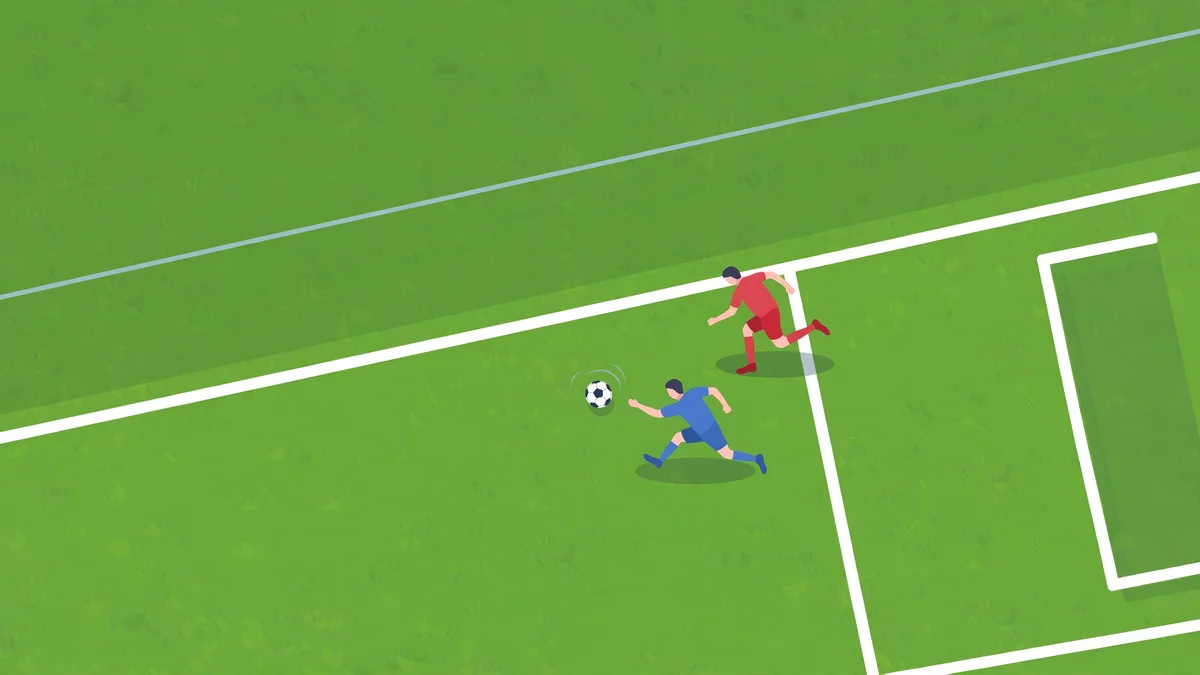
The crowd erupts. A striker taps the ball into the net. Then the flag goes up, the goal is ruled out, and half the stadium groans. If you have ever watched a football match and wondered what just happened, you are not alone. The offside rule confuses new fans, frustrates old ones, and sparks arguments in living rooms every weekend.
So what is the offside rule in football, and why does it exist? This guide explains it in plain language, with everyday examples you can picture. You will learn the rule itself, the three ways a player becomes involved, the exceptions, how VAR checks offside, and the mistakes fans make most often. By the end, you should be able to spot an offside call before the flag goes up.
Why Does the Offside Rule Exist?
Imagine football without offside. Attackers could stand next to the goalkeeper all match, waiting for a long ball. The game would turn into a kicking contest, with no build-up play and no skill in timing a run. Defenders would have to stay deep, and the midfield would empty out.
The offside rule stops that. It forces attackers to time their runs, and it forces teams to build attacks through passing and movement. In other words, the offside rule in football keeps the game a matter of skill rather than a matter of camping by the goal.
The rule has changed over the years. Early versions were stricter and needed three defenders between the attacker and the goal. The modern version needs two. Each change was made to encourage more attacking football, and each one made the game a little more open. The basic idea, though, has stayed the same: no goal-hanging.
The Offside Rule in Football, in One Sentence
Here is the whole rule in a single sentence. A player is in an offside position if, at the moment a team-mate plays the ball forward, any part of the player’s head, body or feet is in the opponent’s half and closer to the opponent’s goal line than both the ball and the second-last opponent.
That sounds complicated, so let us break it into three smaller questions. Answer all three, and you can judge almost any offside call yourself.
Question 1: Where is the player?
First, the player must be in the opponent’s half. You cannot be offside in your own half, no matter how far forward you stand. The halfway line is the boundary. If you are standing on your own side of it, you are safe.
Second, the player must be closer to the opponent’s goal line than both the ball and the second-last opponent. The second-last opponent is usually the last outfield defender plus the goalkeeper. In practice, that means you need two opponents between you and the goal, or the ball itself must be ahead of you.
Only body parts that can legally score a goal count. That means your head, your body and your feet. Your hands and arms do not count, because you cannot score with them. The boundary of the arm, for offside purposes, is the bottom of the armpit. This detail is why VAR checks sometimes come down to a shoulder or a toe.
Question 2: When is it judged?
Offside is judged at the exact moment the ball is played by a team-mate, not when the attacker receives it. This is the part most fans get wrong.
Picture a striker standing onside when the pass is made. The ball travels for two seconds. During those two seconds, the striker sprints past the last defender and receives the ball behind the defence. Is that offside? No. The judgement was made when the ball left the passer’s foot, and at that moment the striker was onside.
Now picture the reverse. A striker stands beyond the last defender when the pass is made, then runs back to collect the ball. Is that offside? Yes, if the striker then gets involved in play. Running back does not undo the position at the moment of the pass.
This timing rule is also why attackers practise their runs so carefully. A well-timed run is one of the most valuable skills in football. It is a race between the passer’s foot and the defender’s line, and the best strikers win it by a fraction of a second.
Question 3: Is the player actually involved?
Standing in an offside position is not an offence by itself. A player can stand beyond the defence all day, as long as they do not get involved in play. The whistle only blows when the player becomes actively involved. There are three ways that happens.
Interfering with play. The player touches or plays a ball passed by a team-mate. This is the most common case, and the easiest to spot.
Interfering with an opponent. The player blocks the goalkeeper’s view, challenges a defender for the ball, clearly tries to play the ball, or makes an obvious action that affects an opponent’s ability to play. A striker standing in front of the goalkeeper, blocking their sight line, is a classic example.
Gaining an advantage. The player receives a ball that rebounds off the goalpost, the crossbar, a defender or the goalkeeper after a save. If the ball comes back to them from a rebound, and they were offside when it was first played, the offence still stands.
So if a player stands offside but the ball goes to a team-mate on the other side of the pitch, play continues. The assistant referee keeps the flag down. Only involvement turns a position into an offence.
The Three Exceptions: When Offside Cannot Happen
There are three situations where offside simply does not apply, even if the attacker is standing beyond every defender. Every fan should know these, because they explain goals that look offside but are perfectly legal.
From a goal kick. If the goalkeeper kicks the ball out and it reaches an attacker standing beyond the defence, there is no offside. Teams use this to launch quick counter-attacks.
From a corner kick. A corner is taken from the goal line, so the ball is always ahead of the attackers when it is played. Offside cannot apply. That is why strikers crowd the six-yard box at corners.
From a throw-in. A player receiving the ball directly from a throw-in cannot be offside. Quick throw-ins near the opponent’s box can therefore catch a defence off guard.
There is one more situation worth knowing. If a defender deliberately plays the ball — a controlled pass, a clearance, a deliberate touch — the attacker is considered onside, no matter where they were standing before. A simple deflection, though, does not reset anything. The difference between a deliberate play and a deflection is a judgement call, and it causes plenty of arguments.
A Simple Analogy: The Supermarket Queue
Still finding it tricky? Try this analogy. Imagine a supermarket with one checkout. The rule is that you cannot join the queue from the front. You must join at the back, behind the second-last person in line. If you slip in ahead of them, you have jumped the queue.
Football works the same way. The goal line is the checkout. The defenders are the people in the queue. The ball is the shopping basket. You can only receive the ball if you are behind or level with the second-last person in the queue when the ball is passed to you. If you are ahead of them, you have jumped the queue, and the referee sends you back.
Like all analogies, this one has limits. It does not cover the exceptions or the timing rule. But for a first understanding, it captures the spirit: no sneaking ahead of everyone else.
What Happens When Offside Is Called?
When the assistant referee spots an offside offence, they raise their flag. The referee then stops play and awards an indirect free kick to the defending team. The kick is taken from the place where the offside player became involved in play.
An indirect free kick means the ball must touch another player before a goal can be scored. In practice, the defending team usually just passes the ball out from the back and restarts their attack. There is no card for offside, no matter how many times it happens. It is a technical offence, not a foul, so players are never booked for it.
The assistant referee, often called the linesman, is the official who watches the offside line. They run along the touchline, level with the second-last defender or the ball, whichever is further forward. It is one of the hardest jobs in football, because they must watch the passer and the attacker at the same time, across the full width of the pitch.
How VAR Checks Offside
Since the arrival of VAR, the video assistant referee, offside decisions have become more accurate and more controversial at the same time. VAR has changed how the offside rule in football is enforced, and here is how a check works.
First, the video team freezes the frame at the exact moment the ball was played. Then they draw lines on the screen: one through the second-last defender, one through the attacker. If any scoring part of the attacker is beyond the defender’s line, the player is offside.
Modern competitions use semi-automated offside technology. Cameras track the players’ bodies, and a computer draws the lines almost instantly. The decision still goes to a human referee, but the measurement is far more precise than the human eye alone.
This precision is also the source of frustration. Goals are now ruled out because a toe or an armpit is a few centimetres beyond the line. Fans call these decisions harsh, and many feel the rule was meant to catch clear cheating, not millimetre margins. The debate continues, and the rules are reviewed regularly. For now, though, the technology is here to stay.
If you follow big tournaments closely, you will have seen this drama play out on the biggest stage. Our report on the controversies at the Paris 2024 Olympics shows how technology and refereeing decisions can dominate the conversation around a tournament, sometimes more than the sport itself.
Five Offside Mistakes Fans Make Most Often
Even regular watchers get these wrong. Check yourself against this list next time you watch a match.
Mistake 1: Judging offside when the ball is received. Remember, it is judged when the ball is played, not when it arrives. A striker can be well beyond the defence at the moment of the touch and still be onside.
Mistake 2: Forgetting the ball counts. A player is onside if the ball is ahead of them, even if no defender is between them and the goal. A square pass or a cut-back is safe, because the ball itself is the reference point.
Mistake 3: Thinking level is offside. If the attacker is exactly level with the second-last opponent, they are onside. The benefit of the doubt goes to the attacker. Level means onside, not offside.
Mistake 4: Assuming offside applies from every restart. Goal kicks, corners and throw-ins are all exempt. A goal from a corner can never be ruled out for offside.
Mistake 5: Blaming the linesman for a VAR call. Since VAR arrived, the assistant referee often keeps the flag down on tight calls and lets play continue. The VAR team then reviews the incident. A late flag is usually a deliberate choice, not a mistake.
Offside Tactics: How Teams Use the Rule
Offside is not just a rule for referees. It shapes how teams play. Coaches build whole tactics around it, and understanding those tactics makes matches far more interesting to watch.
The Offside Trap and the Timed Run
The offside trap. Defenders step forward together, just as the opponent passes, to leave the attacker beyond them. It is a high-risk, high-reward move. When it works, it looks brilliant. When one defender steps up a fraction late, the attacker is through on goal. The trap needs perfect timing and trust between defenders.
The timed run. Strikers practise starting their run a split second before the pass. The best forwards watch the passer’s body shape, not the ball, so they can move early. A well-timed run beats the trap and creates a one-on-one with the goalkeeper.
Holding the Line
Holding the line. Some teams defend high up the pitch, keeping their defensive line near the halfway line. This squeezes the space for attackers, but it leaves a large gap behind the defence. One good through ball can undo the whole plan. Other teams defend deep, giving attackers space in front of them but none behind. Each choice is a trade-off.
Watching for these patterns changes how you see a match. Instead of waiting for goals, you start noticing the chess game between the defensive line and the strikers. That is where much of football’s real drama lives.
That drama is part of what makes live sport so compelling, wherever it is played. From packed professional stadiums to community venues, the same rules create the same tension. Our look at the professional sports teams of Montana shows how sport builds identity and community far beyond the biggest leagues, and the A4One indoor sports facility and Penberthy Rec Sports Complex show where everyday players learn the same game, offside trap included. Fine margins decide matches in every sport, not just football — think of Michael Smith’s iconic nine-dart finish, a moment of perfection decided by millimetres, just like a VAR offside call.
How to Practise Spotting Offside
The best way to learn the rule is to watch for it deliberately. Next time you watch a match, try this simple exercise.
First, pick one team and watch their strikers, not the ball. Notice where they stand when a team-mate is about to pass. Are they level with the last defender, or behind them? Do they check their run, or do they go early?
Second, watch the defensive line. Do the defenders step up together? Does one of them drop deeper than the rest? A single defender playing everyone onside is a common sight, and it often leads to a goal.
Third, when a goal is disallowed, rewind if you can. Freeze the moment of the pass. Draw an imaginary line through the second-last defender. Then check the attacker’s position. You will usually see the call clearly once you know what to look for.
Within a few matches, the rule will start to feel natural. What once looked like a random flag will become a decision you can predict. That is the moment football becomes a richer game to watch.
And if you play the game yourself, the same awareness helps on the pitch. Good positioning is a skill, and it starts with understanding the line. Facilities like Rinkside Sports in Wesley Chapel give players of all levels a place to practise, and the fitness habits you build around the game matter too — even something as simple as learning to read nutrition labels can help you fuel properly for a match.
Frequently Asked Questions About the Offside Rule
Can a goalkeeper be the second-last opponent?
Yes. The rule counts the second-last opponent, whoever that is. Usually the goalkeeper is the last opponent and an outfield player is second-last. If the goalkeeper comes out of their area, though, an outfield defender can become the last opponent instead. The rule does not care about positions, only about the order of players.
Can you be offside from your own half?
No. You cannot be offside in your own half, even if you are standing right on the halfway line. The rule only applies in the opponent’s half.
Is it offside if the ball comes off a defender?
It depends. If the defender deliberately plays the ball, the attacker is onside. If the ball simply deflects or rebounds off the defender, the attacker is still offside. The referee must judge whether the defender’s action was deliberate.
Why do some offside decisions take so long with VAR?
Because the check has several steps. The team must find the exact frame when the ball was played, identify the second-last defender, and measure the attacker’s furthest scoring body part. Tight calls take longer, and the referee may also check whether the attacker interfered with play. Semi-automated technology is making this faster.
Has the offside rule ever changed?
Yes, many times. The earliest versions needed three defenders between the attacker and the goal. In 1925, that changed to two, which opened the game up and increased scoring. Smaller changes have followed ever since, including the modern guidance that level means onside.
The Bottom Line
So what is the offside rule in football? A player is offside if they are in the opponent’s half, ahead of both the ball and the second-last opponent when a team-mate plays the ball, and then they get involved in play. That is the whole rule. Everything else — the exceptions, the timing, the VAR lines — follows from those three questions: where, when, and involved?
Next time you watch a match, you will know what the flag means before the commentator explains it. And when a goal is ruled out by a toe, you will understand why — even if you still disagree with it. That is part of football’s charm. The rule is simple to state and endlessly tricky to apply, which is exactly why fans keep arguing about it, week after week.
Do you have a favourite offside controversy? Think about the last disallowed goal you saw, and run it through the three questions. Where was the player? When was the ball played? Did they get involved? If you can answer all three, you have mastered the rule that confuses millions.