
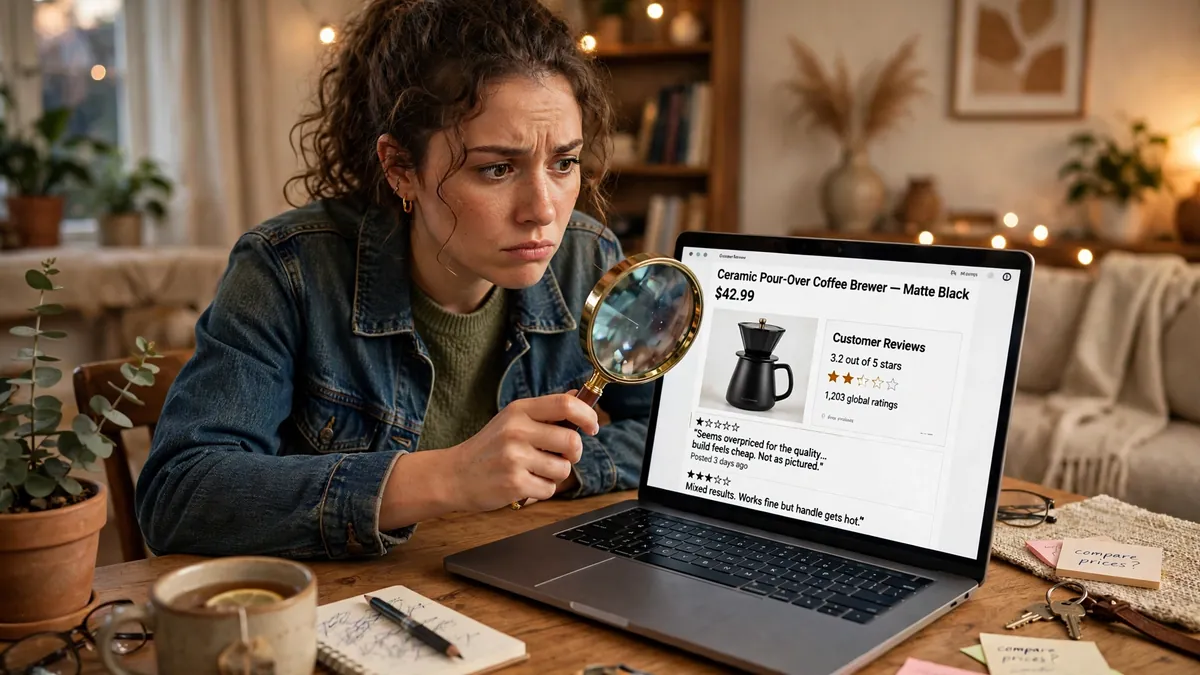
A glowing rating can feel like a shortcut. However, a high score does not always mean happy buyers. Some sellers boost weak products with paid praise. Others hide flaws behind floods of cheerful comments. Consequently, smart shoppers pause before they trust any number.
This guide shows you how to spot fake reviews in minutes. Moreover, it gives you a calm routine you can reuse anywhere. You will learn the clearest fake review signs first. Furthermore, you will learn how to tell if reviews are real without special skills.
Most fakes fail a few simple checks. For example, they sound vague, rushed, or strangely alike. In contrast, honest reviews usually mention real use and small flaws. Therefore, detail and balance become your best clues. Ultimately, you need pattern spotting, not guesswork.
The same habits help with supplements, gadgets, and services. For instance, our guide to judging supplement reviews before you buy shows similar checks in action. Similarly, careful reading protects you across every category. Indeed, a few minutes of checking can save real money.
Your 3-Minute Routine Before You Trust Any Rating
Start with the middle, not the top. Specifically, open the three-star reviews first. Those writers often liked some things and disliked others. Moreover, that balance makes their comments easier to trust. Their notes also reveal flaws that fans ignore.
Next, scan the one-star and five-star reviews together. However, treat both extremes with healthy doubt. Extreme praise can hide paid promotion. Likewise, extreme anger can hide a rival attack. Therefore, compare both sides before you decide.
Then check dates, profiles, and wording. Additionally, look for clusters, repeats, and sudden spikes. A steady flow of reviews usually looks natural. Conversely, a sudden flood often looks planned. As a result, timing tells a story by itself.
Finally, leave the product page for a moment. In addition, search the same product on another site. Different stores should show a broadly similar picture. Meanwhile, wildly different ratings deserve a closer look. This routine is the core of how to read product reviews critically.
12 Signs to Check Before You Buy
1. Praise Sounds Vague and Could Fit Any Product
Vague praise is one of the clearest warning signs. For example, fakes say great product, works well, or love it. However, they rarely explain what worked or why. Genuine buyers usually name a task or moment. Consequently, empty praise should lower your trust.
Real reviews often include ordinary, specific details. They might mention battery life, fit, taste, or delivery. Moreover, they might describe a room, routine, or problem. In contrast, fake comments stay safely general. Therefore, ask whether the review could describe anything.
Specific complaints can be oddly reassuring. Indeed, a small flaw makes praise feel more honest. Someone paid to praise rarely adds balance. Similarly, someone rushing through many reviews keeps comments short. As a result, thin detail is a strong early filter.
2. Many Reviews Arrive in a Tight Burst
Timing clusters deserve close attention. Normally, reviews arrive in a slow, uneven stream. However, bought reviews often land within days. Sometimes dozens appear right after a launch. Consequently, a sudden spike should prompt more checks.
Scroll back and note the dates carefully. Additionally, look for quiet months followed by sudden noise. That pattern rarely matches normal buying habits. Meanwhile, seasonal products can spike for honest reasons. Therefore, treat timing as a clue, not proof.
Launch timing matters for new brands especially. For example, a new seller with instant fame looks odd. Established sellers also face pressure to stand out, as this look at how digital marketing shapes consumer products and services explains. Nevertheless, honest growth usually leaves a longer trail. Ultimately, steady history beats sudden glory.
3. The Same Phrases Keep Repeating
Repeated wording is hard for fakers to hide. Sometimes ten reviews share one odd phrase. Moreover, they may repeat the same benefit in same order. Real buyers phrase the same point very differently. Therefore, repetition points toward a script or brief.
Copy a distinctive sentence into a search box. Furthermore, check whether it appears on other listings. Copied text sometimes spreads across many products. In addition, sellers may reuse praise for near-identical items. As a result, one search can expose a whole network.
Watch sentence rhythm as well as words. For instance, several reviews may share short, punchy lines. Others may use identical superlatives and exclamation marks. Conversely, natural writing varies in length and tone. Indeed, variety is a quiet sign of real people.
4. The Reviewer Has No Real History
Always check reviewer profile history before trusting praise. Click the name and scan earlier reviews. However, a profile with one review is not proof. New shoppers have to start somewhere. Consequently, combine this check with other signs.
Some profiles review only one brand ever. Others praise five unrelated products in one day. Moreover, their comments often stay short and glowing. That pattern suggests paid work or automation. Therefore, a thin profile should reduce your confidence.
Strong profiles look refreshingly ordinary. For example, they review mixed products over many months. They also give varied ratings, not constant fives. Similarly, their language changes with each product. Ultimately, a believable history is hard to fake cheaply.
5. The Verified Badge Is Missing or Misunderstood
Understanding the verified purchase badge meaning helps a lot. Usually, the badge means the platform linked a purchase. However, it does not prove the review is honest. A buyer can still receive a refund privately. Therefore, treat the badge as one signal only.
Unverified reviews are not automatically fake either. For instance, someone may have bought the item elsewhere. Someone else may have received it as a gift. Nevertheless, a page full of unverified praise looks weaker. In contrast, mixed verified detail usually looks stronger.
Look at which reviews carry the badge. Additionally, compare their tone with unverified comments. If verified buyers complain while others gush, pause. Meanwhile, consistent verified detail supports the rating. As a result, badge patterns matter more than single badges.
The same caution applies to service reviews too. Our reading of SPS Technologies reviews and real user experiences shows why context matters. Indeed, labels help only when you read beyond them. Consequently, never let one badge end your checking.
6. Every Rating Sits at One Extreme
Most real products attract a spread of opinions. However, manipulated pages often lean heavily one way. Understanding one star vs five star review bias explains this pattern. Happy and angry buyers write more often than contented ones. Therefore, extremes naturally dominate many pages.
Fakers exploit that natural bias. For example, paid praise pushes perfect scores upward. Rival attacks push perfect products downward suddenly. Moreover, both tactics bury calm, middle reviews. As a result, the average can mislead you badly.
Read the distribution, not just the average. Additionally, check how many reviews sit at three stars. A healthy spread usually includes some middle ground. Conversely, a wall of fives with no nuance looks staged. Ultimately, balance remains your most reliable guide.
7. A Sudden Attack Looks Like Review Bombing
Having review bombing explained clearly protects good sellers too. Bombing means many negative reviews arrive at once. Sometimes the anger follows news, not product quality. Moreover, many bombers never bought the item. Consequently, their complaints often mention outside events.
Spot bombing by reading the newest negatives first. For instance, they may repeat one slogan or grievance. They may also ignore features, delivery, or use. In contrast, genuine complaints usually describe a personal experience. Therefore, shared outrage without detail signals bombing.
Bombing can also follow a price rise or update. Nevertheless, some of those complaints may be fair. Check whether criticism targets the product itself. Similarly, check whether ratings recover over time. As a result, you can separate protest from product truth.
8. Free Products Hide Behind Quiet Praise
Free products can shape opinions in subtle ways. That is why incentivized reviews disclosure matters so much. Reviewers should state clearly that they received something. Moreover, the disclosure should appear near the review itself. Hidden or missing disclosure breaks reader trust.
Incentivised does not always mean dishonest. For example, a tester may still write fairly. However, gratitude and future offers can soften criticism. A careful reader therefore weighs those reviews lightly. Consequently, undisclosed incentives are a serious red flag.
Look for phrases like received for free or gifted. Additionally, search the page for disclosure labels. Some platforms add tags for incentivised reviews. Meanwhile, other reviews bury the note at the end. Ultimately, clear disclosure respects you as a reader.
Brands know disclosure affects trust and sales. This guide to scaling consumer products and services growth shows that wider pressure clearly. Indeed, growth built on hidden praise rarely lasts. Therefore, honest brands welcome open disclosure.
9. Photos Look Staged, Stolen, or Mismatched
Photos can expose fakes surprisingly quickly. Stock-style images often look too clean and bright. Moreover, the product colour or size may look wrong. Real buyers post imperfect, ordinary photos. Therefore, polished perfection should raise a question mark.
Reverse image search can help here. For instance, one photo may appear on many listings. That reuse suggests a seller library, not buyers. In addition, mismatched backgrounds hint at copied content. As a result, images deserve the same scepticism as words.
Genuine photos usually match the written story. Someone describing a small kitchen shows that kitchen. Similarly, wear, clutter, and odd angles feel authentic. Conversely, glamour shots rarely prove daily use. Ultimately, believable mess often beats staged beauty.
10. Writing Feels Robotic and Oddly Polished
The AI generated reviews problem is growing fast. Automated text can now sound fluent and friendly. However, it often feels smooth without being specific. It may praise everything and risk nothing. Consequently, flawless emptiness should make you pause.
Look for generic transitions between unrelated points. For example, a review may jump from shipping to quality oddly. It may also repeat the product name too often. Moreover, it may misuse a feature or detail. Therefore, small factual slips can reveal automated writing.
Human writing has texture and limits. Real buyers forget details and stress personal priorities. Similarly, they use slang, fragments, or uneven pacing. In contrast, generated praise often sounds evenly enthusiastic. As a result, voice and specificity remain useful tests.
Retail sellers feel this pressure across many markets, as this analysis of digital marketing strategy for retail firms makes clear. Nevertheless, shoppers can still push back with careful reading. Indeed, slow reading defeats fast fakery. Ultimately, attention is your strongest defence.
11. Details Contradict the Product or Each Other
Contradictions are gifts for a careful shopper. Sometimes a review praises a feature the product lacks. Moreover, colours, sizes, or models may not match. Those errors suggest the writer never used it. Therefore, check claims against the product description.
Reviews can also contradict each other strangely. For instance, one calls assembly effortless and instant. Another describes missing parts and confusing instructions. Both experiences could happen, of course. However, clusters of opposite extremes deserve scrutiny. As a result, compare several detailed reviews side by side.
Pay attention to dates in the story too. Additionally, a review may mention seasons that cannot fit. A winter complaint posted in summer looks odd. Meanwhile, copied reviews often carry stale details. Consequently, small mismatches can unravel a fake set.
12. The Story Changes on Other Websites
Always cross check reviews across sites before big purchases. Search the product name on two other stores. However, expect small differences in scores and volume. Different audiences naturally rate products slightly differently. Therefore, look for broad agreement, not identical numbers.
Large gaps tell a different story. For example, one store may show near-perfect praise. Another may show mixed or poor feedback. Moreover, specialist forums may reveal recurring faults. As a result, outside views can correct a managed page.
Independent roundups add useful context too. Additionally, they often test products over longer periods. Their findings may confirm or challenge buyer claims. Similarly, brand growth stories, like this guide to scaling consumer products growth, show why reputation needs consistency. Ultimately, agreement across sources builds real confidence.
Distribution pages can add another angle for online orders. This overview of e-commerce distribution and getting products to customers explains delivery claims well. Indeed, delivery praise should match realistic fulfilment. Consequently, impossible promises in reviews deserve doubt.
Tools That Help You Check Faster
Tools cannot decide for you, but they help. In particular, Fakespot and ReviewMeta tools analyse review patterns automatically. They look for repeats, spikes, and suspicious language. Moreover, they give you a second view quickly. Therefore, use them as a starting point.
Run the product link through a checker first. Additionally, read the reasons behind any warning. A low grade alone tells you very little. Meanwhile, the detailed flags teach you what to inspect. As a result, tools work best alongside manual reading.
No checker catches every fake review. For instance, careful paid reviews can look natural. New manipulation methods also keep evolving. Nevertheless, a warning plus your own checks is powerful. Ultimately, combine tool output with the twelve signs above.
E-commerce guides stress the same layered approach. This piece on redefining e-commerce excellence and customer experience underlines trust repeatedly. Indeed, trust grows from many consistent signals. Consequently, one tool or badge should never decide alone.
What the Rules Say About Fake Reviews
Regulators now treat fake reviews as deception. The FTC fake review rules ban buying and selling fake reviews. Moreover, the rules cover reviews that mislead shoppers about experience. They also address paid praise presented as independent opinion. Therefore, manipulation is not just poor practice.
Disclosure sits at the heart of those rules. Businesses must not hide material connections with reviewers. Similarly, reviewers should reveal free products or payment. Hidden incentives prevent shoppers from judging fairly. As a result, transparency protects both buyers and honest sellers.
Rules alone cannot clean every product page. Enforcement takes time, and new listings appear daily. However, knowing the rules sharpens your expectations. You can report suspicious patterns to the platform. Ultimately, informed shoppers make manipulation less profitable.
A Quick Checklist You Can Save
- Read the three-star reviews before the extremes.
- Check dates for bursts, spikes, or bombing.
- Compare repeated phrases across several reviews.
- Open profiles and review their wider history.
- Note verified badges, but never trust them alone.
- Look for clear disclosure on incentivised reviews.
- Inspect photos for stock images or mismatches.
- Run the listing through a review checker tool.
- Compare ratings and complaints on other sites.
- Trust detailed balance more than perfect praise.
This checklist takes only a few minutes. Moreover, it becomes faster with regular practice. You will start noticing patterns almost instantly. For example, vague bursts will stand out immediately. Consequently, fake pages lose their power over you.
Expensive or health-related purchases deserve extra care. Additionally, read policy pages and return terms carefully. Reviews should support, not replace, that research. Meanwhile, a poor return policy raises the stakes. Therefore, slow down when mistakes would cost more.
The Bottom Line for Smarter Shopping
Fake reviews work by rushing you toward trust. However, a short routine breaks that spell. Start in the middle, check profiles, and compare sources. Moreover, watch timing, language, photos, and disclosure. As a result, you will judge products far more clearly.
No single sign proves a review is fake. Indeed, honest reviewers can look unusual sometimes. Nevertheless, several weak signals together mean real risk. Similarly, several strong signals together support confidence. Ultimately, patterns matter more than any one comment.
Use this guide whenever a rating feels too perfect. Furthermore, share the routine with family and friends. Collective scepticism makes marketplaces healthier for everyone. In addition, honest sellers benefit when fakes stand out. Finally, your attention rewards the businesses that earn trust.
Explore more practical guides on WordGlowUp.



