
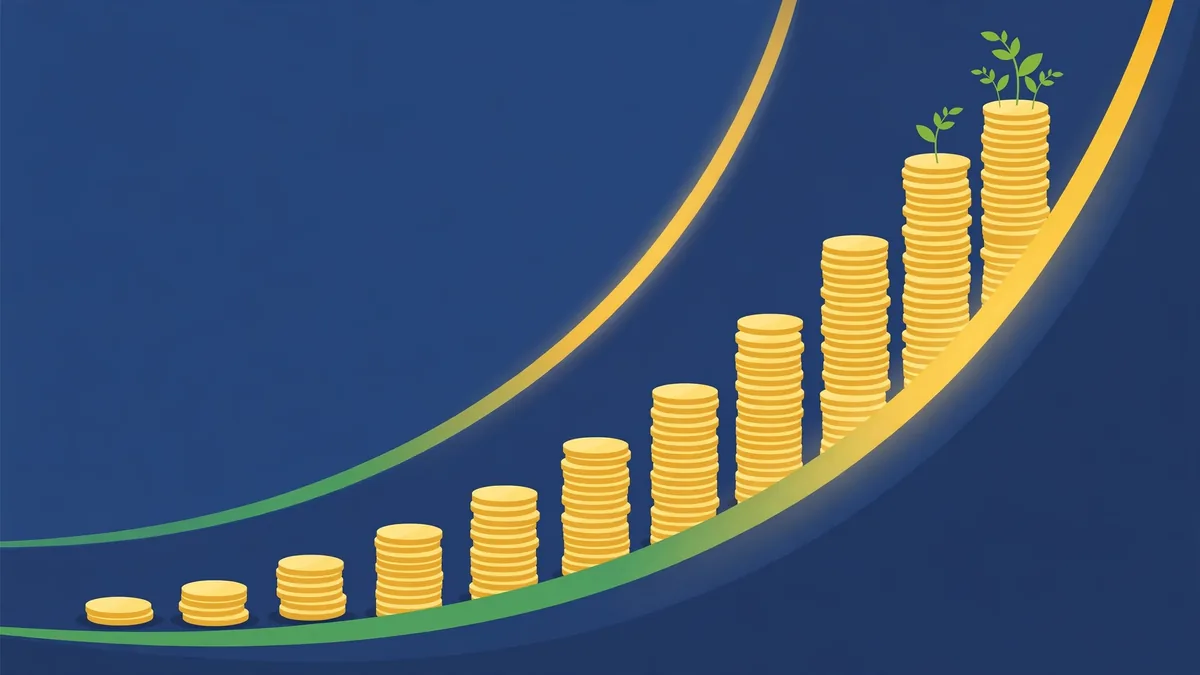
Amara opened her first savings pot at twenty-five, with modest pay. Meanwhile, her older brother Ben waited until thirty-five to begin. Admittedly, both siblings are fictional characters created for this story. Nevertheless, their numbers reveal a real and powerful maths lesson.
Importantly, every figure below uses clearly stated hypothetical assumptions. For example, both savers place one hypothetical $5,000 sum aside once. Furthermore, both examples assume a hypothetical 7% a year, compounded yearly. Therefore, nothing here promises returns or predicts real markets.
Clearly, this article is education, not financial advice. Indeed, real returns vary, and real accounts follow different rules. However, the underlying maths stays exactly the same everywhere. Consequently, learning the mechanism helps you judge any product calmly.
Meet Amara and Ben, Ten Years Apart
Firstly, picture Amara at twenty-five, working her second job. Specifically, she decides to set aside a single hypothetical $5,000 amount. Moreover, she leaves that money untouched and adds nothing else. Ultimately, her only real advantage is an early starting date.
Meanwhile, Ben spends his twenties focused on rent and training. Subsequently, he starts at thirty-five with the identical hypothetical $5,000. Admittedly, his delay feels small and completely understandable in real life. However, those ten missing years change his final result dramatically.
Have you ever wondered why a head start matters so much?
Indeed, the answer lies in how interest begins earning interest. Furthermore, each year builds on a slightly larger balance than before. Therefore, growth starts slowly and then accelerates over time. Consequently, time itself becomes the most powerful ingredient here.
How Does Compound Interest Work?
Firstly, you need one simple answer to how does compound interest work in practice. Basically, you earn interest on your original money first. Subsequently, you also earn interest on interest already added. Therefore, your balance grows from an expanding base each period.
Imagine a snowball rolling gently down a long snowy hill. Initially, each turn adds only a thin new layer. However, the ball grows larger with every single rotation. Consequently, later turns collect far more snow than earlier turns.
Similarly, compound interest rewards patience far more than speed. For instance, Amara earns interest on $5,000 during year one alone. Afterwards, she earns interest on $5,350 during year two instead. Therefore, her interest itself starts working alongside her original sum.
Importantly, neither saver lifts a finger after starting here. Indeed, the growth comes from time and reinvested interest alone. Moreover, no extra deposits hide inside these hypothetical illustrations. Consequently, you can see the pure effect of compounding clearly.
Simple vs Compound Interest: The Core Difference
Firstly, simple interest pays only on your original principal amount. In contrast, compound interest pays on principal plus accumulated interest. Therefore, the gap between them widens steadily over longer periods. Indeed, that widening gap explains most long-term growth stories.
Consider a clean compound interest example with hypothetical numbers. Suppose you place a hypothetical $1,000 at a hypothetical 5% yearly rate. Under simple interest, you earn exactly $50 every single year. Meanwhile, under compounding, your yearly interest grows slightly each year.
After ten years, simple interest gives you $1,500 in total. However, compounding gives you $1,628.89 under those same assumptions. After twenty years, simple interest reaches only $2,000 exactly. In contrast, compounding reaches $2,653.30 over that longer span.
Finally, thirty years stretches the difference even further apart. Specifically, simple interest ends at $2,500 after thirty years. Meanwhile, compounding ends at $4,321.94 under the same assumptions. Consequently, simple vs compound interest is never a small detail.
The Compound Interest Formula, in Plain Words
Admittedly, formulas scare many readers before they even begin. However, the compound interest formula contains only four simple parts. Indeed, each part answers one ordinary question about your money. Therefore, you can learn it comfortably in a few minutes.
Firstly, the formula reads A equals P times one plus r divided by n, all raised to the power of n times t. Here, A means your final amount after growth ends. Meanwhile, P means your principal, or starting amount. Additionally, r means the annual rate written as a decimal.
Furthermore, n means how often interest compounds each year. Similarly, t simply means the total number of years involved. For example, a 7% rate becomes 0.07 inside the formula. Consequently, every symbol maps to one clear everyday idea.
Importantly, Amara and Ben both use yearly compounding here. Therefore, n equals one, and the formula becomes much simpler. Specifically, their version reads A equals P times one plus r, raised to the power of t. Ultimately, simple inputs produce their entire forty-year story below.
How to Calculate Compound Interest, Step by Step?
Firstly, learning how to calculate compound interest takes four steps. Initially, write down your principal, rate, frequency, and years. Secondly, convert the percentage rate into a decimal value. Thirdly, insert those numbers carefully into the formula above.
Finally, subtract your principal from the final amount afterwards. Indeed, that subtraction isolates the interest you actually earned. Moreover, checking each step slowly prevents most beginner mistakes. Consequently, a basic calculator handles the whole process easily.
Take Amara and her hypothetical first year as practice. Firstly, multiply $5,000 by 1.07 for one year of growth. Therefore, her balance becomes $5,350 after that first year. Subsequently, multiply $5,350 by 1.07 for year two again.
As a result, her second year ends at $5,724.50 exactly. Interestingly, she earned $350 in year one alone. Meanwhile, she earned $374.50 during year two instead. Consequently, her interest grew even though her rate never changed.
Amara’s First Ten Years, Year by Year
Below, Amara’s hypothetical journey unfolds one year at a time. Admittedly, the early gains look modest and almost disappointing initially. However, each row quietly builds the base for the next. Therefore, reading the full table changes how patience feels.
| Year | Balance at Year End | Interest Earned That Year |
|---|---|---|
| 0 | $5,000.00 | Starting point |
| 1 | $5,350.00 | $350.00 |
| 2 | $5,724.50 | $374.50 |
| 3 | $6,125.22 | $400.72 |
| 4 | $6,553.98 | $428.76 |
| 5 | $7,012.76 | $458.78 |
| 6 | $7,503.65 | $490.89 |
| 7 | $8,028.91 | $525.26 |
| 8 | $8,590.93 | $562.02 |
| 9 | $9,192.30 | $601.37 |
| 10 | $9,835.76 | $643.46 |
Notice how her yearly interest almost doubles across the decade. Indeed, year ten adds $643.46, compared with $350 initially. Moreover, she deposited nothing beyond the original hypothetical $5,000 sum. Consequently, reinvested interest alone explains the entire acceleration shown.
Meanwhile, Ben has not even started during this whole decade. Admittedly, he was busy building skills and handling real responsibilities. Nevertheless, the maths clock was already running without him. Therefore, his later start becomes the heart of this story.
The Power of Compounding Over Time
Firstly, the power of compounding over time appears in decades. Initially, curves look flat and rewards feel painfully slow. However, later years add larger amounts with surprising speed. Consequently, long horizons reward calm savers far more visibly.
At year ten, Amara reaches $9,835.76 in this hypothetical illustration. Meanwhile, Ben finally starts with his identical hypothetical $5,000 sum. From here, both balances grow at the same assumed rate. Therefore, Ben simply repeats Amara’s path, ten years behind her.
At year twenty, Amara reaches $19,348.42 under these assumptions. Meanwhile, Ben reaches $9,835.76, exactly Amara’s earlier ten-year mark. At year thirty, Amara reaches $38,061.28 in the illustration. Meanwhile, Ben reaches $19,348.42, again one full decade behind.
Finally, year forty brings the comparison to age sixty-five. Specifically, Amara ends with $74,872.29 in this hypothetical example. In contrast, Ben ends with $38,061.28 at the same age. Consequently, Amara finishes with almost double, from identical contributions.
| Years Since Amara Started | Amara Balance | Ben Balance |
|---|---|---|
| 0 | $5,000.00 | Not started yet |
| 10 | $9,835.76 | $5,000.00 |
| 20 | $19,348.42 | $9,835.76 |
| 30 | $38,061.28 | $19,348.42 |
| 40 | $74,872.29 | $38,061.28 |
Importantly, Ben never catches up by saving harder here. Indeed, both savers contributed exactly the same hypothetical amount overall. Moreover, both earned the same hypothetical rate throughout the story. Therefore, starting time alone created the entire final difference.
Why Does Starting Early Matter So Much?
Firstly, early years buy extra doublings for your money later. Indeed, each doubling needs roughly the same time span. Therefore, losing one early decade often means losing a doubling. Consequently, starting early investing compound growth favours time over size.
Could Ben fix the gap by doubling his deposit instead?
Interestingly, a hypothetical $10,000 start at thirty-five helps him substantially. Under the same assumptions, that larger sum reaches $76,122.55 by sixty-five. However, Amara reached nearly the same result with only $5,000. Therefore, her early start matched double the money started later.
Admittedly, starting later still beats never starting at all. Indeed, Ben’s $38,061.28 hypothetical outcome far exceeds keeping cash idle. Moreover, real life offers catch-up options beyond this simplified story. Nevertheless, this illustration shows why delay carries a genuine cost.
Meanwhile, speculative shortcuts promise to recover lost time quickly. For example, this explainer on cryptocurrency correlation and diversification shows how volatile assets move together. Similarly, this guide to crypto hedge funds and their risks underlines professional risk management. Therefore, patient compounding deserves comparison with flashier, riskier approaches.
Rule of 72 Explained: A Doubling Shortcut
Firstly, the rule of 72 explained simply estimates doubling time. Specifically, divide 72 by your annual percentage rate. Therefore, the answer approximates how many years doubling takes. Indeed, no formula or calculator is needed for this estimate.
For example, a hypothetical 6% rate gives 72 divided by 6. Consequently, money doubles in roughly twelve years at that rate. Meanwhile, the exact maths gives about 11.90 years here. Therefore, the rule lands remarkably close for everyday rates.
Similarly, a hypothetical 8% rate gives nine years approximately. In fact, the exact answer is about 9.01 years there. However, a hypothetical 4% rate gives roughly eighteen years. Indeed, the exact figure there is about 17.67 years.
Importantly, the rule of 72 remains an approximation only. Admittedly, accuracy weakens at very high or very low rates. Moreover, taxes, fees, and changing rates alter real outcomes. Consequently, treat the rule as a planning shortcut, never a guarantee.
Have you tried estimating a doubling time in your head?
Meanwhile, Amara uses the rule to sanity-check her table. At a hypothetical 7%, 72 divided by 7 gives roughly 10.3 years. Indeed, her $5,000 almost doubles to $9,835.76 within ten years. Therefore, her table and the shortcut agree reassuringly closely.
Compounding Frequency: Daily, Monthly or Yearly?
Firstly, compounding frequency daily monthly yearly choices change your result modestly. Specifically, frequency means how often interest gets added to balances. Moreover, each addition starts earning interest from that moment onwards. Therefore, more frequent compounding produces slightly faster growth overall.
Suppose a hypothetical $10,000 earns a hypothetical 6% nominal yearly rate. Additionally, suppose that money stays untouched for ten full years. Under yearly compounding, the balance reaches $17,908.48 in this illustration. Meanwhile, monthly compounding reaches $18,193.97 under identical stated assumptions.
Furthermore, daily compounding reaches $18,220.29 in the same illustration. Admittedly, daily beats monthly by only $26.32 over ten years. However, daily beats yearly by $311.81 across that decade. Consequently, frequency matters, although rate and time matter more.
| Compounding Frequency | Balance After 10 Years |
|---|---|
| Yearly | $17,908.48 |
| Monthly | $18,193.97 |
| Daily | $18,220.29 |
Importantly, comparing offers requires reading the compounding terms carefully. For instance, two products can quote identical headline rates differently. Moreover, fees can quietly erase a small frequency advantage entirely. Therefore, always compare the effective yearly figure where available.
Additionally, modern platforms change how savers access accounts and investments. For example, this analysis of the future of online brokers and their strategy explores that shift. Nevertheless, platform convenience never replaces checking rates and terms. Consequently, informed readers still compare details before committing money.
Compound Interest on a Savings Account
Firstly, compound interest on savings account balances works very visibly. Typically, the bank adds interest monthly or daily there. Subsequently, your next interest calculation includes that added interest automatically. Therefore, even small balances demonstrate the mechanism in miniature.
Suppose a hypothetical $10,000 sits at a hypothetical 4% yearly rate. Additionally, suppose yearly compounding and no withdrawals happen here. After five years, the balance reaches $12,166.53 in this illustration. After ten years, the balance reaches $14,802.44 under those assumptions.
Admittedly, these figures illustrate maths only, not any real account. Indeed, real savings rates change and vary between providers. Moreover, some accounts compound daily while others compound monthly. Consequently, always check the actual terms of any real account.
Meanwhile, everyday flexibility also shapes how people hold money. For example, this guide to maximising flexibility with a lifestyle spending account shows another money structure. Similarly, this overview of Petros Pace Finance and smart financial solutions covers broader planning ideas. Therefore, savings growth forms only one part of personal finance.
APY vs APR Difference: Reading Rates Honestly?
Firstly, the APY vs APR difference confuses many savers initially. Specifically, APR states the simple yearly rate without compounding effects. In contrast, APY shows the effective yearly yield including compounding. Therefore, APY usually reads slightly higher for savings products.
Suppose a hypothetical nominal rate of 5% compounds monthly here. Then, the APY becomes about 5.116% under those assumptions. Meanwhile, daily compounding lifts APY to about 5.127% instead. Consequently, identical APR figures can hide slightly different real yields.
Have you ever compared two accounts using different rate labels?
Indeed, comparing APY with APY gives the fairest savings comparison. However, borrowing products usually quote APR alongside various fees. Moreover, loan APR may exclude some important charges entirely. Therefore, reading the full terms matters more than headline numbers.
Additionally, tax treatment changes what growth you actually keep. For example, this guide to cryptocurrency taxes and finding a crypto tax accountant explains specialist help. Similarly, mainstream savers should understand their own tax position clearly. Consequently, gross growth and kept growth are different things.
Compound Interest on Debt: The Same Maths, Reversed
Sadly, compound interest on debt works against borrowers relentlessly. Firstly, unpaid interest gets added to the amount you owe. Subsequently, future interest charges apply to that larger total. Therefore, balances can grow even without any new spending.
Later, Ben borrows during a difficult year in this story. Suppose he owes a hypothetical $3,000 and pays nothing for illustration. Additionally, suppose a simplified hypothetical 20% yearly rate applies here. After one year, the balance reaches $3,600 in this illustration.
After three years, the same simplified balance reaches $5,184 exactly. Meanwhile, after five years, it reaches $7,464.96 under those assumptions. Admittedly, real borrowing terms vary and often compound more frequently. Nevertheless, the direction of travel should worry every borrower.
Importantly, real cards and loans include payments, fees, and rules. Indeed, minimum payments, due dates, and penalty terms change outcomes significantly. Moreover, this simplified yearly example deliberately ignores those extra details. Consequently, always read your actual agreement rather than relying on illustrations.
Could you describe which side of compounding you are on?
Clearly, savers want compounding working quietly in their favour. In contrast, borrowers want to shrink balances before interest compounds further. Therefore, paying above minimums can reduce later interest charges substantially. Ultimately, understanding both sides turns one maths idea into protection.
What Do Amara and Ben Teach Us at Sixty-Five?
Firstly, both siblings arrive at sixty-five with very different outcomes. Indeed, Amara holds $74,872.29 in the hypothetical illustration at forty years. Meanwhile, Ben holds $38,061.28 after his thirty years of growth. Consequently, one missing decade cost him roughly half the outcome.
Admittedly, neither sibling made brilliant or terrible decisions here. Specifically, both chose the same amount and same hypothetical rate. Moreover, neither added extra money nor withdrew anything early. Therefore, their story isolates timing as the single decisive variable.
Furthermore, professional guidance can help people apply these ideas personally. For example, this guide on finding a financial advisor who understands cryptocurrency shows how specialist advice works. Similarly, general savers may benefit from regulated, personalised advice. Consequently, education plus advice beats guessing on important decisions.
Finally, remember that every number here was explicitly hypothetical. Indeed, real products change rates, charge fees, and involve risk. Moreover, past patterns never guarantee any future result whatsoever. Therefore, use this story to understand maths, not predict wealth.
Your Takeaway: Start, Understand, and Check the Terms
Firstly, understand the mechanism before choosing any savings product. Secondly, compare rates using APY where providers quote it. Thirdly, check compounding frequency, fees, access rules, and tax treatment. Ultimately, small details compound into meaningful differences over time.
Additionally, revisit the two-saver story whenever waiting feels harmless. Indeed, Amara gained almost double Ben’s outcome from time alone. Moreover, Ben still gained far more than doing nothing would give. Therefore, late starts still deserve encouragement, not regret or shame.
Finally, keep the educational boundary firmly in mind always. Specifically, this article explains maths through fictional, hypothetical illustrations only. Moreover, nothing here recommends a product, account, or investment personally. Consequently, seek qualified advice before making significant financial decisions.