
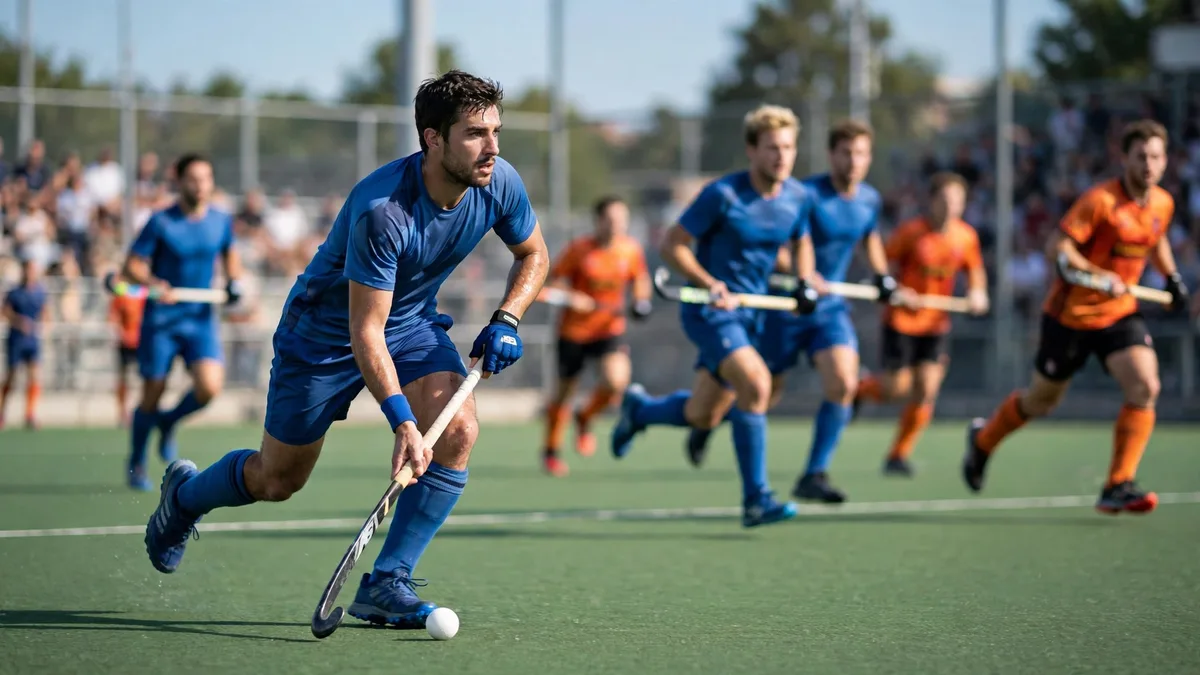
If you have ever watched a field hockey match and thought, “That looks fun, but I would have no idea where to start,” you are not alone. Field hockey is one of those sports that looks fast, skilful and slightly chaotic from the sidelines. Sticks flash and players sprint in every direction. A small white ball seems to move quicker than your eyes can follow. But underneath all that speed is a game with simple ideas at its heart. Keep the ball moving, work together as a team, and get it into the goal. Learning how to play field hockey starts with those simple ideas.
The good news is that field hockey is one of the most beginner-friendly team sports you can pick up. You do not need to be the fastest runner or the strongest player. Expensive kit is not needed to get started, and most clubs welcome complete beginners with open arms. If you are ready to learn how to play field hockey, this guide is for you. It walks you through everything you need for your first weeks on the pitch. That includes the rules that actually matter, the gear to buy, the positions, and the first skills to practise. It also covers the mistakes that nearly every beginner makes, so you can skip them.
By the end, you will know enough to turn up to your first training session feeling prepared rather than nervous — and to enjoy the game from the very first whistle.
What Is Field Hockey?
Field hockey is a team sport played on a rectangular pitch, usually on artificial turf, where two teams use hooked sticks to pass a small, hard ball and try to score in the other team’s goal. Each team has 11 players on the pitch: 10 outfield players and a goalkeeper. The team with the most goals at the end of the match wins.
It is played in more than 100 countries and is especially popular in the Netherlands, India, Australia, Argentina and England, where it is a major school and club sport. It is also an Olympic sport, with both men’s and women’s competitions, which is part of why so many people first discover it while watching the Olympics and then want to try it themselves.
One thing that surprises newcomers is how much field hockey has in common with football. Both games are about space, passing and teamwork rather than individual brilliance. If you have ever played football, you will already understand a lot of the thinking behind hockey. It is about finding space, moving into gaps, and passing to a teammate in a better position. The main difference is the stick, and the fact that you play the ball with it instead of your feet. If you are curious about how the rules of the two games compare, our beginner’s guide to the offside rule in football is a useful read — and you will be pleased to know that hockey does not have an offside rule at all.
The Equipment You Need to Start
You do not need to spend a fortune before your first session. Most clubs lend sticks to new players, so it is worth asking before you buy anything. That said, a few items are worth having from day one.
The stick. This is the one piece of kit that matters most. A field hockey stick has a long handle and a short, curved head. It has a flat side and a rounded side. Only the flat side may be used to play the ball. Stand the stick on the ground next to you. The top of the handle should reach roughly to your hip bone. Beginners usually do best with a lighter stick with a little flex in it. It is more forgiving while you are learning to control the ball. Sticks come in different lengths, usually measured in inches, and your height is the best guide — your coach or the shop can help you pick.
Shin guards. These are not optional. The ball is hard, sticks swing low, and your shins are right in the firing line. A decent pair of shin guards costs very little and saves you a lot of bruises. Wear them under long socks so they stay in place.
A mouthguard. A mouthguard protects your teeth if the ball or a stick ever comes up unexpectedly. It might feel strange at first, and it can make talking a little harder, but it quickly becomes second nature. Speaking of teeth, it is worth knowing how to prevent cavities with daily dental habits — looking after your teeth off the pitch matters just as much as protecting them on it.
How to play field hockey: the rest of your kit
The ball. A field hockey ball is small, hard and made of plastic, roughly the size of a cricket ball. Your club will supply balls for training, but having one at home is handy for practising dribbling in the garden.
Footwear. Most beginners play in trainers or astroturf shoes with small rubber studs. Avoid metal studs, which are not allowed on artificial turf, and avoid flat-soled trainers if you can, because they slip on wet turf. If you are not sure what to wear, ask your coach — they have seen every type of shoe imaginable.
Water bottle. Bring one to every session. You will be running more than you expect, and you will be glad of it.
How to Hold the Stick and Stand
Before you learn any fancy skills, you need a comfortable grip and a good stance. These two basics affect everything else you do, so it is worth getting them right early.
Hold the stick with your left hand at the very top of the handle, with your thumb pointing down towards the head of the stick. Your right hand goes lower down the grip, roughly halfway down the handle. The left hand does most of the steering — it turns the stick over when you need to switch sides — while your right hand adds support and power.
Keep your stance low and athletic. Bend your knees, keep your back fairly straight, and let the head of the stick rest close to the ground in front of you. Stand with your feet about shoulder-width apart and your left foot slightly forward, pointing towards the ball. The ball should sit about a stick’s length away from your body, slightly to your right.
It will feel unnatural at first. Most beginners stand too upright, which makes the ball hard to control and puts strain on the lower back. Try to stay low, keep your chest up so you can see the pitch, and let your knees do the bending rather than your back. A few minutes of practice in the garden, just standing in position and tapping the ball gently from side to side, makes a real difference before your first session.
The Basic Rules Every Beginner Should Know
You do not need to memorise the full rulebook before you play. Your coach and teammates will help you through your first games. But knowing the handful of rules below will stop you feeling lost, and will keep you on the right side of the umpire.
Only the flat side of the stick
This is the single most important rule in field hockey. You may only play the ball with the flat side of the stick. Using the rounded side — known as a backstick — is a foul. It takes practice, because turning the stick over quickly becomes second nature only after a few weeks, but every beginner goes through the same learning curve.
No feet, hands or body
Outfield players may not deliberately play the ball with their feet, hands or any other part of the body. If the ball touches your foot, even by accident, the umpire will usually award a free hit to the other team. The goalkeeper is the exception: inside the shooting circle, the goalkeeper may use their feet, pads and body to stop the ball.
Goals only count inside the shooting circle
This one catches out a lot of newcomers. A goal only counts if an attacker touches the ball inside the shooting circle — the semi-circular area marked in front of each goal, 14.63 metres from the goal line. Shots from outside the circle do not count, even if they fly into the goal. This rule shapes the whole game, because it means attacks have to work the ball into the circle before shooting.
No offside
Unlike football, there is no offside rule in field hockey. Attackers are free to run in behind the last defender whenever they like. This makes the game faster and more open, and it means forwards can stay high up the pitch waiting for a pass.
Fouls, free hits and penalty corners
Most fouls — a backstick, a foot, obstruction, or a dangerously raised stick — result in a free hit for the other team, taken from roughly where the foul happened. Obstruction means using your body or stick to shield the ball from an opponent without trying to play it, and it is one of the most common fouls beginners commit without realising it.
A penalty corner is awarded when a defender commits a foul inside the shooting circle, or deliberately fouls outside it. It is one of the most exciting moments in hockey: the attacking team gets a set-piece chance from the backline, and goals from penalty corners are common at every level of the game.
How long is a match?
International matches are played in four quarters of 15 minutes each, with short breaks between quarters. Many grassroots, school and club games still use the older format of two halves of 35 minutes each, with a half-time break in the middle. Either way, expect to be moving for most of the match — hockey involves repeated short sprints rather than steady jogging.
Teams can also make rolling substitutions, which means players can be swapped in and out throughout the match as often as the team likes. If you need a breather, you can come off for a few minutes and go back on. Beginners should not be shy about using this — it exists for exactly that reason.
The Positions on the Pitch
A hockey team is organised into four groups, and understanding them helps you know where to be and what your job is.
Goalkeeper. The last line of defence, wearing full protective kit — pads, helmet, kickers and a smock in a different colour from the rest of the team. Only the goalkeeper may use their body to stop the ball, and only inside the shooting circle. It is a specialist position, and most clubs have dedicated goalkeepers, so beginners rarely start here.
Defenders. Usually three or four players who stay closer to their own goal. Their job is to stop attacks, win the ball back, and start the team’s own attacks with calm, accurate passes. Defenders need to be good tacklers and good communicators, because they can see the whole pitch in front of them.
Midfielders. The engine room of the team. Midfielders link defence and attack, which means they run the most and touch the ball the most. They need a mix of everything: tackling, passing, dribbling and fitness. If you like being involved in every part of the game, midfield is where you will be happiest.
Forwards. The attackers, whose main job is to get into the shooting circle and score. Forwards need quick reactions, clever movement and a calm finish. They also need to be the first line of defence when the team loses the ball, pressing the opposition high up the pitch.
Finding your position as a beginner
As a beginner, you will probably rotate through several positions in your first weeks. That is a good thing — it teaches you how the whole team works, and it helps you and your coach work out where you fit best. Do not worry if you feel out of position sometimes. Everyone does at first, and it improves quickly once you start to recognise the patterns of play.
The First Skills to Learn
You do not need a big bag of tricks to be useful on a hockey pitch. Six core skills cover almost everything a beginner needs, and they are all learnable with a bit of patient practice.
1. Dribbling
Dribbling means moving the ball with you while you run. Keep the ball close to your stick, slightly in front of you and to your right, and use small, controlled taps rather than big hits. Try to keep your head up as much as you can — the whole point of dribbling is to move the ball into space or past a defender, and you cannot do that if you are staring at the ball the whole time. Practise by dribbling slowly around cones, or even around shoes in the garden, and build up speed gradually.
2. The Indian dribble
This is the signature hockey skill, and it looks far harder than it is. The ball moves quickly from your left to your right as you turn the stick over it, again and again. Start slowly, with the ball almost still, and focus on clean, quiet touches. Speed comes later. Once you can do it smoothly, it is the best way to beat a defender one-on-one.
3. The push pass
Learn this before you learn to hit the ball. A push pass is a short, accurate pass made by keeping the stick in contact with the ball and pushing it towards your teammate. It is the pass you will use most often in a game, because hockey is a passing game and most passes are short. Aim for your teammate’s stick, not their feet, and follow through towards your target.
4. Receiving the ball
Receiving is just as important as passing, and it is where a lot of beginners lose the ball. Angle your stick so the ball is cushioned and stops close to your body, rather than bouncing away. Keep your stick low and your hands soft — if you grip too tightly or hold the stick too stiffly, the ball will bounce off. Practise receiving passes of different speeds with a friend, and you will quickly get a feel for it.
5. Hitting the ball
Once your push pass is solid, learn the hit. Bring your hands together at the top of the stick, swing smoothly, and strike through the ball rather than at it. Keep the ball in line with your left foot and your eyes on the ball until after contact. Power comes from timing and technique, not from swinging as hard as you can — a well-timed hit with good technique travels further than a wild swing.
6. Tackling
Good tackling is about patience, not aggression. Stay low, stay on your feet, and stay on the goal side of your opponent so they cannot get past you towards your goal. Wait for the right moment — when the ball is slightly too far from their stick — and then step in and take it with a clean, flat-stick tackle. Never swing your stick wildly or tackle from behind, because both are dangerous and both will be penalised.
Fitness for Field Hockey
Field hockey is a demanding sport, and the fitness it asks for is a particular kind: short, sharp sprints, quick changes of direction, and a lot of time spent in a low, bent-over stance. The good news is that you build hockey fitness by playing hockey — you do not need to be fit before you start.
That said, a little extra work between sessions speeds things up a lot. Short runs with bursts of speed, rather than long slow jogs, match the stop-start rhythm of a match. Bodyweight exercises like squats, lunges and planks build the leg and core strength that supports the low hockey stance. And simple daily movement helps more than people expect — walking 30 minutes a day keeps your legs moving and your base fitness ticking over between training sessions.
Warm up properly before every session, with a few minutes of light jogging and some gentle stretches, and cool down afterwards. Hockey asks a lot of your hamstrings, groin and lower back, especially when you are new to the bent-over stance, so do not skip the stretching. Your body will thank you the next morning.
What to Eat and Drink Before a Game
You do not need a special sports diet to play hockey as a beginner, but a few simple habits make a real difference to how you feel on the pitch. Eat a normal meal two to three hours before a game — something with slow-release energy, like pasta, rice, bread or potatoes, with some protein and vegetables. Avoid heavy, greasy food close to kick-off, because it sits in your stomach and slows you down.
Drink water through the day before a match, not just in the ten minutes before it starts, and bring a bottle to the pitch. If you play in hot weather or sweat heavily, an electrolyte drink or a pinch of salt in your food after the game helps replace what you have lost. Learning how to read nutrition labels is a useful life skill here too — it helps you spot the difference between a genuinely useful sports snack and a chocolate bar pretending to be one.
Common Beginner Mistakes (and How to Avoid Them)
Every beginner makes the same handful of mistakes. Knowing about them in advance means you can skip most of them.
Standing too upright. The most common mistake of all. If your stick is not close to the ground, you cannot control the ball. Bend your knees, stay low, and check your stance every few minutes until it becomes habit.
Chasing the ball. It is tempting to follow the ball everywhere, but hockey is a team game and every player has a zone. Trust your teammates, hold your position, and move into space where you can receive a pass. You will touch the ball more, not less.
Hitting the ball too hard, too soon. Beginners often try to hit every ball as hard as they can. A controlled push pass to a teammate is almost always better than a wild hit into nowhere. Power comes later; accuracy comes first.
Forgetting to talk. Hockey is a noisy game. Call for the ball, warn teammates when an opponent is behind them, and celebrate good passes. Communication is a skill, and it is one of the fastest ways to become a player your teammates love playing with. Teamwork is something you build everywhere, not just on the pitch — even playing co-op games for beginners with friends teaches you the same habits of talking, sharing and trusting your team.
Not practising the basics. It is much more fun to practise shooting than receiving, but the players who improve fastest are the ones who practise the boring skills: trapping the ball, push passing, and staying low. Ten minutes of basics a few times a week beats one long session of trick shots.
Your First Game: What to Expect
Your first proper game will feel fast. The ball moves quickly, players shout a lot, and you will probably feel a step behind the play for the first ten minutes. That is completely normal. Give yourself permission to be new.
A few practical tips help. Arrive early so you are not rushing. Warm up properly. Listen to your captain and your coach — they will tell you where to stand and what to do. Keep your shifts short and come off for a breather when you need one; rolling substitutions exist for exactly this reason. And when you get the ball, keep it simple: control it, look up, and pass to a teammate in space. You do not need to do anything spectacular.
One thing worth preparing for is the mental side. Starting a new sport can stir up nerves and self-doubt, especially if you are the only beginner in the group. That feeling passes quickly once you are playing, but if you want a tool for handling it, journaling for mental health is a genuinely useful habit — writing down how a session went, what went well and what you want to work on next time turns nervous energy into a plan. And remember that learning positions, patterns and plays is a memory skill too; the same techniques that help you improve your memory for studying — short, repeated practice and testing yourself — work just as well for learning a sport.
How to Keep Improving After Your First Month
Once you have a few sessions under your belt, progress comes from consistency rather than intensity. Turn up regularly, even when you feel tired. Practise one skill at a time rather than everything at once. Ask your coach for one thing to work on each week, and focus on that single thing in training and in games.
Watch hockey when you can — a club match, a league game on television, or highlights online. Good players show you positioning and movement in a way that drills alone cannot. Pay attention to what players do when they do not have the ball, because that is most of the game.
Finally, be patient with yourself. The first month is about learning the rules and surviving the fitness. In the second month, the skills start to click. By the third month, most beginners are surprised at how much they have improved. The players who stick with it are rarely the most talented ones — they are the ones who kept turning up.
Frequently Asked Questions
How long does it take to learn how to play field hockey?
Most beginners can follow a game and contribute within a few weeks of regular training. Basic dribbling and passing usually feel comfortable after a month or two, while the finer skills — the Indian dribble, tackling under pressure, and reading the game — keep developing over your first year. Regular practice matters far more than natural talent.
Is field hockey hard on the knees and back?
The low stance can be tiring at first, and it does ask a lot of your legs and lower back. That is why warming up, stretching and building leg strength matter. If you have an existing knee or back problem, talk to your doctor before starting, and tell your coach so they can adapt drills for you.
Can adults start field hockey as complete beginners?
Absolutely. Most clubs have adult beginner groups, social teams and back-to-hockey sessions designed for people who have never played. Many players start in their twenties, thirties and beyond, and social hockey is one of the friendliest ways to get into a team sport as an adult.
What is the difference between field hockey and ice hockey?
They share a name and a stick, but they are very different games. Field hockey is played on grass or artificial turf with a ball, 11 players a side, and almost no physical contact. Ice hockey is played on ice with a puck, six players a side, and full-body checking. The skills do not transfer as much as people expect, so treat field hockey as its own sport.
Do I need my own stick before my first session?
No. Most clubs lend sticks to new players, and it is better to borrow one for a few sessions before buying, so you know what length and weight suit you. Once you decide to buy, a mid-priced composite stick is a good starting point for most beginners.
Final Thoughts
Field hockey is a game that rewards anyone willing to learn it. The rules are simple once you know them, and the skills build on each other logically. Playing with a team around you makes the whole thing more fun than any solo sport. You do not need to be fast, strong or naturally gifted. All you need is a stick, a pair of shin guards, a willingness to stay low and keep practising, and a club that welcomes beginners.
So if you have been wondering how to play field hockey, the answer is simple: find your nearest club, send them a message, and turn up. Your first session will feel clumsy, your second will feel better, and by your tenth you will wonder why you did not start sooner. See you on the pitch.