
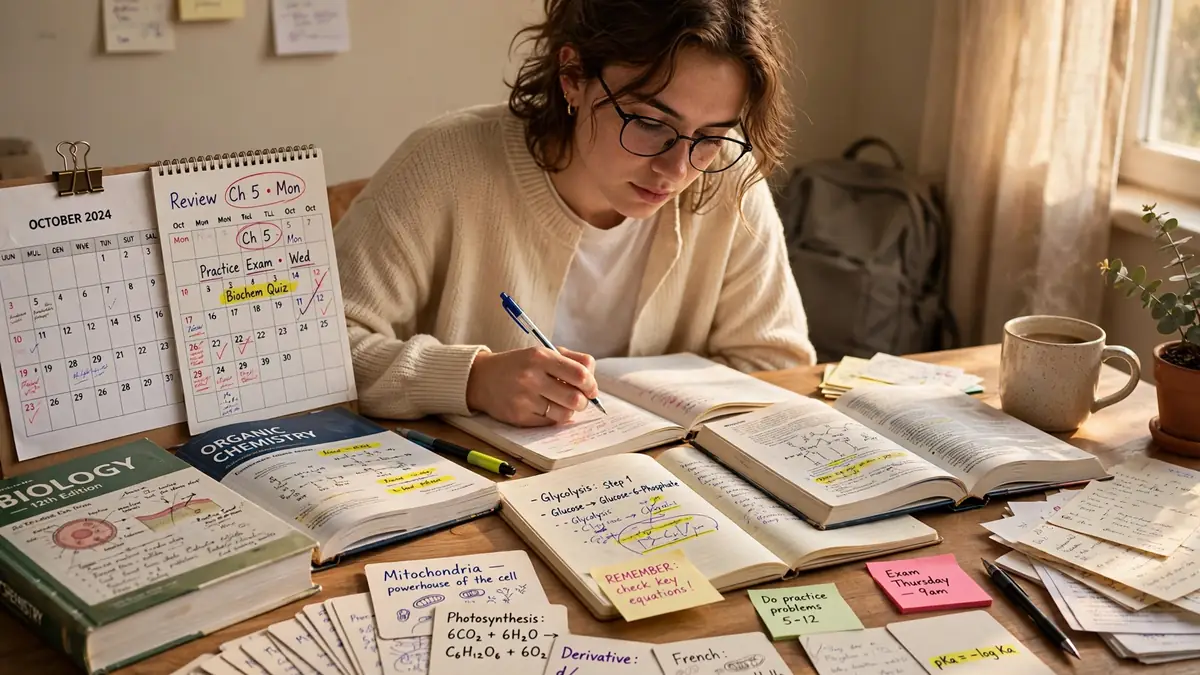
You read a chapter twice and still forget it within a week. However, that frustrating pattern rarely signals a weak memory at all. Instead, it usually signals a weak study method behind your effort. Learning how to improve memory for studying therefore starts with changing your method. Moreover, research reviews consistently rank some techniques far above familiar classroom habits. Consequently, this guide ranks twelve techniques by strength of supporting evidence.
Additionally, you will find a worked review calendar and subject examples below. For example, vocabulary, concepts, and maths problems each need a slightly different approach. Meanwhile, the final section names habits that waste time despite feeling productive. Overall, the goal stays practical rather than theoretical throughout this article. Specifically, every technique includes a clear first step you can use today.
Why does rereading feel effective while failing you?
Familiar text feels fluent, and fluency easily tricks your judgement. However, recognising a sentence differs sharply from recalling it under exam pressure. Therefore, a page can feel known while your memory remains surprisingly fragile. In contrast, effortful recall feels harder yet builds much stronger retention. As a result, discomfort during study often signals learning rather than failure.
Researchers describe memory fading over time through the forgetting curve. Nevertheless, that description stays qualitative rather than a fixed personal timetable. Accordingly, you should treat any review schedule as a flexible practical template. Indeed, the forgetting curve review schedule 1 2 4 7 offers one such template. Ultimately, regular review matters far more than chasing an exact percentage.
Among study techniques that do not work highlighting rereading sits near the bottom. Similarly, Dunlosky and colleagues rated highlighting and rereading as low utility overall. Meanwhile, practice testing and distributed practice earned high utility ratings instead. Consequently, this ranking places proven methods first and popular shortcuts last. Below, each technique explains its logic, its steps, and its best use.
1. Practice testing, the strongest single habit
Practice testing means answering questions without looking at your notes first. Moreover, the practice testing study method works for quizzes, past papers, and flashcards. However, testing only helps when you check answers and correct every error. Therefore, always pair each test attempt with prompt, specific feedback afterwards. For example, mark wrong answers, find the gap, and retest them soon.
Course-based learners already use this pattern when they revise past exam papers. Similarly, candidates comparing options in this guide to Texas adjuster licence courses still need tested recall afterwards. In addition, short low-stakes quizzes beat one huge mock exam before finals. As a result, ten questions daily usually teach more than occasional marathon testing. Finally, keep scores visible so progress stays honest and motivating.
2. Spaced repetition, spreading study across days
Spaced repetition means reviewing material at gradually widening gaps over time. Specifically, spaced repetition studying replaces cramming with several shorter, separated sessions. However, spacing only works when each return visit involves active effort. Therefore, reopen your notes briefly, attempt recall first, and then check accuracy. Consequently, four spaced sessions normally outperform one long session of equal length.
Meanwhile, spacing also reveals what you have genuinely forgotten between visits. For example, a definition recalled after two days shows stronger retention. In contrast, a definition recalled after two minutes proves very little indeed. Additionally, digital tools can schedule these widening gaps automatically for you. Ultimately, your calendar, not your mood, should decide each review date.
3. Active recall, closing the book on purpose
Active recall means pulling information from memory before checking any source. Moreover, active recall techniques include blank-page recall, self-quizzing, and teaching aloud. However, many students stop too early when recall feels slow or messy. Instead, struggle briefly, write partial answers, and then verify each line carefully. As a result, every gap you expose becomes a precise study target.
Blank-page recall offers the purest version of this powerful technique. Specifically, close everything, write all you remember, and then compare against notes. Meanwhile, missing points stand out clearly in a different pen colour. Therefore, your next session can target only those highlighted weak spots. Finally, repeat the blank page after several days without any warning.
4. Flashcards used properly, not passively
Flashcards work well only when each card demands genuine recall first. Indeed, flashcards anki quizlet studying tools all succeed or fail by usage. However, flipping a card quickly and nodding builds recognition, not retention. Therefore, say or write your answer fully before revealing the reverse side. Moreover, grade yourself honestly, because generous grading quietly destroys the spacing system.
Well-made cards ask one clear question with one clear answer. For example, split a long list into several separate, focused cards instead. In addition, add a small example or image to stubborn difficult cards. Consequently, vague cards produce vague answers and false confidence during revision. As a result, rewriting a bad card often fixes a stubborn topic.
5. Interleaved practice, mixing topics deliberately
Interleaving means mixing related problem types within a single study session. Specifically, interleaved practice studying feels confusing because each problem demands fresh thinking. However, that confusion teaches you to choose methods, not just repeat them. Therefore, shuffle algebra, geometry, and word problems rather than blocking them separately. Meanwhile, your brain learns to spot which approach fits each question.
Blocked practice feels smoother because the method repeats without real decisions. In contrast, mixed practice mirrors exams, where questions arrive in random order. For example, language learners can mix tenses instead of drilling one tense. Additionally, science students can rotate diagrams, definitions, and calculations within one session. Overall, slight disorder during practice usually produces order during the exam.
6. Elaborative interrogation, asking why repeatedly
Elaborative interrogation means asking why a fact is true, then answering fully. Moreover, elaborative interrogation why questions connect new facts to knowledge you hold. However, a shallow why question produces only a shallow, useless answer. Therefore, push further and explain causes, contrasts, and real-world consequences aloud. For example, ask why tariffs raise prices, then trace each step.
Biology students can ask why enzymes stop working at high temperatures. Similarly, history students can ask why a treaty failed within five years. In addition, law students benefit because legal reasoning depends on justified arguments. Consequently, learners exploring education law programmes and school legal careers should practise why questions early. Ultimately, explanation exposes gaps that silent reading politely hides from you.
7. Dual coding, pairing words with visuals
Dual coding means presenting one idea through words and visuals together. Specifically, dual coding words visuals studying combines explanations with diagrams, timelines, or sketches. However, decorative images add nothing, because the visual must carry real meaning. Therefore, draw the process yourself rather than copying a polished textbook diagram. Moreover, a rough sketch you create beats a beautiful image you admire.
Geography students can sketch river systems beside their written definitions. For example, a labelled diagram often explains erosion faster than paragraphs alone. Meanwhile, anatomy students can pair each term with a simple outline drawing. In addition, mind maps help when they show genuine relationships between ideas. As a result, two memory routes support recall better than one route.
8. The memory palace, placing ideas in space
The memory palace links each item to a location along a familiar route. Indeed, the memory palace technique students use suits lists, speeches, and sequences. However, this method needs practice before it feels natural or reliable. Therefore, start with ten locations inside your home and one short list. For example, place each shopping item vividly at a different doorway.
Exaggerated images stick better than polite, realistic ones inside your palace. Moreover, movement along a fixed route keeps items in correct order. Meanwhile, reviewing the route forwards and backwards strengthens the whole chain. Consequently, medical and language students often use palaces for ordered terminology. Finally, reuse one palace only after the earlier list fades completely.
9. Self-explanation, teaching the topic aloud
Self-explanation means describing each step aloud while you work through material. Additionally, explaining forces you to connect steps instead of merely copying them. However, reading notes aloud in a monotone does not count as explaining. Instead, pretend a younger student listens and might ask awkward questions. Therefore, use simple words, clear examples, and honest admissions of confusion.
Recording yourself adds useful feedback without needing a study partner present. For example, listen back and notice every place where your explanation stalls. Similarly, teaching a friend reveals gaps even faster and more honestly. As a result, teachers often report learning subjects deeply through teaching them. Overall, clear explanation signals understanding, while mumbling signals another review round.
10. Concrete examples, anchoring abstract ideas
Abstract ideas stick better when each one carries a vivid concrete example. Moreover, examples translate definitions into situations your brain can picture easily. However, a single example can mislead you about a concept’s boundaries. Therefore, collect two contrasting examples for every important abstract idea you meet. For example, pair a typical case with an unusual edge case.
Economics students can anchor inflation using everyday shopping experiences they know. Meanwhile, marketing learners can link theory to campaigns from real local businesses. In addition, readers of this analysis of digital marketing education in New York can map concepts onto city examples. Consequently, abstract coursework becomes memorable when examples feel specific and personal. Finally, inventing your own example proves deeper understanding than borrowing one.
11. Sleep and consolidation, protecting the night before
Sleep supports the process that stabilises new learning after study ends. Indeed, sleep and memory consolidation students discuss often appear together in research. However, sleep advice here stays general and never replaces medical guidance. Therefore, protect a regular sleep routine, especially during intense revision weeks. Moreover, an all-night cramming session usually undermines the learning it chases.
Evening review can work well when it stays calm and structured. For example, a short recall session before bed reinforces the day’s material. Meanwhile, late caffeine, bright screens, and panic scrolling can disrupt rest. In contrast, a planned finish time helps your evening wind down properly. As a result, rested students usually recall more with noticeably less effort.
Movement during the day can also support alertness and general wellbeing. Similarly, active school programmes discussed in this overview of California physical education standards link activity with learning readiness. Additionally, short walks between sessions refresh attention without stealing study time. Overall, treat rest and movement as study infrastructure, not rewards afterwards.
12. Feedback and error logs, learning from mistakes
An error log records every mistake, its cause, and its correct version. Moreover, reviewing that log weekly turns scattered errors into clear patterns. However, copying corrections passively wastes the log’s real diagnostic value completely. Therefore, retest each logged error later without looking at the correction. Consequently, repeated errors shrink because you attack their actual root causes.
Students often discover that most errors share just two or three causes. For example, misread questions, sign errors, and confused terms recur frequently. In addition, an honest log guides where your limited time should go. Meanwhile, vague resolutions like trying harder never fix a specific weakness. Finally, celebrate shrinking error categories, because visible progress sustains long revision plans.
What does a worked 1-2-4-7 review calendar look like?
The calendar below applies the spacing idea to one new topic. Specifically, you learn the topic on day zero and review it repeatedly. However, each review means recall first and notes second, every single time. Therefore, treat each session below as a short test, not a reread. Moreover, adjust the gaps slightly when exams or weekends demand flexibility.
| Day | Session | Task |
|---|---|---|
| Day 0 | Learn | Study actively, then close notes and recall |
| Day 1 | Review 1 | Blank-page recall, then correct gaps |
| Day 2 | Review 2 | Flashcards plus two practice questions |
| Day 4 | Review 3 | Mixed questions with older topics |
| Day 7 | Review 4 | Timed mini-test without notes |
| Day 14 | Review 5 | Teach aloud, then log errors |
| Day 30 | Review 6 | Full practice test section |
After day seven, monthly maintenance usually keeps strong material accessible. Nevertheless, weak items should return to shorter gaps immediately after any failure. For example, a card missed on day seven restarts at day one. As a result, strong and weak items naturally follow different personal schedules. Ultimately, this honest adjustment answers how to remember what you study long term.
How should each subject use these techniques differently?
Vocabulary learning rewards flashcards, dual coding, and short daily spaced sessions. Moreover, each word needs a sentence example, not just a translation equivalent. However, concepts demand elaborative interrogation and self-explanation more than simple flashcards. Therefore, explain each concept aloud and connect it to contrasting examples. Meanwhile, problem subjects demand interleaved practice testing above every other method.
Language learners in programmes like this Lucknow education enrolment playbook context still need daily recall habits. Similarly, younger learners at centres such as this education centre profile benefit from short, playful retrieval games. In addition, project-based settings like this education farm at Fairview Gardens naturally encourage concrete examples outdoors. Consequently, match the technique to the material rather than forcing one system.
Inclusive classrooms also remind us that learners process information very differently. For example, visual supports celebrated in this piece on special education and unique learning highlight varied learning needs. Therefore, offer yourself options across visuals, speech, writing, and movement daily. Overall, the best system remains the evidence-based system you actually sustain.
How can you start this week without overhauling everything?
Beginners should climb a simple ladder instead of changing everything overnight. Firstly, convert tomorrow’s revision into ten flashcards with clear single answers. Secondly, schedule those cards again after one, two, four, and seven days. Moreover, end the week with one blank-page recall for your hardest topic. As a result, one working system beats twelve half-started systems every time.
- Day one, build cards and attempt a first recall round.
- Day two, review cards and add one mixed practice set.
- Day three, teach one concept aloud for five minutes.
- Day four, retest weak cards and log every error.
- Day seven, sit a timed mini-test without any notes.
Tracking your ladder in a notebook keeps the routine visible daily. However, fancy apps remain optional, because paper systems work perfectly well too. Therefore, choose the simplest tool that you will open every day. Meanwhile, tell a friend your schedule, because shared accountability strengthens follow-through. Finally, review your progress weekly and keep only what demonstrably works.
Which popular habits should you drop first?
Highlighting everything feels productive, yet it rarely forces any real thinking. Similarly, copying notes neatly rewards handwriting rather than memory or understanding. However, both habits can stay as minor preparation steps before recall. Therefore, highlight sparingly, then convert marked points into questions for testing. Consequently, preparation supports retrieval instead of replacing retrieval as your method.
Summarising without checking sources also risks memorising your own misunderstandings confidently. In contrast, testing against the original material corrects errors before they settle. For example, compare every summary line against the textbook after recall. Additionally, avoid studying while multitasking, because divided attention weakens each encoding attempt. Overall, dropping low-value habits frees time for methods that genuinely work.
Your memory improves when study demands retrieval, spacing, explanation, and feedback. Moreover, none of these twelve techniques requires expensive courses or special talent. However, consistency across weeks matters far more than intensity on one day. Therefore, start with practice testing tomorrow and add spacing the day after. Finally, trust effortful recall, because that productive difficulty builds lasting learning.



