
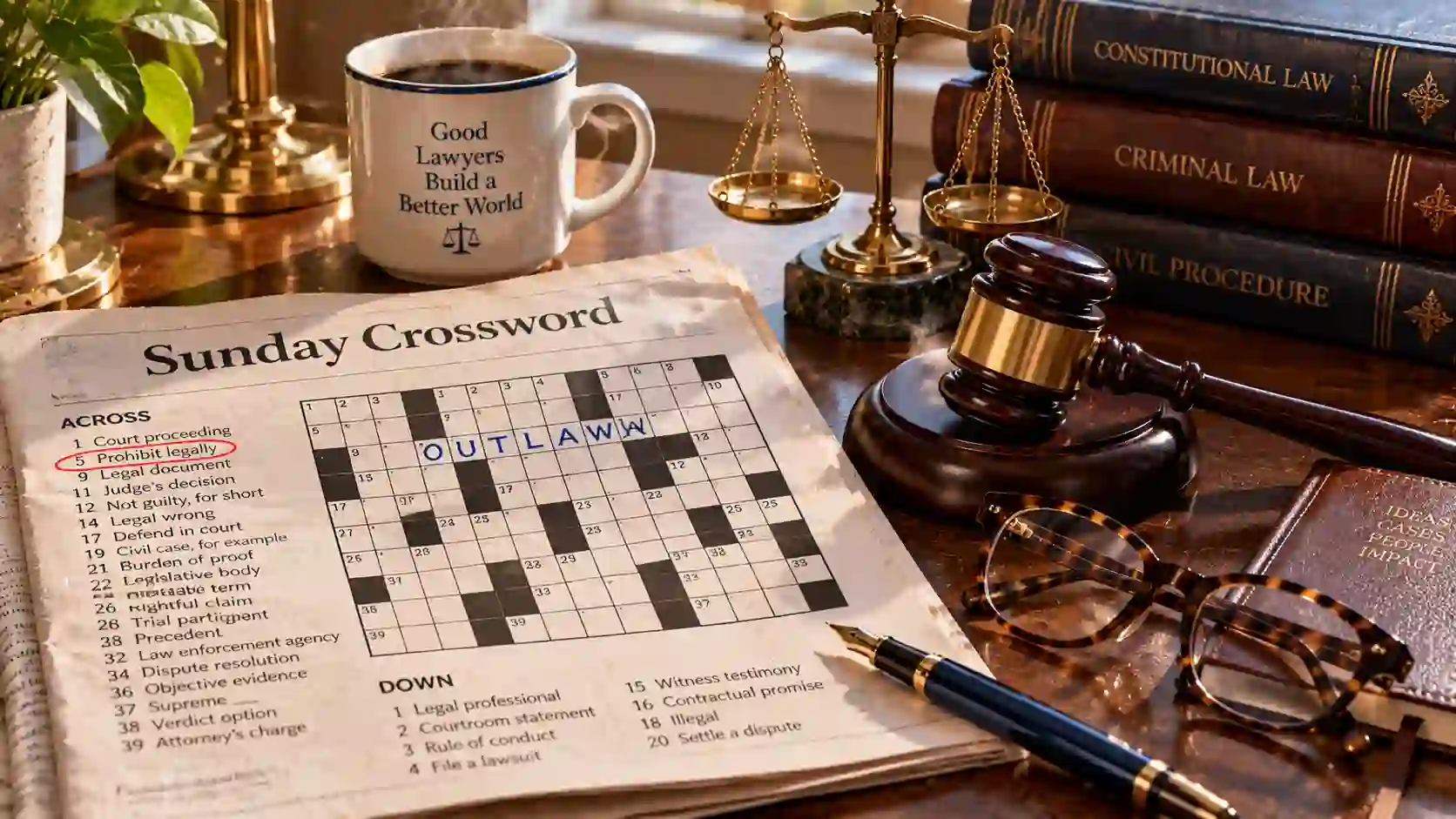
Tackling daily crossword puzzles provides an invigorating mental workout that sharpens deductive logic and expands your vocabulary. However, encountering formal jurisprudence jargon like the Prohibit Legally Crossword Clue: Unlocking the Answers You Need Today! can momentarily halt your solving momentum. Puzzle editors love legal terminology because statutory words feature versatile vowels and alternating consonants. Fortunately, identifying the exact solution becomes simple once you evaluate letter counts and crossing words. Consequently, understanding the primary answers to this classic clue ensures you complete your daily grid with ease.
Historically, daily word puzzles drew heavily from ancient geography and classical literature. However, modern puzzle syndicates regularly test solvers on civil procedure, criminal law, and regulatory mandates. Clues such as “Prohibit legally” or “Bar by law” require solvers to distinguish between common everyday bans and formal courtroom decrees. For enthusiasts seeking curated perspectives across intellectual pastimes, civic literacy, and refined living, visit the WordGlowUp homepage. Examining the most frequent solutions, legal contexts, and cruciverbal strategies reveals how to crack this puzzle clue every time.
Why Puzzle Constructors Favor Legal Terminology
Crossword constructors face strict structural rules when designing interlocking letter grids. Every horizontal answer must intersect seamlessly with multiple vertical entries. Therefore, words containing common letters like E, N, O, S, and T are exceptionally valuable to grid builders.
Legal terms fit these architectural demands perfectly. For example, terms like ENJOIN and ESTOP supply friendly vowels and common consonants that connect difficult grid corners. In addition, legal clues carry precise definitions that allow editors to vary clue difficulty across different days of the week.
Key reasons why legal prohibition clues appear so frequently include:
- Multiple Word Lengths: Ranging from short three-letter fillers like BAN to nine-letter entries like INTERDICT.
- Balanced Phonetics: Providing alternating vowel-consonant patterns that link smoothly with crossing words.
- Broad Syndicate Appeal: Appearing regularly in the New York Times, Los Angeles Times, and Wall Street Journal puzzles.
- Linguistic Precision: Testing whether solvers understand the difference between informal taboos and statutory prohibitions.
To explore more in-depth perspectives on mindful leisure, intellectual hobbies, and modern domestic culture, browse our comprehensive Lifestyle category archive for practical guides on contemporary living.
Top Solutions Sorted by Letter Count
When you encounter a clue asking for a legal prohibition, your first step should always be counting the empty grid boxes. Below are the definitive answers arranged by word length.
1. Three-Letter Solutions
If your puzzle presents a compact three-box space, the constructor is likely seeking one of two foundational words:
- BAN: The most common three-letter answer. A ban represents an official or legal prohibition against a specific product, activity, or practice.
- BAR: Used both as a noun and a transitive verb. To bar someone legally means to exclude or prevent them from exercising a right or entering a jurisdiction.
2. Four-Letter Solutions
Four-letter entries often emphasize executive authority or judicial vetoes:
- VETO: Originating from the Latin for “I forbid.” A veto allows an executive officer or sovereign body to refuse assent to a legislative bill, blocking it legally.
- STOP: Occasionally used in commercial or maritime contexts, such as a legal stop order issued against financial transfers or maritime cargo.
3. Five-Letter Solutions
Five-letter answers introduce specialized common-law doctrines:
- ESTOP: A quintessential legal term. Under procedural law, to estop means to preclude or legally prevent a party from asserting a claim or fact contrary to their prior acts.
- DEBAR: Meaning to exclude someone officially from a right, tenure, or public office through administrative authority.
4. Six-Letter Solutions (The Most Common Answers)
Six-letter slots represent the sweet spot for major daily crosswords. The two most frequent answers in the New York Times and Universal Crossword are:
- OUTLAW: To declare a practice, organization, or substance illegal through formal legislative enactment.
- ENJOIN: A powerful judicial remedy. In chancery and equity courts, a judge enjoins a party by issuing an official injunction that prohibits a specific harmful action.
5. Seven to Nine-Letter Solutions
In mid-week and weekend puzzles, constructors often utilize longer, more academic terminology:
- FORBID (6) / FORBADE (7): Classic Anglo-Saxon verbs indicating statutory bans or parental authority.
- DISALLOW (8): Frequently clued in reference to tax exemptions, court motions, or patent filings that are officially denied.
- PROSCRIBE (9): To condemn or forbid as harmful or unlawful through authoritative public proclamation.
- INTERDICT (9): A formal prohibitory decree issued under civil or ecclesiastical law to restrain specific activities.
Comparative Analysis: Common Crossword Clue Variations
Evaluating the clue phrasing helps you identify the correct solution immediately. Review this side-by-side reference guide before filling in your grid:
| Crossword Clue Text | Letter Count | Correct Solution | Legal & Semantic Context |
|---|---|---|---|
| Prohibit legally | 6 Letters | OUTLAW | Legislative enactment making an act criminal. |
| Prohibit legally | 6 Letters | ENJOIN | Judicial injunction prohibiting specific conduct. |
| Bar legally | 5 Letters | ESTOP | Procedural legal impediment under equity law. |
| Prohibit by law | 3 Letters | BAN | General statutory or administrative prohibition. |
| Legally forbid | 9 Letters | PROSCRIBE | Official denunciation or outlawing by authority. |
| Legally stop | 3 Letters | BAR | Preventing entry, access, or procedural rights. |
As this comparative overview demonstrates, checking your letter count quickly isolates the exact legal synonym required by the puzzle constructor.
Legal Context: Enjoin vs. Outlaw vs. Estop
Understanding the subtle nuances between these legal verbs enriches your solving experience while expanding your real-world legal literacy.
When a legislature passes a criminal statute banning an activity, it outlaws the behavior. For instance, statutory vehicle safety regulations outlaw dangerous driving practices. Similarly, administrative codes strictly regulate automotive equipment standards, as highlighted in our statutory guide to legal tint in connecticut ultimate guide for vehicle window safety compliance. In this context, outlawing represents legislative action applied broadly to all citizens.
Conversely, the verb enjoin belongs to the courtroom. When a court finds that a defendant’s actions cause irreparable harm, the judge issues an injunction to enjoin the conduct. For example, civic advocacy clinics frequently petition district judges to enjoin wrongful evictions, as explored in metrowest legal services framingham navigating free and low cost civil legal aid. Enjoining targets specific individuals or organizations through direct court orders.
Finally, the term estop governs contractual disputes and procedural fairness. Under the doctrine of estoppel, a party cannot deny a fact they previously established if another party relied on that representation. Similar contractual principles apply in commercial risk management, such as the broker authorizations detailed in bor meaning in insurance understanding its impact on your coverage. Estoppel stops individuals from using bad faith arguments in formal legal proceedings.
Cruciverbal Strategies: How to Solve Legal Clues Quickly
Encountering unfamiliar legal phrasing does not have to ruin your puzzle streak. By applying structured cruciverbal techniques, you can identify the correct word in seconds.
Follow these dependable techniques whenever you encounter legal wordplay:
- Check Tense and Grammatical Voice: The answer must match the exact tense of the clue. If the clue reads “Prohibited legally,” look for past-tense endings like OUTLAWED, ENJOINED, or BANNED.
- Solve Crossing Vowels First: If you are stuck between OUTLAW and ENJOIN, check the perpendicular downs. Finding an initial “O” or “E” immediately confirms the correct choice.
- Watch for Question Marks: A clue ending with a question mark indicates a pun. For instance, “Legal bar?” might clue a tavern called PUB rather than an official legal prohibition.
- Memorize Cruciverbal Law Staples: Keep frequent four- and five-letter legal terms in mind, such as TORT, LIEN, PLEA, WRIT, and ESTOP. These short words appear frequently in daily crosswords.
Connecting Wordplay with Mindful Daily Living
Solving crosswords reflects a lifestyle that prioritizes intellectual curiosity, slow living, and focused mindfulness. Dedicating twenty minutes each morning to a challenging grid offers a peaceful alternative to scrolling through busy social feeds.
Furthermore, balancing mental hobbies with a comfortable domestic environment aligns with the living principles celebrated in american lifestyle magazine your ultimate guide to modern living. Creating a quiet morning nook with natural sunlight, good coffee, and a fresh puzzle fosters daily calm and mental clarity.
Moreover, curious puzzle enthusiasts often seek enriching real-world adventures. Solvers love cultural trips where they can unlock unforgettable moments with lifestyle xperiences 365 live fully across historic capitals and museums. Visiting ancient courthouses and parliamentary halls turns abstract puzzle clues into vivid memories.
Finally, modern organizations rely on structured problem-solving models similar to crossword logic. Building sustainable community programs—such as the frameworks detailed in our guide on sustainable business architecture triple bottom line—ensures civic systems remain equitable, durable, and legally sound.
Actionable 5-Step Guide to Mastering Crosswords
If you want to improve your puzzle-solving speed and conquer tricky legal clues, follow this practical five-step roadmap:
- Complete the Short Three-Letter Words First: Fill in short three- and four-letter entries across the grid. These short words provide anchor letters that unlock longer crossing entries.
- Look for Common Plurals and Suffixes: Check the ends of clues. If a clue uses a plural noun, the answer almost always ends in “S.” If it uses a gerund, pencil in “-ING” lightly.
- Keep a Dedicated Crossword Vocabulary Journal: Write down recurring crossword words that rarely appear in casual speech, such as ESTOP, ERNE, ETUI, and AGLET.
- Use the Crossing-Letter Elimination Technique: When torn between multiple valid synonyms, write down the intersecting letters on scrap paper to visualize possible words.
- Practice Daily Themed Puzzles: Consistency builds pattern recognition. Solving daily digital puzzles sharpens your mental instincts and expands your vocabulary over time.
Frequently Asked Questions
What is the most common 6-letter answer for “Prohibit legally”?
The two most common six-letter answers are OUTLAW and ENJOIN. Check the first and last letters using intersecting down clues to determine which word fits your grid.
What does “ESTOP” mean in a crossword puzzle?
ESTOP is a five-letter legal term meaning to bar, impede, or preclude someone from making a legal claim because of their own previous actions or statements.
How can I tell if the answer is “BAN” or “BAR”?
Both words have three letters and mean to prohibit. To confirm the correct answer, check the crossing vertical word that intersects with the middle letter (the “A” is shared) or the final letter (“N” versus “R”).
Does “ENJOIN” mean to prohibit or to command?
In legal usage, enjoin functions as a contronym. In equity courts, it almost always means to prohibit an action via an injunction. However, in broader literary English, it can also mean to urge or instruct someone authoritatively to perform a duty.
To learn more about our linguistic research, intellectual wellness guides, and editorial contributors, explore our About Us page. If you have questions regarding puzzle-solving guides, vocabulary resources, or general editorial feedback, please connect with our team through our Contact Us page.



