
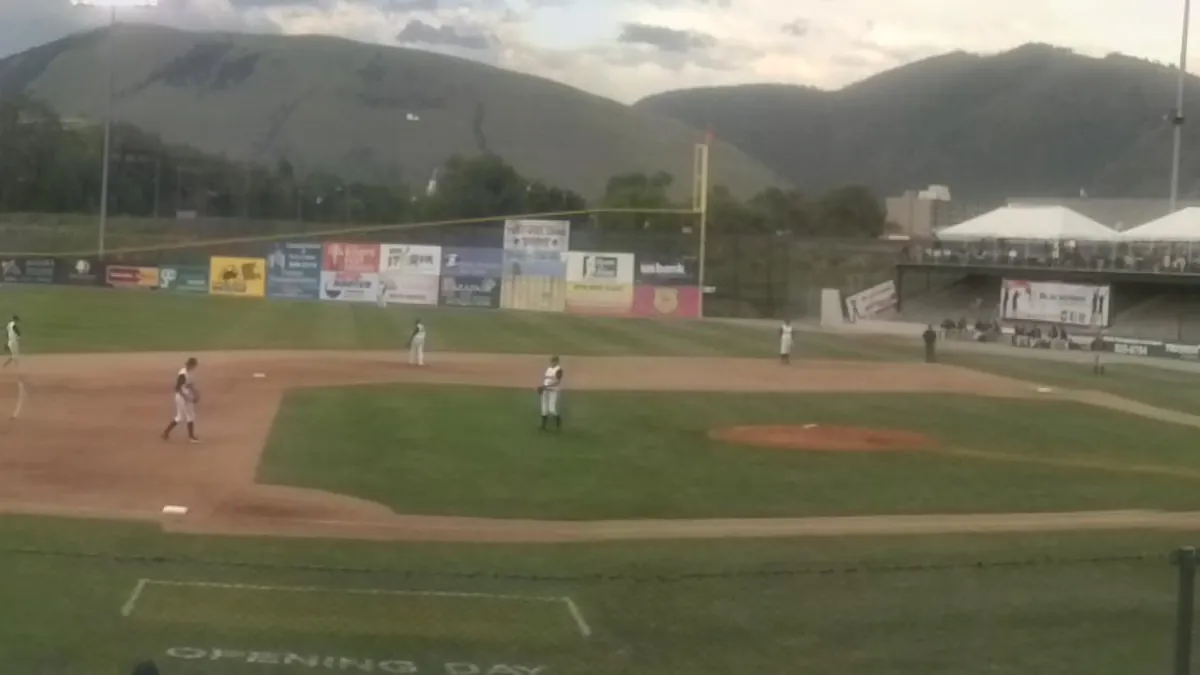
Search for Montana professional sports teams and one fact hits you first. Montana has no NFL, NBA, MLB, NHL, or MLS franchise at all. Yet nobody who spends a summer evening at a ballpark in Billings would call this a sports desert. Instead, Montana built its own version of professional sport, and it looks very local. Small ballparks, junior hockey rinks, rodeo arenas, and one fierce college rivalry carry the whole state.
In fact, that mix tells you more about Montana than a single big-league logo ever could. Distances are long here, and towns are small and spread far apart. So sport grew around places people could actually reach on a Friday night. A Pioneer League game, a high-school gym, or a county rodeo became the shared living room. This guide walks through each pillar in turn, town by town and season by season.
Why does Montana have no major league team?
The short answer is population, and the longer answer is geography. Montana holds a little over a million people across an enormous land area. Because those fans live in small cities and rural counties, no single market can fill a major league stadium weekly. Owners also look at television audiences and corporate boxes, and Montana offers fewer of both. So the biggest leagues simply never planted a flag here.
However, that absence never meant an absence of paying crowds or loyal fans. Montana towns have supported professional baseball since long before the modern minor leagues settled. Fans here learned early to love the level of sport that fits their towns. A three-thousand-seat ballpark can feel packed, loud, and personal in a way giant arenas rarely do. In short, Montana skipped the major leagues and built something closer to home instead.
Pioneer League baseball is the real professional game here
If Montana has a flagship professional sport, it is Pioneer League baseball without question. The Pioneer League dates back to 1939, and Montana towns have anchored it for generations. Today, four Montana clubs play in the league, more than in any other state. Billings, Missoula, Great Falls, and the Flathead Valley each host a team. Together, they give the state a genuine summer circuit that fans can follow town to town.
These clubs are professional in the full sense of the word. Players sign contracts, coaches build careers, and front offices sell tickets, sponsorships, and merchandise locally. Still, the scale stays human, because the ballparks sit right inside their neighbourhoods. Kids chase foul balls, players sign autographs by the dugout, and everyone walks back to the car together. For many families, minor league baseball in Montana is simply what summer sounds like.
How do the Billings Mustangs anchor the story?
The Billings Mustangs are the grand old name of Montana professional sports teams. Founded in 1948, the club has played in the Pioneer League almost ever since. Billings spent decades as a Cincinnati Reds farm team, from 1974 through 2020. During those years, future Hall of Famers like George Brett and Trevor Hoffman passed through town early on. Fans still swap those stories as if the games happened last season.
Since 2008, the Mustangs have played at Dehler Park, a compact ballpark near downtown Billings. The setting suits the club perfectly, because the Rimrocks rise behind the outfield. Evenings there mix serious baseball with a county-fair mood that visitors grasp within one inning. If you buy one ticket on a Montana road trip, many locals would point you here first. The Mustangs remain the benchmark every other Montana club quietly measures itself against.
What makes the Missoula PaddleHeads different?
Missoula offers the same league with a very different personality. The Missoula PaddleHeads play at Ogren Park at Allegiance Field, right beside the Clark Fork River. Before 2020, generations of fans knew the club as the Missoula Osprey. That earlier team served as an Arizona Diamondbacks affiliate and won league titles in Missoula. Then the club rebranded around the moose, whose antlers are known locally as paddles.
The new name worked quickly, because the PaddleHeads won the Pioneer League title in 2021. That championship mattered, since it arrived in the first season of the league’s new independent era. Missoula fans also enjoy one of the prettiest walks to a ballpark anywhere in the minors. You can follow the river trail, cross into downtown for dinner, and still make first pitch easily. Baseball culture here blends with bikes, books, and fly fishing in a distinctly Missoula way.
Why do the Great Falls Voyagers matter so much?
Great Falls keeps one of the longest baseball stories in the state alive. The Great Falls Voyagers carry a lineage that runs through earlier names, including the Electrics. For years, the club developed young players for big-league organisations, notably the Chicago White Sox. That history explains the pockets of White Sox loyalty you still find around central Montana. Baseball in Great Falls has always been a working town’s game, played hard and watched closely.
Today the Voyagers give the Pioneer League a vital stop along the Missouri River. Their presence also keeps a friendly in-state rivalry bubbling with Billings and Missoula. When those clubs visit, the stands fill with fans who have driven serious miles. Because Montana distances forgive nothing, that effort says everything about local loyalty. Great Falls may not grab national headlines, but its baseball roots run as deep as anyone’s.
Who are the Glacier Range Riders?
The Glacier Range Riders are the newcomers, and they changed the map in 2022. Based in Kalispell, the club brought Pioneer League baseball to the Flathead Valley for the first time. Their home, Glacier Bank Park, opened with that inaugural 2022 season. The team takes its name and identity from nearby Glacier National Park and its historic range riders. Even the colours and logos lean into backcountry Montana rather than generic minor league flash.
Timing helped the Range Riders, because the Flathead keeps growing as a visitor and second-home region. Summer visitors can now pair a day on Flathead Lake with an evening at the ballpark. Locals, meanwhile, finally gained a team of their own instead of driving hours to Missoula. The club’s ballpark even earned national ballpark-of-the-year recognition soon after opening. In just a few seasons, the Range Riders have made the league feel statewide at last.
What changed for Montana baseball in 2021?
Everything about the business model changed in 2021, even though the teams stayed put. Major League Baseball reorganised the minor leagues and cut many long-standing affiliations. As a result, the Pioneer League left the affiliated system and became independent. Crucially, it also became an MLB Partner League, so a formal link with MLB remains. Clubs now sign their own players instead of receiving assignees from a parent team.
That shift scared fans at first, because affiliation had defined Montana baseball for decades. In practice, though, the independent model brought older, more experienced players to town. Rosters now mix hungry rookies with veterans chasing one more contract offer. Games often feel looser and higher scoring, which casual fans tend to enjoy. Above all, the four Montana clubs survived a national shake-up that ended baseball in many towns.
Junior hockey keeps Montana winters loud
When the baseball lights go off, Montana junior hockey takes over the calendar. Four Montana teams play in the NA3HL Frontier Division, the league’s rugged western group. They are the Bozeman Icedogs, the Butte Irish, the Great Falls Americans, and the Helena Bighorns. The NA3HL is a USA Hockey Tier III junior league focused on developing young players. Many skaters use it as a stepping stone toward college hockey or higher junior levels.
Montana junior hockey has a character that suits its towns perfectly. Rinks are small, sightlines are close, and the student sections can be gloriously noisy. Road trips between Bozeman, Helena, Butte, and Great Falls create natural rivalry weekends all winter. Because the same towns meet again and again, grudges build in a healthy, entertaining way. Fans who love intimate venues often rate these rinks above bigger arenas, much like visitors praise compact venues in our guide to rinkside sports destinations.
Helena deserves a special mention, because the Bighorns have built a notably strong local following. Bozeman, meanwhile, pairs hockey with a booming ski and college-town energy. Butte brings its mining-town edge, and Great Falls adds its long all-round sports tradition. Together, the four clubs prove that winter in Montana is not a sporting off-season. It is simply baseball season played indoors, on ice, at much higher speed.
Indoor football has a stop-start Billings story
Football fans looking beyond the colleges find their Montana chapter in Billings, indoors. The original Billings Outlaws played from 2000 to 2010 and won league titles in 2006, 2009, and 2010. After they folded, the Billings Wolves kept indoor football alive briefly in 2015 and 2016. Then the Outlaws name returned in 2022 with a new team at MetraPark. That revived club won ArenaBowl XXXIII in 2024 with the Arena Football League.
Honesty matters here, because indoor leagues change shape almost every season. Teams join, move, pause, and rebrand at a pace that frustrates even loyal supporters. So treat Billings indoor football as a recurring tradition rather than a guaranteed fixture. When a team is active, the arena game offers fast scoring and a party atmosphere downtown. When it pauses, fans simply fold that energy back into college football Saturdays instead. Indoor facilities clearly matter to Montana sport, just as they do in this look at an indoor sports facility built to raise your game.
Rodeo is not a sideshow in Montana
Ask a Montanan to name the state’s defining spectator sport and many will say rodeo. Visit Montana describes American rodeo as the state’s official sport, and the calendar backs that up. Dozens of PRCA-sanctioned rodeos run across Montana each summer, from tiny ranch towns to fairground cities. Events like bull riding, barrel racing, and bronc riding test skills born on working ranches. So a rodeo crowd here judges quality the way baseball crowds judge a curveball.
The Miles City Bucking Horse Sale stands at the centre of Montana rodeo culture. Held on the third weekend of May, the event has run officially since 1951. It mixes a working auction of bucking stock with rodeo action, racing, parades, and street parties. Stock contractors travel in from across the United States and Canada to buy future rodeo stars. Meanwhile, the Wolf Point Wild Horse Stampede claims the title of Montana’s oldest rodeo. Livingston then hosts its famous Roundup over the Fourth of July weekend each year.
Dillon closes the summer with what locals proudly call Montana’s Biggest Weekend at Labor Day. Taken together, these events show why rodeo belongs in any honest list of Montana professional sports. The athletes are professionals, the stock is bred and traded professionally, and the crowds are huge by Montana standards. If your trip planning starts with scenery, our guide to the best place to visit in Montana pairs well with a rodeo weekend. Just book early, because small towns fill every room when the chutes open.
Why does the Brawl of the Wild feel like a pro game?
Every November, Montana stops for a college football game that behaves like a championship final. The Montana Grizzlies of the University of Montana meet the Montana State Bobcats of Montana State University. Locals call it the Cat-Griz game, and promoters have billed it as the Brawl of the Wild since 1997. The winner lifts the Great Divide Trophy, named for the Continental Divide between Missoula and Bozeman. Both schools play in the Big Sky Conference at the FCS level.
The rivalry’s age explains its grip, because the teams first met back in 1897. By December 2025, the series had reached its 125th meeting, staged as a playoff game. Washington-Grizzly Stadium in Missoula and Bobcat Stadium in Bozeman both sell out for this fixture. Families divide, workplaces pick colours, and the whole state argues happily for one week. For pure occasion, it rivals famous single moments like Michael Smith’s iconic nine-dart finish in darts.
Basketball carries the same feud through the winter, with the Grizzlies and Bobcats meeting in the Big Sky. Still, football remains the main event, and its final-regular-season slot raises the stakes yearly. Playoff places and conference bragging rights often ride on a single cold afternoon. In a state without a pro franchise, this game supplies the Super Bowl feeling locally. That is why Montanans guard the Brawl of the Wild so fiercely.
What do Montana fans follow beyond their own teams?
Montanans still watch the major leagues, of course, but they choose their teams regionally. For the NFL, the Seattle Seahawks and Denver Broncos are the closest franchises and draw strong followings. In baseball, the Colorado Rockies and Seattle Mariners attract fans, alongside older Pioneer League loyalties. The Utah Jazz often serve as the nearest NBA option for Montana basketball fans. These allegiances split by family history and by which town you grew up in.
College sport fills the rest of the emotional space, especially beyond the two big schools. Smaller Montana colleges compete in conferences like the Frontier Conference across several sports. High-school sport also matters enormously, because small towns follow their own teenagers like professionals. Some communities even play six-man football, a format built for Montana’s smallest schools. Community venues anchor that culture statewide, much like the multi-sport hubs celebrated in this profile of a rec sports complex and fitness hub.
Outdoor competition quietly competes with all of it for Montana weekends. Fishing derbies, trail races, ski events, and hunting seasons pull fans away from screens. Indeed, the state’s famous outdoor life is the one rival every ticket office respects, as this roundup of top outdoor places to visit in the US makes clear. Montana teams win attention by fitting around that life, not by fighting it head-on. Summer baseball under long northern evenings is the perfect example of that bargain.
How can a visitor plan a Montana sports trip?
Start with the season, because Montana sport changes completely between June and January. Summer means Pioneer League baseball, rodeo weekends, and long drives in daylight. Autumn belongs to the Brawl of the Wild and college football across the state. Winter then hands the stage to junior hockey and college basketball. Spring is quieter, although the Bucking Horse Sale fires an early starting pistol in May.
Next, pick a base town instead of chasing every venue on the map. Billings suits a Mustangs game plus an indoor event or a rodeo nearby. Missoula pairs PaddleHeads baseball with Grizzlies sport and a lively downtown scene. Kalispell works beautifully if you combine Range Riders baseball with Glacier National Park. Great Falls and Helena, by contrast, reward travellers who like their sport unpolished and local. Baseball style even follows fans home, as this playful look at baseball lifestyle donut shorts cheerfully proves.
Finally, respect the distances and book the big weekends early. Montana drives look short on a map and feel long behind the wheel. Rodeo weeks and Brawl of the Wild weekend sell out rooms across whole regions. Check team and league schedules before you commit, since junior and indoor calendars can shift. Then leave one evening unplanned, because a small-town game you stumble into may become the trip highlight.
Frequently asked questions
Does Montana have any major league sports teams?
No, Montana has no team in the NFL, NBA, MLB, NHL, or MLS. Its small and dispersed population has never supported a major league franchise. Instead, professional sport here means Pioneer League baseball and other smaller leagues. College sport, especially the Grizzlies and Bobcats, supplies the biggest occasions.
How many Pioneer League teams play in Montana?
Four Pioneer League teams currently call Montana home. They are the Billings Mustangs, the Missoula PaddleHeads, the Great Falls Voyagers, and the Glacier Range Riders. Each club is independent, and the league operates as an MLB Partner League. Their season runs through the summer months.
Are the Montana Pioneer League teams affiliated with MLB clubs?
Not anymore, although they were affiliated for many decades before 2021. Billings worked with the Cincinnati Reds, and Missoula worked with the Arizona Diamondbacks. The league then became independent during MLB’s 2021 minor league reorganisation. It kept a partnership with MLB, but clubs now sign their own players.
What is the Brawl of the Wild?
The Brawl of the Wild is the Montana Grizzlies versus Montana State Bobcats football rivalry game. The schools first played each other in 1897 in one of college football’s oldest series. Since 1997, the Brawl of the Wild name has promoted the fixture statewide. The winner receives the Great Divide Trophy each year.
Which junior hockey teams play in Montana?
Four Montana teams play in the NA3HL Frontier Division. The Bozeman Icedogs, Butte Irish, Great Falls Americans, and Helena Bighorns make up that group. The NA3HL develops young players for college and higher junior hockey. Their season gives Montana fans fast, affordable hockey all winter.
When is the best time to visit Montana for sport?
Summer offers the widest choice for visiting sports fans. You can combine Pioneer League baseball with PRCA rodeo weekends in one trip. November, by contrast, delivers the Brawl of the Wild and peak college football emotion. Winter suits hockey lovers who enjoy small, loud rinks.



