
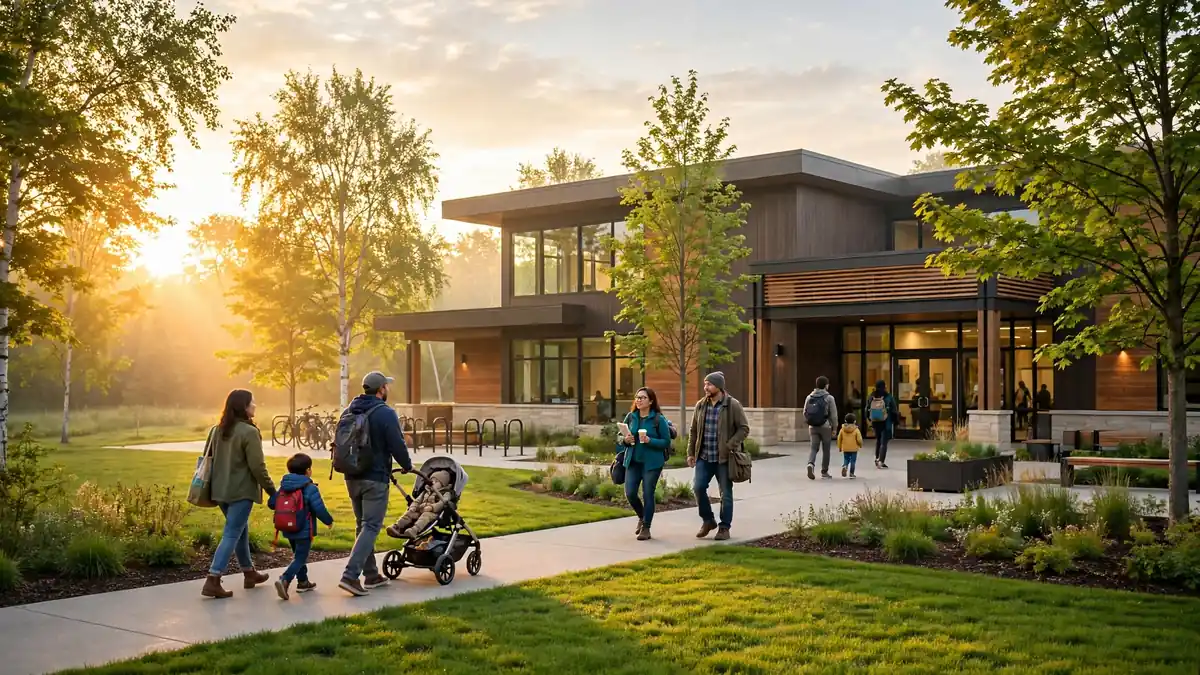
Some mornings begin before the sun feels ready. A parent buckles a toddler into a car seat, still half asleep. An adult learner rehearses English phrases quietly on the bus ride over. Then the doors open, and the day changes its tone completely.
That small daily moment explains the name on the building. Aŋpétu Téča means “New Day” in Dakota, and the phrase carries real weight here. In fact, every program inside treats learning as a fresh start, not a deadline. An adult can return to school after years away. A family can walk in nervous and leave with a plan.
The Aŋpétu Téča Education Center sits at 1910 County Road B West in Roseville, Minnesota. The building was formerly known as the Fairview Community Center, and many longtime residents still use that name. However, the Dakota name now leads, and it suits the place well. The center belongs to Roseville Area Schools, District 623, and it serves learners from infancy through older adulthood.
A Name That Promises a Fresh Start
Indeed, names shape how a place feels before anyone steps inside. Dakota is the language of the Indigenous people who lived in this region long before Roseville existed. Therefore, the name also honors a history that stretches far beyond the school district itself.
For example, a new parent may arrive with a baby and a long list of worries. Similarly, an immigrant learner may arrive unsure about English and unsure about the building. A teacher then slows down, smiles, and helps that learner find the right classroom.
So the “new day” idea shows up in small, practical ways. It appears in a second chance at a diploma. A first preschool morning without tears shows it too. It also lives in a swim lesson where an adult finally floats without fear. It grows through ordinary mornings, repeated kindly.
One Building, Many Beginnings
The center sits just south of Rosedale Mall, in the heart of the community. Roseville Area Schools serves all or parts of seven communities in total. Those communities are Roseville, Arden Hills, Falcon Heights, and Little Canada. Lauderdale, Maplewood, and Shoreview complete the list.
Inside one address, the district gathers several big pieces of public education. The Early Childhood Center at Aŋpétu Téča serves the youngest learners and their families. The Roseville Adult Learning Center serves adults who want language skills or a credential. Meanwhile, Roseville Community Education runs classes, aquatics, and activities for every age group.
Overall, that mix creates a building unlike a typical school. Toddlers pass adults in the hallway, and both belong there. Older adults arrive for senior programs while teenagers head to driver education sessions. In short, the center treats education as a whole-life project, not a childhood phase.
The Youngest Learners Come First
Early learning anchors the building, and it starts remarkably young. The district runs an early learning center Roseville families trust at this site. Programs welcome children from birth through age five, along with their parents and caregivers. So learning here begins with relationships, not worksheets.
Early Childhood Family Education for Parents and Children?
Early Childhood Family Education, called ECFE, teaches children and parents together. Children play, explore, and practice social skills with licensed early childhood teachers. Parents, meanwhile, join guided discussions about development, routines, and family life.
For example, a toddler class might mix sensory play, songs, and simple science activities. Caregivers then talk honestly about sleep, tantrums, and screen time. The toy lending library also adds a practical layer for families. In addition, drop-in play sessions welcome children ages birth to five without advance registration.
These family education programs build confidence on both sides of the classroom. Children gain language, motor skills, and comfort with other children. Parents gain ideas, friendships, and reassurance from people facing similar challenges. Staff treat families as partners, because families know their children best.
In addition, cultural liaisons help families feel at home from the first visit. Liaisons support African American, American Indian, Hmong, and Karen families, for example. Similarly, Latino, Nepali, and Somali families have a named liaison to call. Teachers also make home visits, so support can start right where families live.
Parents who learn alongside their children often seek ideas beyond school too. A guide to an education farm where children learn through growing food shows that same spirit outdoors. Both settings trust children to learn by touching, asking, and trying.
Preschool and Pre-K That Build School Readiness
As children grow, preschool programs Roseville parents choose often start right here. The district offers Pre-K classes for children who turn three or four by September 1. Aŋpétu Téča is one of three Early Childhood Centers, alongside Parkview and Harambee. Families can choose half-day or full-day classes, so the schedule can fit work and home life.
Classrooms focus on growth that is social, emotional, physical, and intellectual. Teachers build routines that help children listen, share, and solve small problems. Therefore, kindergarten feels less like a cliff and more like a next step.
Early childhood screening supports that journey for every district child. Screening checks vision, hearing, growth, and immunization status. It also reviews large and small muscle skills, thinking, and language development. If concerns appear, staff then connect families with help early, when support works best. Screening is free, and Minnesota requires it before kindergarten starts. Staff recommend age three, yet daytime, evening, and Saturday appointments keep it flexible.
Early Childhood Special Education, called ECSE, serves children with developmental needs. A birth-to-two teacher, for instance, may coach families at home or in natural settings. Speech-language pathologists and occupational and physical therapists also work alongside that teacher. Families who value that spirit may enjoy reading about ways to celebrate unique learners and special education pride too.
Daily details matter for young families, and evenings matter too. Healthy routines at home support the learning that happens at school. For example, many parents explore healthy bedtime snacks for kids while building calmer nighttime routines. Small habits, repeated nightly, help children arrive rested and ready.
Support for School-Age Children and Teens
Older children fill the building too, especially after school and in summer. Roseville Community Education offers youth enrichment programs for a wide range of ages. Fall lineups, for instance, include camps, field trips, and activities for ages two to fourteen. Children also find many of these opportunities at their own schools.
The choices also stay refreshingly varied from season to season. One child joins a theater club while another builds art from beads. Arts and sports camps even welcome children as young as two to five. As a result, families can match activities to a child’s real interests.
Meanwhile, driver education adds a milestone program for teenagers here. The district offers classroom and behind-the-wheel instruction for youth ages fourteen to seventeen. Students can attend sessions in person at Aŋpétu Téča or online by Zoom. So a teenager’s “new day” might literally begin with a driver’s license. In addition, optional parent classes help families guide new drivers at home.
Movement runs through the youth offerings in a healthy way. That goal echoes the spirit behind physical education standards that aim for lifelong fitness in schools elsewhere. Roseville families, however, can pursue that fitness right in their own neighborhood pool.
A Second Chance, and a First Class, for Adults
For many adults, this building holds the most personal stories. The Roseville Adult Learning Center operates from the same County Road B address. It forms part of adult basic education Minnesota learners rely on statewide. Others come to finish a credential that life interrupted years earlier. These core classes carry no cost, so money rarely blocks a restart.
English Language Classes That Fit Real Life
English language classes for adults form the largest part of the adult program. Classes meet in person only, and the schedule respects working lives. Morning classes run Monday through Friday, from nine in the morning until one. Evening classes run Monday through Thursday, from six until eight thirty.
Teachers focus on language that adults use every single day. Students practice speaking with teachers, employers, and health care providers. They read forms, write messages, and build vocabulary for work and family life. In addition, the classes build confidence, which often matters as much as grammar.
Fall classes traditionally begin in early September, right after Labor Day. Registration also opens during the summer, and staff help new students find the right level. Still, adults should check current schedules, because times can shift by term.
Earning a Diploma or Preparing for the GED
Some learners left high school without graduating, and this center welcomes them back. The adult high school diploma pathway lets adults complete credits toward graduation. GED classes Minnesota students use for test preparation run here as well. Adult diploma and GED prep classes have met on Tuesday afternoons from three until six, in person and online.
The pace stays personal, because every returning learner starts somewhere different. Teachers assess skills, set goals, and check progress with each learner. As a result, adults move forward without repeating what they already know.
In fact, career training grows from this same doorway each year. The Apprentice Ready+ program, for example, runs for eight weeks each summer. It runs with the Karen Organization of Minnesota as a training partner. Graduates then prepare for building trades and other apprenticeship pathways.
Adults often pair a credential with a longer career plan. Some graduates later explore professional training in fields far beyond Roseville. For example, career changers sometimes compare online licensing courses for new professions before committing time and money. Others research education law programs for careers inside schools and districts. The diploma, however, remains the doorway that makes those plans possible.
Community Education for Curiosity at Every Age
Beyond credentials, the building hums with classes taken purely for joy. Roseville’s community education programs carry a simple, generous mission statement. Learning opportunities, the district says, should exist for everyone, at every age. The mission promises meaningful services, quality programs, and lifelong learning for all residents.
Adult enrichment classes fill the seasonal catalog with color and variety. One season might offer group guitar and ukulele lessons for beginners. Another might feature astrology, aura photography, or pruning trees and shrubs. Cooking classes remain favorites, from Italian family dinners to handmade chocolate bars.
Parents and children also learn side by side in these catalogs. Saturday parent and child art classes, for instance, meet right at Aŋpétu Téča. Young artists make woodland creatures, paper gifts, ornaments, and family murals together. On the other hand, some classes meet at Roseville Area High School or other district sites.
Families who love shared outings often plan learning adventures beyond Minnesota too. A roundup of family-friendly places to visit in New York City suits that same curious spirit. Closer to home, however, a Saturday class here costs less and needs no airfare.
The Pool Where Roseville Learns to Swim
Ask longtime residents about the building, and many mention the pool first. Aquatics has anchored this site since its Fairview Community Center days. Roseville Community Education runs swim lessons for the whole family at Aŋpétu Téča. Lessons teach water safety skills and build foundations for a lifetime around water.
Adult and child lessons welcome little ones from nine months old, with caregivers in the water. Pre-K lessons serve ages three to five in two levels. Youth lessons serve ages five to fourteen across six levels. Teen and adult lessons then welcome swimmers ages fifteen and older.
The pool, however, stays open beyond lessons for everyday swimming too. Open swim and lap swim sessions welcome families and fitness swimmers alike. Water exercise classes, in addition, offer gentle, low-impact movement in shallow water. The pool stays warm at 86 degrees, so new swimmers relax sooner. Staff also offer level assessments, because the right starting level matters.
Adult beginners get patient, slower-paced teaching that builds confidence step by step. A women’s only beginner option helps some swimmers feel more comfortable. Adult refinement classes, meanwhile, polish technique for people who already swim. In short, nobody is too old, too nervous, or too new for this pool. Popular lessons fill quickly, so families should also register early.
Older Adults Belong Here Too
The Roseville Area Senior Program has long been part of this building’s identity. Older adults also find classes, activities, and company under the same roof. Senior programming reflects the center’s belief that curiosity does not retire. In fact, the program also guides seniors toward support services and resources. Caregiver support groups, for example, meet in the building during the month. Open pickleball sessions, meanwhile, keep active older adults moving each week.
Community events widen that circle even further each season. The school board holds regular meetings in the building’s Fairview Room, usually twice a month. The annual gift and craft sale also fills the center with local artisans each fall. Meanwhile, astronomy clubs, parent groups, and neighborhood organizations meet here too. Therefore, the building stays busy long after school hours end. Alive & Kickin’, a senior rock ensemble, even sold out the Fairview Room recently. Performers aged 64 to 99 then sang rock classics for a joyful crowd.
How Enrollment and Registration Generally Work?
That question deserves a straight answer, because each program enrolls a little differently. Most Community Education classes use the district’s online registration system. Families browse the seasonal catalog, choose a class, and register online in minutes.
Early childhood registration follows its own calendar each year. For district Pre-K, registrations received during February are processed together as one group. Families then hear about class placement starting in the last week of March. Registrations after March 1 are processed on a rolling basis, as space allows.
Adult Learning Center registration works more like an intake conversation. New English and diploma students contact the center, discuss goals, and arrange placement. Staff then match each learner to the right class level and schedule. Because demand stays strong, early contact helps adults secure a seat. New students first complete a short online form, then book a registration appointment. Appointments have run on Tuesdays and Thursdays, and walk-ins join when space allows. Learners should allow one to two hours, because placement includes assessment and goal setting.
What Should You Know About Fees, Refunds and Deadlines?
Some programs ask for fees, while others keep costs low or free. Enrichment classes list a clear price per session in the catalog. However, families should confirm current fees with the district before registering. ECFE fees, for example, slide with family income, and some classes stay free. Community Education refunds, in addition, return fees minus a small service charge. Cancellations, however, need notice at least one week before a class starts.
A few practical tips help every new learner start smoothly. First, check the catalog early, because popular classes and swim lessons fill fast. Then call the Community Education office if online registration feels confusing. After all, the staff would rather answer one question than lose one learner. Registration for most classes closes three days before the start date, so late planners should call quickly.
What the Center Means to Roseville?
That question sounds large, yet the answer lives in daily details. The center proves that a public school district can serve a whole lifetime. For instance, a baby in an ECFE class may return years later for swim lessons. Decades later, that person might return for an enrichment class or a senior program.
Early childhood education Roseville MN families receive here strengthens the whole district. Children who start confident tend to thrive in kindergarten and beyond. Parents who feel supported tend to stay engaged with their schools. Therefore, investment in the youngest learners pays the community back for years.
The adult programs carry an equally deep community value. English classes, for instance, help new neighbors join workplaces, schools, and civic life fully. Diploma and GED pathways raise earnings and open doors to further training. In addition, enrichment classes keep isolated adults connected to other people. A district that teaches its adults, in fact, strengthens every family inside it.
The Dakota name adds one more layer of meaning to that mission. It also reminds every visitor whose land this region has long been. So a struggling learner hears a different message at the front door. Today is new, the name says, and so is your chance.
Frequently Asked Questions
Where is the Aŋpétu Téča Education Center located?
The center stands at 1910 County Road B West in Roseville, Minnesota, 55113. It sits just south of Rosedale Mall and was formerly the Fairview Community Center. Roseville Area Schools, District 623, operates the building.
What does Aŋpétu Téča mean in Dakota?
Aŋpétu Téča means “New Day” in the Dakota language. The name reflects the center’s focus on fresh starts for learners of every age. It also honors the Indigenous heritage of the land around Roseville.
Which programs can families find at the center?
Families find early childhood classes, ECFE, preschool and Pre-K, and early screening here. Youth enjoy enrichment activities, driver education, and swim lessons at the site. Adults can join English classes, diploma and GED preparation, and enrichment courses. Senior programs and community events also run in the building.
How do adults join English or GED classes there?
Adults should contact the Roseville Adult Learning Center at the County Road B address. Staff discuss goals, assess skills, and place learners in the right class level. English classes meet in person, with morning and evening options. Diploma and GED prep has offered both in-person and online attendance.
How can someone register for Community Education classes?
Most people register online through the Roseville Community Education catalog and registration system. Registration by phone is also available at 651-604-3770. Popular classes and swim lessons fill quickly, so early registration helps. Staff can also explain fees, locations, and schedules for each class.
How much do programs at the center cost?
Costs vary widely, because each program family funds itself differently. Adult Learning Center classes carry no cost for enrolled learners. ECFE fees slide with income, while enrichment classes list one clear price. Families should still confirm current fees before registering.
Can newcomers get help in a language besides English?
Yes, and that help starts well before the first class begins. Cultural liaisons support families across several languages and communities in early childhood. English classes, meanwhile, welcome adult learners at every starting level. Staff can also explain interpreter options, so no family navigates enrollment alone.



