
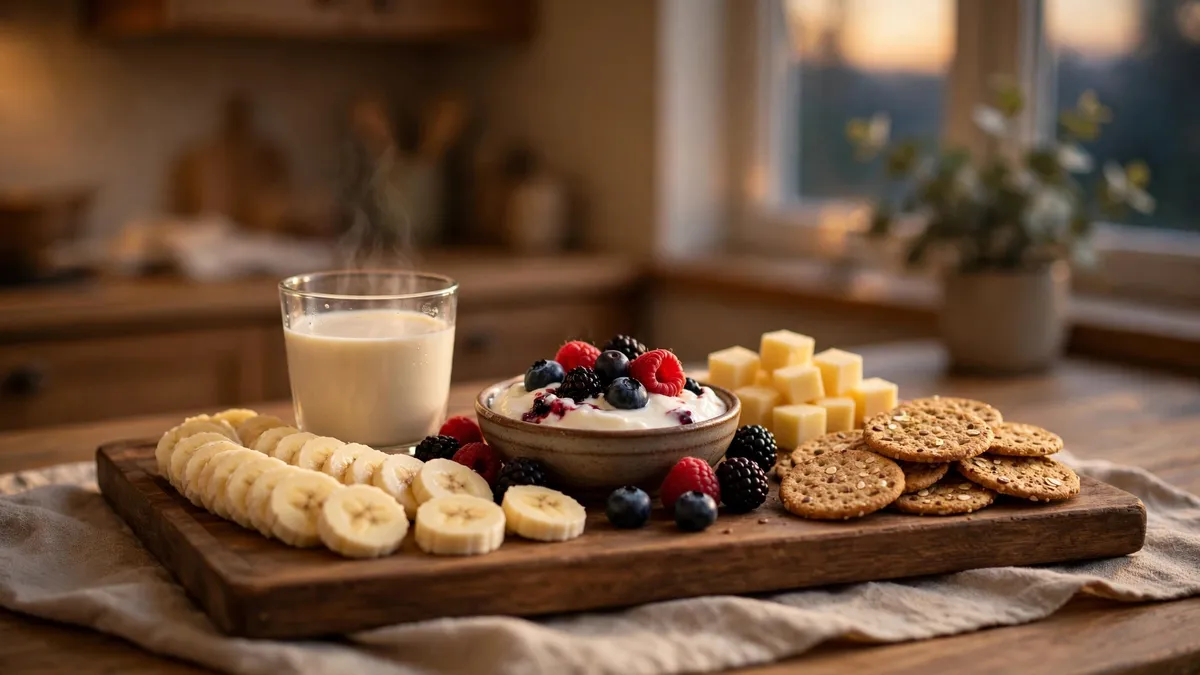
The kitchen lights are low, dinner ended hours ago, and then it happens. A small voice asks for one more snack before bed. Almost every parent knows that moment well. Also, almost every parent has wondered what that nightly habit really costs. Bedtime snacks for kids sound tiny, yet they quietly repeat seven nights a week. Consequently, a snack that costs a dollar each night becomes thirty dollars each month. This guide therefore compares healthy snacks for kids by price, not just by nutrition. You will find twelve bedtime snack ideas with honest per-serving estimates below. Additionally, you will see weekly budgets, monthly budgets, and simple ways to save. All prices are approximate typical US grocery prices, so treat them as planning guides. After all, local prices vary, and seasonal prices vary even more.
What makes a good bedtime snack for kids?
A good evening snack is small, calm, and genuinely filling. Ideally, it pairs a slow carbohydrate with a little protein or healthy fat. That pairing, in general terms, helps a child feel settled rather than hungry again quickly. For example, toast alone fades fast, whereas toast with nut butter lasts much longer. Similarly, fruit alone is light, while fruit with yogurt feels more complete. Portion size matters too, because a bedtime snack is not a second dinner. Roughly, a small bowl, a small glass, or one handheld portion usually suits most children. Timing matters as well, and most families find thirty to forty-five minutes before lights-out works well. That gap, importantly, leaves time for teeth brushing afterwards.
Certain nutrients come up often in bedtime snack conversations, and the claims need care. Milk, yogurt, cheese, eggs, and turkey all contain tryptophan, an amino acid found in many protein foods. Bananas, oats, and dairy also provide nutrients like calcium, magnesium, and vitamin B6. These nutrients are commonly associated with normal sleep routines in general nutrition writing. However, no single snack can promise that a child will fall asleep faster. Sleep depends on routine, light, activity, and comfort far more than one food. So think of these snacks as part of a calm routine, not a sleep remedy. Parents who worry about poor sleep should, of course, talk to their child’s doctor.
Why does the cost per serving matter so much?
Bedtime snacks repeat so often that small price gaps grow surprisingly large. A forty-cent snack and a one-dollar snack differ by only sixty cents nightly. Over a month, however, that gap becomes roughly eighteen dollars for one child. For two children, meanwhile, the same gap doubles to about thirty-six dollars monthly. That difference could instead cover fresh fruit for the whole week. Cost per serving is therefore the fairest way to compare evening snacks honestly. Packaged snacks look cheap per box, yet their per-serving price is often high. Conversely, simple whole foods look plain, but their per-serving price is usually low. Once you calculate cost per serving, the grocery budget for families becomes much clearer.
12 healthy bedtime snacks for kids, with costs
Each idea below uses familiar ingredients and takes about five minutes to prepare. Prices assume store-brand groceries, bulk basics, and ordinary family-size packs bought once. Admittedly, prices in big cities run higher, and prices in discount stores run lower. Still, the ranking between snacks stays fairly stable almost anywhere you shop. Popcorn, notably, suits older children only, since whole popcorn can be a choking hazard for toddlers. Likewise, whole nuts suit older children, while nut butters suit younger ones better. Evening snacks for toddlers should always be soft, small, and served sitting down.
The 12 snacks at a glance
| Bedtime snack | What is in it? | Approx. cost per serving | Why families like it? |
|---|---|---|---|
| Banana with peanut butter | One banana plus one spoon of peanut butter | $0.45 | Filling, sweet, and quick |
| Warm milk | One small glass of milk, warmed gently | $0.30 | Calm, classic, and very cheap |
| Greek yogurt with berries | Half a cup of yogurt plus a few berries | $0.85 | High protein and creamy |
| Warm oatmeal with cinnamon | Small bowl of oats, milk, and cinnamon | $0.35 | Warm, soft, and very filling |
| Hard-boiled egg with fruit | One egg plus a few apple slices | $0.50 | Simple protein snacks for kids option |
| Cheese with whole grain crackers | One cheese portion plus five crackers | $0.65 | Crunchy, savoury, and satisfying |
| Cottage cheese with fruit | Half a cup of cottage cheese plus fruit | $0.70 | Soft, mild, and protein-rich |
| Whole grain toast with nut butter | One small slice plus a thin spread | $0.45 | Warm, familiar, and filling |
| Unsweetened applesauce | Half a cup, homemade or from a jar | $0.40 | Gentle, soft, and toddler-friendly |
| Hummus with carrot sticks | Two spoons of hummus plus carrot sticks | $0.55 | Crunchy, savoury, and fibre-rich |
| Air-popped popcorn | Two cups, for older children only | $0.15 | The cheapest snack on this list |
| Banana oat smoothie | Half a banana, oats, and milk blended | $0.60 | Creamy and popular with picky eaters |
What do the cheapest snacks have in common?
Clearly, the cheapest options share one trait, namely very simple ingredients. Bananas, oats, milk, eggs, and popcorn kernels cost pennies per portion in bulk. In contrast, berries, branded yogurt, and cottage cheese push the price upward quickly. That does not make pricey options bad, because variety keeps children interested at bedtime. Instead, treat those options as rotation snacks rather than nightly defaults. A sensible pattern, for instance, is cheap staples on weekdays and favourites on weekends. Families planning active days out, like trips to places to visit in NYC with kids, often notice hungrier evenings afterwards. On those nights, a slightly bigger protein snack usually prevents a midnight wake-up request.
Which snacks suit toddlers best?
Toddlers need softer textures, smaller pieces, and very predictable choices at night. Warm milk, applesauce, oatmeal, cottage cheese, and banana all work beautifully for toddlers. Additionally, offering just two choices keeps the routine calm and short. Parents sometimes rotate in a homemade option like the applesauce food mill recipe on this site. That batch approach, incidentally, makes several toddler portions from one pot of apples. Grapes, whole nuts, and popcorn should stay off the toddler menu entirely. Cutting soft foods small and serving them seated also keeps snack time safe.
Which snacks work best for older kids?
Older children usually want crunch, choice, and a snack that feels grown-up. Cheese with crackers, hummus with carrots, popcorn, and smoothies all hit that mark. Moreover, older kids can help prepare their own snack, which saves parents time. Some families let older children build a tiny snack tray on Friday nights. That small ritual, happily, turns a cheap snack into an event they genuinely enjoy. Travel days also change appetites, especially after exploring the best places in Costa Rica to visit with kids or similar family trips. After such days, a smoothie or egg snack restores energy without a heavy meal.
Homemade vs store-bought bedtime snacks
Homemade snacks for kids almost always win on price, sometimes by a wide margin. Packaging, branding, and single-serve convenience explain most of that price gap. Nevertheless, store-bought snacks still earn a place in busy family life. A pouch or bar, for example, saves real time on late work nights. The honest comparison, therefore, is not homemade good and store-bought bad. Rather, it is about knowing exactly what the convenience costs your family. The table below compares typical per-serving prices for common evening options. Again, these figures are approximate and based on typical supermarket prices.
| Snack | Homemade cost | Store-bought cost | Approx. saving per serving |
|---|---|---|---|
| Yogurt with fruit | $0.55 from a big tub | $1.00 per small cup | $0.45 |
| Applesauce | $0.40 from cooked apples | $1.10 per pouch | $0.70 |
| Granola bar | $0.45 per homemade bar | $0.90 per packaged bar | $0.45 |
| Trail mix portion | $0.50 from bulk ingredients | $1.20 per snack pack | $0.70 |
| Banana oat muffin | $0.35 per homemade muffin | $1.50 per bakery muffin | $1.15 |
| Popcorn portion | $0.15 air-popped at home | $0.80 per mini bag | $0.65 |
What does that saving mean each month?
Savings of fifty cents sound trivial until you multiply them across a month. One child eating homemade snacks nightly could save roughly fifteen dollars monthly. Besides, homemade snacks let parents control sugar far more easily at night. Many packaged evening treats hide added sugar in yogurts, bars, and cereal portions. Sugar-free snacks for kids are much easier to build from plain whole ingredients. Plain yogurt with real fruit, for instance, needs no added sugar at all. Cinnamon, vanilla, and ripe banana add sweetness without any syrup or honey. Even so, keep a few store-bought backups for travel, illness, and exhausting days.
Weekly and monthly budget scenarios for families
Numbers become real when you see them as a weekly and monthly routine. Imagine one child eating a budget rotation that averages about $0.45 nightly. That week costs roughly $3.15, and that month costs about $13.50 total. Now imagine two children sharing a mixed rotation averaging about $0.60 each nightly. Their week costs roughly $8.40, and their month costs about $36 overall. Finally, imagine two children eating mostly packaged snacks at about $1.20 each nightly. That week jumps to roughly $16.80, and that month reaches about $72. The packaged habit, strikingly, costs double the mixed homemade rotation every month.
Those scenarios show why cheap healthy snacks matter beyond the nightly kitchen moment. Switching just half the packaged nights to homemade saves about $18 monthly. Over a school year, that saving grows past $150 for many families. Families could then redirect that money toward fresh fruit, books, or days out. Planning trips using guides like places to visit in the UK for families feels easier with that cushion. Similarly, a family saving for outings in Manchester for families notices every small grocery win. Budget snacks are therefore not about restriction, but about choosing where money goes.
How can a family build a weekly snack rotation?
A written rotation removes nightly negotiation and stops expensive impulse choices completely. Start by listing five cheap staples your child already likes without prompting. Then add two favourite snacks, even if those favourites cost a little more. Next, assign staples to school nights and favourites to Friday and Saturday. This pattern, importantly, keeps bedtime predictable while weekends still feel special. Shopping also becomes simpler, because the same short list repeats every week. Leftover ingredients rarely go to waste, since each item appears twice weekly. One parent described it as autopilot for the last hour of the day.
Money-saving tips that actually lower the nightly cost
Bulk buying is the single biggest lever for lowering cost per serving. Big tubs of yogurt, large oat sacks, and family cheese blocks beat individual packs easily. However, buy bulk only for foods your children already eat willingly every week. Otherwise, a bargain that nobody eats becomes the most expensive snack of all. Seasonal fruit offers another easy saving, because in-season produce costs noticeably less. Strawberries in spring and apples in autumn, for example, beat imported winter berries. Frozen fruit also helps, since frozen berries cost less and waste nothing. Batch prep on Sunday saves money too, because ready snacks prevent convenience purchases later.
Store brands deserve a fair trial in almost every snack category as well. Store-brand oats, milk, peanut butter, and crackers usually match branded quality closely. Portioning snacks yourself also cuts costs, so skip pre-divided packs whenever possible. A reusable small container, after all, does the same job for free nightly. Families should also watch the half-eaten snack problem with honest eyes. Serving half portions first, then seconds on request, reduces waste almost immediately. Active holiday days, like exploring family spots in Phoenix, Arizona, justify the bigger portion instead. Matching portion size to the day, ultimately, keeps both children and budgets comfortable.
What should kids avoid before bed?
Some snacks before bed reliably work against a calm evening, whatever their price tag says. Sugary cereal, candy, cookies, and sweetened drinks can leave children feeling wired. Chocolate also contains a little caffeine, so hot chocolate is a poor bedtime choice. Fizzy drinks add both sugar and, sometimes, caffeine into the evening mix. Heavy and greasy foods sit uncomfortably, especially when children lie down soon afterwards. A big slice of pizza, for instance, belongs at dinner rather than bedtime. Parents curious about such foods can read about Peter Piper Pizza calories on this site. Large portions of any food, finally, can make small stomachs feel uncomfortably full.
Spicy foods deserve caution too, because they can cause discomfort for some children. Very acidic juices may bother sensitive stomachs and also harm teeth overnight. Energy drinks, tea, and coffee obviously never belong in a child’s evening routine. Water remains the safest late drink, although only a small glass is wise. Too much liquid late, predictably, leads to extra bathroom trips at night. Keeping the avoid list short and consistent helps children accept it calmly. Children cope better when the rule sounds simple, like kitchen treats end at dinner.
How do you keep bedtime snacks from becoming a stall tactic?
Many parents suspect, correctly, that some snack requests are really bedtime delays. A fixed snack time inside the routine solves most of that problem neatly. Offer the snack before pyjamas, story, and teeth brushing, in that order nightly. Then close the kitchen clearly once brushing is done and lights dim. Two boring choices work better than an open-ended question at that hour. For instance, ask banana or yogurt, rather than asking what they want. Genuine hunger still gets fed, while the negotiation window stays pleasantly short. Consistency over one week, typically, teaches the new pattern better than lectures.
Frequently asked questions
Are bedtime snacks for kids actually necessary?
Not always, because many children sleep perfectly well after a filling dinner. A snack helps most when dinner was early, small, or unusually active beforehand. Also, a snack helps when a child regularly wakes hungry before morning. Parents should watch the pattern for a week before making snack time permanent. If requests happen only on late or busy days, serve snacks only then.
What are the best snacks for kids before bed on a budget?
Bananas, warm milk, oatmeal, popcorn for older kids, and eggs lead on price. Each costs roughly fifty cents or less per serving in most stores. Moreover, each takes under five minutes, which matters on tired school nights. Yogurt from a big tub also stays cheap while adding useful protein. Altogether, these staples form the backbone of most low-cost snacks for kids rotations.
Do snacks that help kids sleep really exist?
No food can guarantee sleep, and parents should treat such claims cautiously. Some foods contain tryptophan, calcium, or magnesium, which are associated with normal sleep processes. Warm milk and yogurt therefore appear often in traditional bedtime routines worldwide. Still, routine, darkness, and a regular bedtime matter far more overall. Think of kid-friendly snacks as comfort and fuel, never as medicine.
How much should a family budget for bedtime snacks each month?
A homemade rotation for one child usually lands near $14 to $20 monthly. Two children on a mixed rotation usually land near $30 to $40 monthly. In contrast, a packaged-heavy habit can pass $70 monthly for two children. Your local prices will shift those figures somewhat up or down. Tracking one week of real spending gives the most accurate family figure.
Are homemade snacks for kids always cheaper than store-bought ones?
Usually yes, because homemade portions avoid packaging and branding costs almost entirely. Muffins, applesauce, popcorn, and trail mix show the biggest savings in practice. However, sales and coupons can occasionally make packaged snacks surprisingly competitive briefly. Time also has value, so a mixed approach suits most families best. Use homemade snacks as the default and packaged snacks as the backup.
What are good sugar-free snacks for kids at night?
Cheese with crackers, hummus with vegetables, eggs, and plain yogurt all qualify naturally. Unsweetened applesauce and warm milk also contain no added sugar at all. Parents can add cinnamon or vanilla when children want a sweeter taste. Reading labels matters, because many kids’ yogurts and bars contain added sugar. Simple whole foods, consequently, remain the easiest sugar-free route every night.
The bottom line on bedtime snack costs
Healthy evening treats do not need premium packaging or premium prices to work. Bananas, oats, milk, eggs, and yogurt deliver comfort for pennies per serving. Meanwhile, a simple rotation protects both the bedtime routine and the grocery budget. Start with five staples, add two favourites, and track one real week. Then adjust portions and choices around what your child actually eats happily. That small experiment, in the end, tells you more than any generic budget. Good bedtime snack ideas are simply the ones your family can repeat calmly nightly.



