
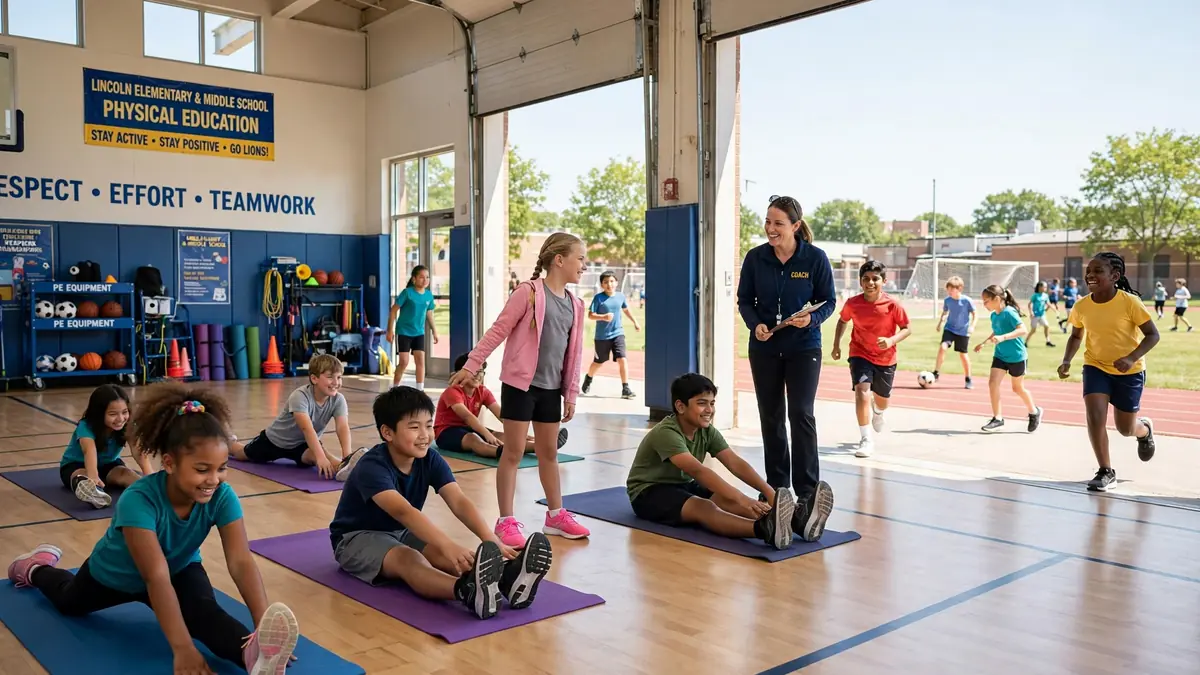
Physical education can look like simple play from the hallway. In fact, a good PE class is planned teaching, just like maths or reading. So California gives that teaching a clear structure. The California physical education standards set out what students should learn about movement, fitness, and healthy habits from kindergarten through high school.
Still, many families never see that structure. They hear about a fitness test, or they see a report card line, and then they wonder what sits behind it. This guide explains the system in plain English. First, it covers who sets the standards. Next, it walks through each grade span. Finally, it shows how parents and teachers can use the standards to build lifelong fitness habits students actually keep.
What are the California physical education standards?
The formal name is long, but the idea is simple. The document is called the Physical Education Model Content Standards for California Public Schools: Kindergarten Through Grade Twelve. In short, it lists the essential skills and knowledge every student needs for a physically active life.
The State Board of Education adopted the standards in 2005. The California Department of Education, often called the CDE, publishes and supports them. However, local school boards still choose the course of study for their own schools. So the standards act as the shared destination, while districts plan the local route toward it.
What are the five California PE standards?
For kindergarten through grade eight, the physical education model content standards use five overarching standards. Each standard covers a different part of learning. One is about doing movements. Another is about understanding movements. Then two standards focus on fitness itself and fitness knowledge. The fifth standard covers the mind and the social side of activity.
Standard 1: Motor skills and movement patterns
Officially, students demonstrate the motor skills and movement patterns needed to perform a variety of physical activities. In plain English, children learn to move well. First, they run, jump, balance, throw, catch, kick, and strike. Then, over time, those basic actions become smoother and more controlled. These motor skills standards form the base for every later sport and activity.
Standard 2: Movement concepts and strategies
Officially, students demonstrate knowledge of movement concepts, principles, and strategies that apply to the learning and performance of physical activities. So this standard is the thinking behind the moving. For example, a student learns why the angle of a foot or paddle changes where a ball travels. Another student learns how spacing helps a team keep possession.
Standard 3: Assessing and maintaining fitness
Officially, students assess and maintain a level of physical fitness to improve health and performance. In other words, students do the fitness work and check their own progress. They build aerobic capacity, strength, endurance, and flexibility through regular activity. Then they learn to notice change, because noticing change helps them stay motivated.
Standard 4: Knowledge of fitness concepts
Officially, students demonstrate knowledge of physical fitness concepts, principles, and strategies to improve health and performance. This standard is the knowledge partner to Standard 3. For example, students learn what aerobic capacity means and why warm muscles work better. They also learn which exercises target which parts of the body, and they learn which movements to avoid because those movements can cause harm.
Standard 5: Psychological and sociological concepts
Officially, students demonstrate and utilize knowledge of psychological and sociological concepts, principles, and strategies that apply to the learning and performance of physical activity. In plain English, this standard covers confidence, cooperation, and respect. Students learn to work toward a shared goal, accept differences, and solve problems as a team. So PE also teaches how people act well together while they move.
How do the standards change in high school?
In high school, the five standards are consolidated into three. First, high school Standard 1 says students demonstrate knowledge of and competency in motor skills, movement patterns, and strategies needed to perform a variety of physical activities. So it combines the earlier skills standard and the movement knowledge standard.
Next, high school Standard 2 says students achieve a level of physical fitness for health and performance while demonstrating knowledge of fitness concepts, principles, and strategies. So it combines doing fitness with understanding fitness.
Finally, high school Standard 3 says students demonstrate knowledge of psychological and sociological concepts, principles, and strategies that apply to the learning and performance of physical activity. It carries the fifth earlier standard forward, but at a more independent level. By then, students should set goals, manage challenges, and choose activities they can sustain as adults.
What do California PE standards by grade level look like?
| Grade span | Main focus | Typical examples |
|---|---|---|
| Kindergarten to grade 2 | Basic movement, balance, and moving safely with others | Hopping, galloping, balancing, underhand throwing, simple dances |
| Grades 3 to 5 | Combining skills, accuracy, and early fitness knowledge | Dribbling while guarded, jumping rope, chest and bounce passes, creative dance |
| Grades 6 to 8 | Teamwork, tactics, decision making, and personal fitness goals | Volleying with a partner, striking against a wall, team problem solving |
| Grades 9 to 12 | Competency, personal fitness planning, and lifelong activity choices | Sport skills, dance, aquatics, strength work, self-designed fitness plans |
What happens in kindergarten through grade 2?
In the earliest years, the PE standards kindergarten California families see are about foundations. Children explore how their bodies move through space and time. They practise travelling in different ways, at different speeds, and in different directions. For example, they walk, run, hop, gallop, and slide in a shared space without bumping into classmates.
Balance also starts early. Students hold shapes, shift weight, and move with control. Then they begin simple manipulative skills, such as rolling, tossing, and catching a large, soft ball. Because success matters at this age, teachers often use larger equipment and shorter distances first.
Learning also reaches beyond the gym. A working education farm shows children how movement, food, and outdoor work connect, and the Fairview Gardens education farm story gives families a useful example of that wider, active learning.
What happens in grades 3 through 5?
Next, the work becomes more connected and more accurate. Students combine locomotor and manipulative skills instead of practising each one alone. For example, by grade five the standards include jumping for height and distance with proper takeoff and landing form. They also include entering, jumping, and leaving a long rope turned by other people.
Older elementary students throw and catch while avoiding an opponent. They field a ground ball, punt a dropped ball toward a target, and trap a moving kicked ball with the foot. They also dribble by hand or foot while another student tries to guard them. So skill now has to survive real game pressure, even in a small-sided game.
Active family time can reinforce this stage well. Walks, park games, and short bike rides repeat the same patterns in a relaxed setting. Even a family day out can help, because varied terrain and play build control, as parents notice on trips like the places to visit in NYC with kids guide describes for city exploring on foot.
What happens in grades 6 through 8?
The middle school PE standards California teachers use place a stronger accent on cooperation and decisions. The CDE notes that middle school standards emphasise working cooperatively to achieve a common goal, meeting challenges, making decisions, and working as a team to solve problems. So games become lessons in communication as much as lessons in technique.
Skills also become more specialised. For example, sixth grade standards include volleying an object repeatedly with a partner using the forearm pass. Students also strike a ball against a wall and with a partner, using forehand and backhand strokes with a paddle. Then they dribble and pass to a partner while being guarded, so timing and awareness matter together.
Fitness work becomes more personal too. Students assess their own levels, set modest goals, and track whether their activity choices help. Still, the aim is progress, not comparison with classmates. A supportive team culture can help belonging, in the same spirit as special education shirts that celebrate unique learning and help every learner feel included.
What happens in grades 9 through 12?
The high school physical education requirements California students face bring the three consolidated standards into daily courses. Students should show real competency, not just exposure. They refine skills in team, individual, and dual activities. They also perform dances, take part in aquatics where courses provide it, and explore activities they might continue after graduation.
Choice grows in importance here. Some students thrive in team sports, while others prefer swimming, dance, martial arts, cycling, or strength training. Because the goal is a lifetime habit, finding a liked activity matters as much as passing a unit. A student who enjoys movement will seek it out at nineteen and at forty.
Personal fitness planning ties the span together. Students assess fitness, read the results honestly, and design a plan that fits their health and performance goals. Then they adjust that plan as results change. In fact, that cycle of assess, plan, act, and review is the adult fitness skill hidden inside the school subject.
How many minutes of PE does California require?
These required PE minutes come from the California Education Code, and they are separate from the content standards themselves. For grades one through six, schools must provide PE instruction for not less than 200 minutes each 10 schooldays, exclusive of recess and the lunch period. That rule sits in Education Code section 51210.
For grades seven through twelve, the requirement rises to not less than 400 minutes each 10 schooldays. That rule sits in Education Code section 51222. However, the CDE notes exemptions in specific situations, so families should check local policy for individual cases.
For graduation, the state minimum is two courses in physical education while in grades nine through twelve, unless a pupil has been exempted under the Education Code. That requirement sits in Education Code section 51225.3. Still, districts may set their own course structures within state law, so course names and sequences vary by school.
What is the difference between the standards and the PE framework in California?
People often mix these two documents up, but they do different jobs. The standards say what students should learn. The framework says how schools can teach that learning well. So one document sets the goals, and the other guides the teaching.
The full framework title is the Physical Education Framework for California Public Schools: Kindergarten Through Grade Twelve. The State Board of Education adopted it on September 11, 2008, and CDE published it in 2009. So the PE framework California educators use is newer than the 2005 standards, because it was written to help schools put those standards into practice.
One legal point deserves care. The CDE has explained that local agencies are not mandated to follow the model content standards and accompanying frameworks in the same way they must follow minute and course laws. Still, the CDE presents both documents as the foundation for a high-quality, sequential course of study. Parents who want wider context on school rules can also explore education law programs and the careers built around guiding schools through those rules.
How does FITNESSGRAM California testing fit in?
Fitness testing is an assessment tool inside the wider programme, not the programme itself. By law, California public schools administer the Physical Fitness Test, or PFT, each year to students in grades five, seven, and nine. That duty comes from Education Code section 60800.
The State Board of Education designated FITNESSGRAM as the test. FITNESSGRAM California schools use was developed by The Cooper Institute. According to the CDE, its primary goal is to assist students in establishing lifelong habits of regular physical activity. So the test should start a conversation about habits, not end with a single score.
The California physical fitness test covers five fitness areas. First, aerobic capacity is measured through options such as the 20-meter PACER, the one-mile run, or the one-mile walk test. Next, abdominal strength and endurance use the curl-up. Then trunk extensor strength and flexibility use the trunk lift. Upper body strength and endurance offer push-up, modified pull-up, or flexed-arm hang options. Finally, flexibility uses the back-saver sit and reach or the shoulder stretch.
How should families read the results?
Results are read against Healthy Fitness Zone criteria set by The Cooper Institute. Those criteria represent a level of fitness linked with protection against diseases associated with inactivity. However, a result outside a zone is information, not a verdict on a child. Teachers can use it to design curriculum, parents can use it to understand fitness levels, and students can use it to plan personal programmes.
Timing follows state rules too. The CDE states the testing window runs from February 1 through May 31 for grades five, seven, and nine. Students take the test whether or not they are enrolled in a PE class that term. Students who cannot take every part should complete as many tests as possible, with disability decisions guided by an individualised education program or Section 504 plan.
What do the standards mean for parents?
First, parents can ask better questions. Instead of asking only whether a child ran today, ask what skill the class practised. Then ask what your child noticed about getting better at it. Because Standards 1 and 2 value skill and understanding together, those questions match the real goals of the course.
At home, support the habits rather than the scores. Walk together, shoot baskets, stretch during screen breaks, or plan an active weekend outing. Family travel can carry the habit too, since hikes and beach play feel like holiday fun, as families find among the best places in Costa Rica to visit with kids rather than formal exercise.
When a FITNESSGRAM report comes home, read it as a starting point. Celebrate areas inside the Healthy Fitness Zone. Then pick one other area and support it with a fun, repeatable activity. Still, avoid turning the report into pressure or shame, because Standard 5 reminds schools that confidence and motivation are part of fitness learning too.
What do the standards mean for teachers?
For teachers, the standards turn planning into a sequence. A unit should build skill, add knowledge, and give students a way to show both. So a volleyball unit might teach the forearm pass, explain positioning, and end with students solving a team problem in a small game.
Variety protects inclusion as well. Some students shine in team games, while others shine in dance, aquatics, or individual challenges. Rotating activity types gives more students a route to success. Indoor options matter on wet or smoky days too, and venues like an A4One indoor sports facility show how covered spaces keep training varied when the weather closes in.
How do these standards build lifelong fitness?
The title promise is lifelong fitness, and the standards are built for exactly that arc. Young children gain basic movement confidence. Older children gain skill range and fitness knowledge. Teenagers then gain planning ability and personal choice. So each stage hands the next stage a stronger tool kit.
Physical literacy sits at the centre of that arc. In simple terms, it is the physical literacy California schools aim to build year after year. A physically literate person can move competently, understand why activity helps, and feel confident joining in. Because of that mix, such a person is more likely to stay active when school timetables disappear. In fact, the CDE links skilled, knowledgeable PE students with adults who stay motivated to remain healthy and active throughout their lives.
Frequently asked questions
Who sets the California physical education standards?
The State Board of Education adopted the Physical Education Model Content Standards in 2005. The California Department of Education publishes and supports them. However, local governing boards choose the course of study for their schools, so districts decide how the standards appear in local timetables and units.
Are the California PE standards the same as the framework?
No, they are companion documents with different jobs. The standards state what students should learn in each grade span. The framework, adopted in 2008 and published in 2009, guides how teachers teach, assess, and support that learning. So schools use the framework to deliver the standards well.
How many PE minutes must California students receive?
Students in grades one through six must receive at least 200 minutes of PE every 10 schooldays, not counting recess or lunch. Students in grades seven through twelve must receive at least 400 minutes every 10 schooldays. Those figures come from Education Code sections 51210 and 51222, as explained by the CDE.
Which grades take the California Physical Fitness Test?
All California public school students in grades five, seven, and nine take the Physical Fitness Test each year. The State Board of Education designated FITNESSGRAM as that test. The usual testing window runs from February 1 through May 31, according to the CDE.
What does FITNESSGRAM actually measure?
It measures five areas of health-related fitness. Those areas are aerobic capacity, abdominal strength and endurance, trunk extensor strength and flexibility, upper body strength and endurance, and flexibility. Results are compared with Healthy Fitness Zone criteria, so families can see where support or practice may help next.
How many PE courses do California high school students need to graduate?
The state minimum is two courses in physical education during grades nine through twelve. A student may be exempted only under provisions in the Education Code. Because districts organise courses differently, families should still check local graduation charts for course names and sequencing.
What can parents do if PE time seems too short?
Start with a calm question to the school about the PE schedule for your child’s grade. Then compare the answer with the 200-minute or 400-minute rule for each 10 schooldays. If a gap remains, raise it with the principal or district through their normal process, because instructional minutes are a legal requirement, not a favour.