
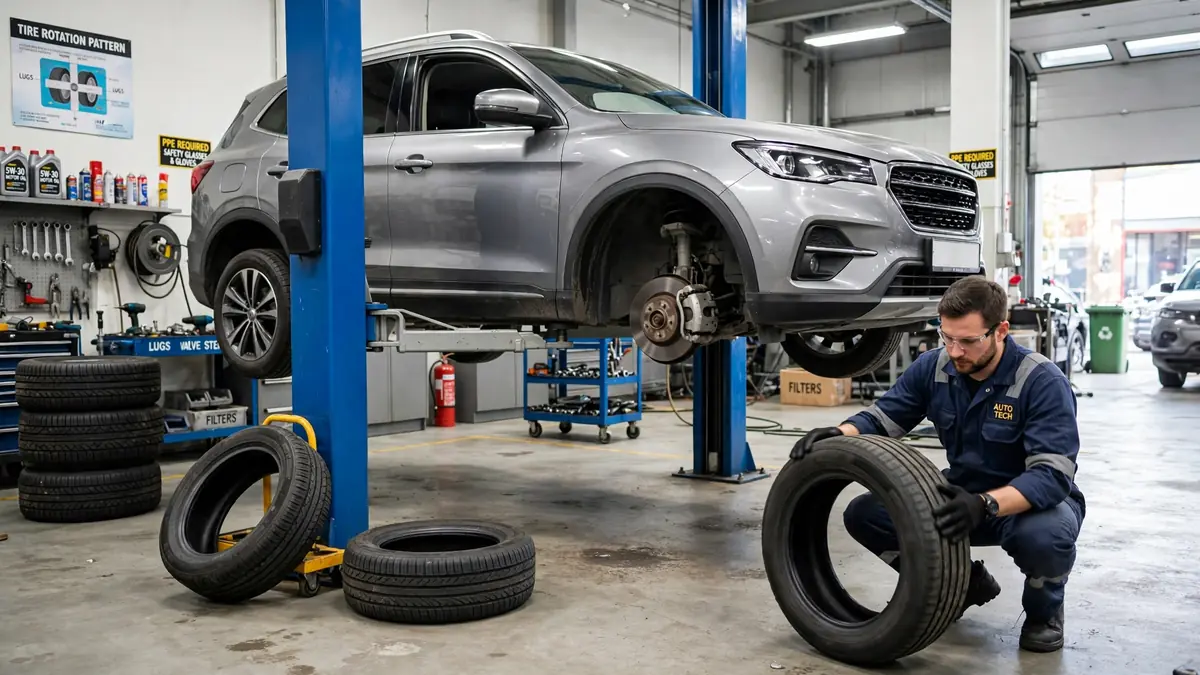
You already know your tires wear unevenly. However, you may not know why one axle always wears faster. Therefore, this guide starts with your drivetrain, not a generic calendar. Indeed, how often should you rotate your tires depends on which wheels drive, steer, and brake. Also, the right pattern matters as much as the right interval.
Firstly, you will learn the standard interval in plain terms. Secondly, you will see the exact pattern for each drivetrain. Finally, you will spot the exceptions that catch many drivers out. For example, directional and staggered setups change everything. Consequently, guessing a pattern can move wear to the wrong corner.
How often should you rotate your tires in general?
Generally, guidance points to roughly every 5,000 to 8,000 miles. Additionally, many drivers use about every six months as a reminder. However, your vehicle owner’s manual always comes first. Therefore, treat any general interval as a starting point only. Indeed, the manual reflects your model, axle loads, and tire fitment.
Similarly, your driving pattern can shift that timing. For instance, heavy city braking wears front tires much faster. Likewise, frequent towing adds extra heat and load at the rear. Consequently, you should check tread depth at every service visit. Also, a quick visual check each month helps you act early.
Moreover, the rotate tires every oil change habit works well for many people. In fact, pairing both jobs saves a separate trip later. However, that habit only works if oil intervals match rotation needs. Therefore, do not stretch rotation just because oil lasts longer. Instead, follow whichever schedule arrives sooner for your car.
Why does rotation timing differ by drivetrain?
Front tires usually steer and handle most braking force. Additionally, they often carry the engine weight as well. Therefore, front tires on many cars wear fastest. However, driven wheels also scrub tread under acceleration. Consequently, wear balance depends on where power goes.
For example, a front-wheel drive car asks front tires to do almost everything. In contrast, a rear-wheel drive car splits jobs between axles. Meanwhile, an all-wheel drive system shares power across all corners. As a result, each setup needs a different movement pattern. Indeed, pattern and interval belong together, not apart.
Also, rotation does not fix worn or damaged tires. Similarly, rotation cannot correct bad alignment on its own. Therefore, you should treat rotation as wear management, not repair. For instance, a tire with exposed cord needs replacement, not rotation. Consequently, inspection must always come before any pattern choice.
What is the tire rotation pattern front wheel drive forward cross?
The tire rotation pattern front wheel drive forward cross suits most front-drive cars. Firstly, both front tires move straight back to the rear. Secondly, both rear tires cross over to opposite front corners. Therefore, each rear tire changes side when it moves forward. Indeed, that crossing helps even out shoulder wear over time.
However, you should picture the move before lifting the car. For example, the left rear tire goes to the right front position. Likewise, the right rear tire goes to the left front position. Meanwhile, both front tires keep their side at the rear. Consequently, the pattern looks like a forward cross from behind.
Also, front-drive cars usually need strict timing discipline. In fact, their front tires combine steering, braking, and power delivery. Therefore, waiting too long leaves rear tires underused and fronts overworked. Additionally, a trusted auto service visit for routine vehicle care can confirm your pattern. Similarly, written service notes help you track each move.
What is the tire rotation pattern rear wheel drive rearward cross?
The tire rotation pattern rear wheel drive rearward cross reverses that logic. Firstly, both rear tires move straight forward to the front. Secondly, both front tires cross over to opposite rear corners. Therefore, each front tire changes side when it moves backward. Indeed, the crossing happens on the rearward journey here.
For instance, the left front tire goes to the right rear position. Likewise, the right front tire goes to the left rear position. Meanwhile, both rear tires keep their side at the front. Consequently, driven rear tires get relief without losing balance. Also, steering tires gain a fresh, even contact patch.
However, rear-drive trucks and performance cars vary widely. Therefore, you should confirm axle loads and tire sizes first. In addition, some rear-drive vehicles use wider rear tires. As a result, those vehicles may fall under staggered limits instead. Indeed, size differences can block a full cross pattern completely.
How does the X pattern tire rotation AWD work?
The X pattern tire rotation AWD moves every tire diagonally. Firstly, the left front tire swaps with the right rear tire. Secondly, the right front tire swaps with the left rear tire. Therefore, every tire changes both axle and side together. Indeed, few patterns distribute wear more evenly than this.
However, all-wheel drive systems stay sensitive to tread differences. For example, uneven diameters can strain differentials and couplings over time. Consequently, AWD owners should rotate on schedule without exception. Also, keeping all four tread depths close protects the system. In fact, that protection is a major reason AWD rotation matters.
Similarly, some AWD vehicles specify a different pattern in the manual. Therefore, the manual still overrules any general diagram you see. Additionally, a shop like a full-service vehicle care centre can verify your system needs. Meanwhile, you should measure all four tread depths before rotating. As a result, you will know whether rotation remains safe.
When do directional tires rotation front to back only apply?
Directional tires rotation front to back only applies to tread with a set direction. Firstly, look for an arrow or rotation mark on the sidewall. Secondly, that arrow must always point toward forward travel. Therefore, a directional tire cannot swap sides on the rim. Indeed, crossing it over would reverse its water-clearing tread.
For example, the left front tire moves only to the left rear. Likewise, the right rear tire moves only to the right front. However, a technician can remount tires to allow crossing. Consequently, most drivers simply accept front-to-back movement instead. Also, remounting adds cost and time without clear benefit.
In addition, directional designs often appear on performance and winter tires. Therefore, checking the sidewall takes seconds and prevents mistakes. Similarly, you should check after buying used wheels or tires. For instance, a previous owner may have fitted them incorrectly. Indeed, one reversed tire can hurt wet grip noticeably.
What are the staggered tires rotation limits you must respect?
Staggered tires rotation limits start with different front and rear sizes. Firstly, wider rear tires cannot move to a narrower front axle. Secondly, narrower front tires cannot fill a wider rear position. Therefore, a normal four-corner rotation becomes impossible here. Indeed, the size stamp on each sidewall settles the question.
However, some staggered cars still allow side-to-side swaps. For example, left and right tires can trade places if non-directional. Consequently, that limited swap can still balance shoulder wear slightly. Also, directional staggered tires may allow no rotation at all. In that case, careful pressure checks become even more important.
Understanding the intricacies of your vehicle’s maintenance extends beyond just tire rotation; it also encompasses the health of your car’s battery. Just as uneven tire wear can lead to compromised handling and safety, a failing battery can manifest through various warning signs that should not be ignored. For instance, if you experience slow cranks or notice dimming lights, these could be early indicators of a battery on the brink of failure. To equip yourself with the knowledge needed to preemptively address these issues, it’s essential to familiarize yourself with the signs your car battery is dying. By integrating this understanding into your vehicle care routine, you can enhance both your safety and your car’s longevity.
Moreover, staggered setups demand closer tread monitoring overall. Therefore, measure depth across each tread, not just the centre. In addition, guidance from experienced vehicle care specialists helps with unusual fitments. Similarly, keep purchase receipts so sizes stay documented. As a result, nobody guesses your fitment at the next visit.
Should you include a spare tire five tire rotation?
A spare tire five tire rotation includes a full-size matching spare. Firstly, the spare joins the normal pattern at each rotation. Secondly, one used tire then rests as the new spare. Therefore, all five tires share wear across their life. Indeed, that sharing can extend the full set evenly.
However, most modern cars carry a temporary space-saver spare instead. For example, a narrow emergency spare must never join rotation. Consequently, five-tire rotation suits only identical full-size spares. Also, the spare must match size, type, and load rating. In fact, a mismatched spare creates the unevenness rotation prevents.
Additionally, AWD vehicles benefit greatly from a matching spare strategy. Therefore, replacing one tire alone can create diameter mismatch problems. Meanwhile, a rotated full-size spare stays close in depth. As a result, you avoid replacing a whole set after one puncture. Similarly, checking spare pressure monthly keeps that plan usable.
What are the uneven tire wear signs cupping feathering and edge wear?
The uneven tire wear signs cupping feathering and edge wear tell different stories. Firstly, cupping creates scalloped dips around the tread surface. Secondly, feathering creates a saw-tooth feel across tread blocks. Therefore, running your palm lightly across the tread reveals both. Indeed, your hand often finds problems before your eyes.
For example, cupping often points toward worn suspension or imbalance. In contrast, feathering often points toward toe alignment problems. Meanwhile, one-sided edge wear usually suggests camber or pressure issues. Consequently, each pattern hints at a different underlying cause. Also, centre wear and both-edge wear usually reflect pressure mistakes.
- Cupping feels like repeated scoops along the tread.
- Feathering feels smooth one way and rough the other.
- Inner edge wear hides from a quick front view.
- Outer edge wear often follows hard, fast cornering.
However, descriptions cannot replace a close physical inspection. Therefore, good light and slow movement around each tire matter. In addition, advice from a workshop focused on peak vehicle performance can confirm the cause. Similarly, photographs at each service create a useful record. As a result, you can compare wear growth between visits.
What is the tire rotation vs balancing vs alignment difference?
The tire rotation vs balancing vs alignment difference confuses many drivers. Firstly, rotation moves tires between positions on the car. Secondly, balancing corrects weight distribution inside each wheel assembly. Thirdly, alignment adjusts the angles at which tires meet the road. Therefore, all three jobs solve different problems entirely.
| Job | What changes? | Main purpose? |
|---|---|---|
| Rotation | Tire position | Even out wear |
| Balancing | Wheel weights | Stop vibration |
| Alignment | Suspension angles | Straight tracking |
However, the three jobs often happen during one visit. For example, a shop may rotate tires and check balance together. Consequently, drivers sometimes think both jobs are the same thing. Also, alignment checks often follow reports of uneven wear. Indeed, separating the terms helps you approve work confidently.
In addition, each job has its own warning signs. Therefore, vibration at speed usually points toward balance first. Meanwhile, pulling to one side usually points toward alignment. As a result, describing symptoms clearly saves diagnostic time later. Similarly, a service such as reliable car care and repair support can separate all three. Finally, keep each completed job listed separately on invoices.
Does tire rotation affect warranty coverage on your tires?
Many drivers ask, does tire rotation affect warranty coverage? Firstly, many tire makers expect documented rotation for wear warranties. Secondly, missed rotations can give a maker grounds to refuse claims. Therefore, keeping dated service records genuinely matters here. Indeed, a simple invoice can protect a later warranty claim.
However, warranty terms differ between makers and tire models. For example, some warranties specify an exact rotation interval. Consequently, you should read your tire warranty booklet carefully. Also, keep mileage notes alongside every rotation receipt. In fact, phone photos of invoices create an easy backup.
Similarly, vehicle warranties can also expect basic maintenance compliance. Therefore, rotation records support your wider service history too. In addition, guidance from a one-stop quality car care provider can clarify paperwork. Meanwhile, never rely on memory when a claim needs proof. As a result, organised records turn disputes into simple checks.
How long does a tire rotation take at a workshop?
Drivers often ask, how long does a tire rotation take? Generally, a straightforward rotation is a short workshop job. However, exact timing depends on the vehicle and inspection scope. Therefore, allow extra time for tread checks and torque verification. Indeed, rushing the final torque check would defeat the purpose.
For example, seized fasteners or locking wheel nuts can slow things. Likewise, a five-tire rotation naturally takes longer than four. Consequently, booking ahead helps the workshop plan your visit. Also, combining rotation with other checks uses waiting time well. In addition, a post-rotation road feel check remains worthwhile.
Similarly, proper lug torque matters more than raw speed. Therefore, a careful technician will tighten fasteners in sequence. Meanwhile, you should ask about rechecking torque after short driving. As a result, wheels stay secure while tires settle in. Finally, note the completion mileage in your service log.
What are the signs you waited too long to rotate tires?
The signs you waited too long to rotate tires appear gradually. Firstly, front tread may look visibly lower than rear tread. Secondly, steering may feel heavier or less precise than before. Therefore, compare tread depth across all four corners regularly. Indeed, a simple depth gauge removes all guesswork here.
- Front tires look smooth while rear tires look fresh.
- Road noise grows louder on coarse surfaces.
- Wet grip feels weaker during braking or turning.
- One axle shows edge wear while the other looks even.
However, late rotation still helps more than no rotation. For example, moving worn fronts rearward can balance remaining life. Consequently, you should book the job rather than abandon it. Also, severe differences may instead require replacing a pair. In fact, a technician may advise against rotating badly worn tires.
Moreover, waiting too long can shorten overall set life. Therefore, early action almost always costs less than delay. In addition, regular care pairs well with checks like vehicle window safety and compliance guidance during ownership. Similarly, small routine jobs together keep a car roadworthy. As a result, rotation becomes habit rather than emergency.
How can you build a simple rotation routine that sticks?
Firstly, anchor rotation to an event you already remember. For example, oil changes, inspections, or seasonal tire swaps work well. Secondly, write the next due mileage inside your service book. Therefore, the decision leaves your memory and becomes visible. Indeed, visible reminders beat good intentions every time.
However, a routine only works when records stay simple. Consequently, keep one note with date, mileage, and pattern used. Also, photograph tread depth readings at the same visit. In addition, ask the workshop to flag wear patterns early. Similarly, early flags let you fix alignment before damage spreads.
Finally, return to the core question before every service visit. How often should you rotate your tires for your drivetrain? Therefore, answer it using your manual, mileage, and wear evidence. Meanwhile, keep the pattern matched to FWD, RWD, or AWD correctly. As a result, your tires will wear evenly and last longer. Indeed, few maintenance habits repay consistency quite like rotation.
Explore more practical guides on WordGlowUp.



