
Bremen rewards travellers who slow down. First, the city is compact enough to cross on foot in an afternoon. Second, its old town packs six centuries of history into a few gentle streets. So a Bremen weekend break feels full without ever feeling rushed.
In fact, this Bremen itinerary follows a simple rhythm. You arrive on Friday and settle beside the river first. Then Saturday belongs to the great squares, statues and lanes. Finally, Sunday leaves room for museums, green parks and one last harbour stroll.
Along the way, you will meet a famous donkey, a giant stone knight and tiny crooked houses. You will also taste hearty northern food and beer brewed in the city itself. Because Bremen mixes fairy tale charm with real port life, it never feels like a museum piece.
Why does Bremen work so well for a short break?
Firstly, almost every headline sight sits within a ten-minute walk of the market square. That closeness saves hours that bigger cities quietly steal through travel. As a result, your list of things to do in Bremen shrinks into one easy loop.
Secondly, the city still feels lived in rather than staged for visitors. Students fill the cafés in the Viertel quarter, for example. Meanwhile, market traders and office workers share the same busy squares as tourists. So the atmosphere stays warm, local and refreshingly unhurried.
Couples often place Bremen high on their northern Europe wish lists. If that sounds like you, our guide to the best places to visit in Germany for couples shows where it fits. Bremen, however, suits solo travellers and families just as easily.
How do you get to Bremen and move around the city?
Most visitors arrive by train at Bremen Hauptbahnhof, the main station north of the old town. From there, the walk to the market square takes around fifteen minutes. Alternatively, frequent trams cover the same route in a few stops.
Flying in is simple too, because Bremen Airport sits unusually close to the centre. Tram line 6 runs from outside the terminal towards the station and university. Usually, that ride takes only around eleven or twelve minutes. So you can land, ride in and be eating lunch surprisingly quickly.
Once you arrive, walking really is the best transport in the Altstadt. The lanes are flat, well signed and mostly free of heavy traffic. For longer hops, though, trams link the station, the university and the stadium. Cycling is popular as well, since the Weser paths are wide and flat.
Friday evening: the river first
What should you do on your first evening in Bremen?
First, drop your bags and head straight for the water. The Schlachte promenade lines the Weser River beside the old town. Long ago, this bank served as the city harbour and trading quay. Today, its terraces, beer gardens and moored ships create a softer welcome.
Then order something simple and watch the light change over the river. A fish roll, a local Beck’s beer or a hot drink all work well. Because Friday evening stays relaxed here, there is no need to rush anywhere. Instead, let the promenade set the slower pace for your whole weekend.
After dinner, take a short loop through the quiet evening streets nearby. You will spot the floodlit town hall towers from several angles. That first glimpse matters, since tomorrow you explore those buildings properly. Finally, get an early night so Saturday starts bright and unhurried.
Saturday morning: the great square and its guardians
What will you find in Bremen Marktplatz?
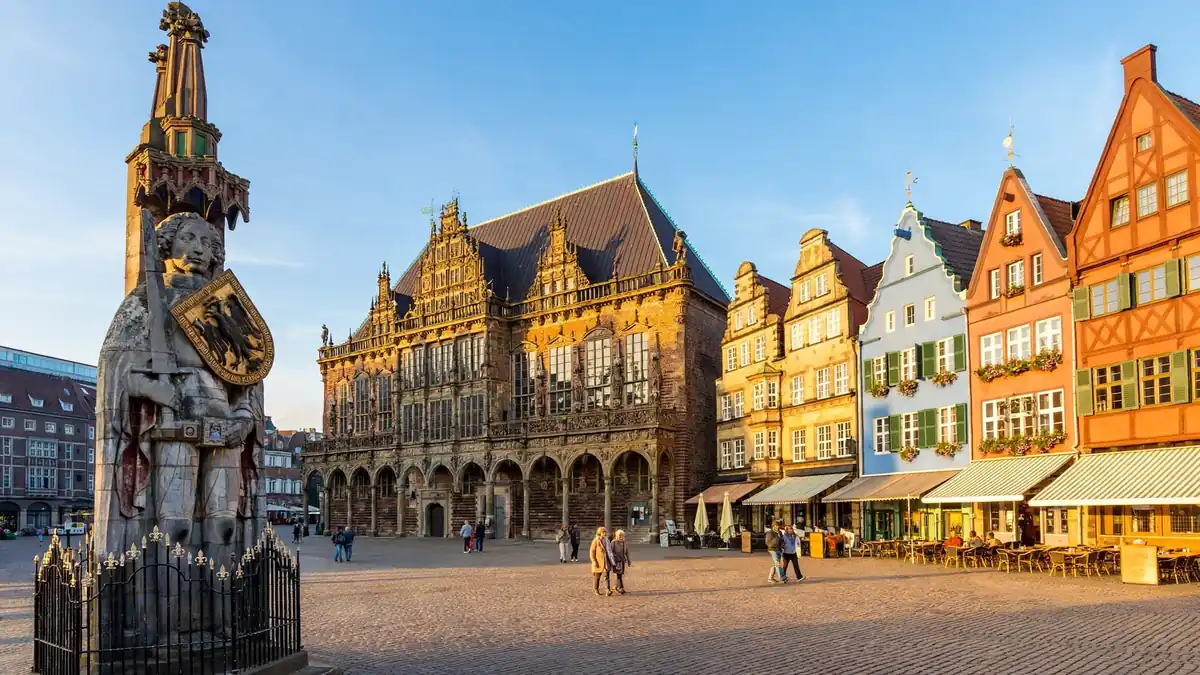
Start early in Bremen Marktplatz, before the tour groups and café crowds arrive. This broad square has anchored city life for centuries. Around it stand gabled merchant houses, the cathedral and two UNESCO-listed treasures. Because everything faces one open space, the history feels easy to read.
First, look up at Bremen Town Hall, completed in the early fifteenth century. Its brick Gothic core later gained an ornate Weser Renaissance facade. Guided tours reveal grand halls that still host civic ceremonies today. So book a tour slot early if interiors matter to you.
Next, stand before the Roland statue, which has guarded the square since 1404. The stone figure rises about ten metres, shield and sword in hand. For Bremen citizens, Roland symbolises freedom, market rights and independence. In fact, local legend says the city stays free while Roland stands.
Where is the Bremen Town Musicians statue?
Just around the town hall corner, a much smaller statue steals the crowds. The Bremen Town Musicians show a donkey, dog, cat and rooster stacked tall. Gerhard Marcks created the bronze sculpture in 1953. It honours the Brothers Grimm tale about four ageing animals seeking a new life.
Tradition says holding the donkey’s front legs brings luck and a return trip. That is why those two legs shine bright gold from countless hands. Take your photo, make your wish and then look closer at the details. Each animal’s face carries real character, weariness and hope.
Afterwards, step inside Bremen Cathedral, the twin-towered St Peter’s Church beside the square. Inside, you will find carved choir stalls, quiet chapels and remarkable old stonework. Some visitors also descend to the Lead Cellar, known for its preserved bodies. If the tower is open, climb it for rooftops and river views.
Saturday late morning: a street built like an artwork
Why is Böttcherstraße so unusual?
From the square, a narrow entrance leads into Böttcherstraße, and the mood changes instantly. This short lane runs only around one hundred metres towards the river. Yet every red-brick facade carries carvings, reliefs or strange golden details. So allow far more time than its length suggests.
Originally, coopers who made barrels for the port worked along this street. Then coffee merchant Ludwig Roselius rebuilt it during the 1920s and 1930s. He filled it with Brick Expressionist buildings, workshops and small museums. As a result, the lane feels like an artwork you walk through.
Look out especially for the Paula Modersohn-Becker Museum, devoted to the early modern artist. Nearby, the House of the Glockenspiel hides thirty porcelain bells between two gables. At set times, the bells chime while carved panels turn beside them. Check the posted times when you arrive, because the schedule changes seasonally.
History lovers often pair this lane with older preserved towns elsewhere in Germany. Our walk through the places to visit in Rothenburg ob der Tauber for cultural and historical sights makes a fine companion read. Bremen, though, adds a working port story that Rothenburg cannot match.
Saturday afternoon: getting happily lost in Schnoor
What makes the Schnoor quarter so special?
After lunch, cross a few streets into the Schnoor quarter, Bremen’s oldest neighbourhood. Its name may link to rope making, a trade once vital for shipping. Rows of tiny houses lean along lanes barely wide enough for two people. Many homes date from the fifteenth and sixteenth centuries.
Fishermen, craftspeople and river workers once lived in these miniature cottages. Today, goldsmiths, galleries, cafés and small independent shops fill the ground floors. Because cars barely enter the quarter, wandering here feels calm and timeless. Still, go slowly, since the best details hide at ankle and eye level.
For example, one lane leads to a tiny house often called Bremen’s smallest home. Another corner holds workshops where makers still sell handmade goods directly. Pop into the Schnoor Museum if you want old photographs and household stories. Then stop for coffee and cake, a ritual locals take seriously.
Couples usually linger longest here, especially in the softer late afternoon light. If romantic old towns are your thing, browse the most romantic places to visit in Italy for a future trip. Schnoor, however, has its own quieter, northern kind of romance.
Where should you eat on Saturday evening?
First, consider the historic Ratskeller beneath the town hall for a special dinner. Its vaulted cellar has served wine and regional food for centuries. Book ahead on Saturdays, because the most atmospheric tables fill quickly. The menu usually mixes German classics with seasonal northern dishes.
Alternatively, wander into the Viertel for a looser, more local evening. This lively district east of the old town mixes bars, cafés and small restaurants. Prices there often feel friendlier than beside the main square. So the Viertel suits travellers who prefer neighbourhood energy over ceremony.
Before bed, return briefly to the Schlachte promenade for one last riverside walk. The moored ships glow under strings of warm lights. It is a simple scene, yet it captures Bremen perfectly.
Sunday morning: museums that pull in opposite directions
Which museum suits your Sunday mood best?
Sunday asks a pleasant question, because Bremen offers two very different museum stars. The Übersee-Museum Bremen stands right beside the main station. Inside, natural history and world cultures share vast, light-filled galleries.
Meanwhile, Universum Bremen takes a playful, hands-on approach near the university. Its silver, whale-like building holds hundreds of interactive science stations. Visitors can feel earthquake forces, explore the senses and test simple physics. Families love it, although curious adults rarely leave disappointed either.
So choose by energy rather than by reputation alone. Pick the Übersee-Museum for world stories, objects and quieter galleries. Choose Universum instead when children, or your own inner child, need action. Either way, tram line 6 makes the return journey simple.
Science and world culture also anchor great city breaks far beyond Germany. Our list of the top ten places to visit in Budapest shows a different capital doing the same trick. Bremen, however, keeps both museums within one relaxed morning.
What can beer lovers do on Sunday?
Beer fans should check whether a Beck’s brewery tour fits their departure time. Beck’s has brewed in Bremen since the nineteenth century, and its green bottles travel worldwide. Tours usually explain the brewing halls, ingredients and bottling process. Tastings often close the visit, so check age rules and booking needs first.
Do not force the tour if your train leaves early, though. A relaxed final morning beats a sprint across the city every time. Instead, buy a small local beer later at the station or airport. Then the taste of Bremen travels home with you anyway.
Sunday afternoon: green space or harbour air?
Why do locals love Bürgerpark so much?
If the weather smiles, spend your final hours in Bürgerpark Bremen, behind the station. Citizens funded this huge landscape park during the nineteenth century. Meadows, woodland paths, lakes and small bridges unfold one after another. As a result, the city centre feels suddenly far away.
Rent a rowing boat in season, or simply follow the shaded paths slowly. You may pass a Swiss-style dairy building and several playful animal enclosures. Locals picnic, cycle and read here as if time costs nothing. That unhurried mood makes the park a perfect weekend ending.
Before the park, the Wallanlagen gardens offer a shorter green alternative nearby. This ribbon of planting follows the line of the old city walls. Its star is the Am Wall windmill, a postcard view above flower beds. So even a spare half hour can end beautifully here.
Is Vegesack harbour worth the extra trip?
With a later departure, Vegesack harbour adds one final, saltier chapter. This northern district grew around one of Germany’s earliest artificial harbours. Old captains’ houses line the streets above the Weser and Lesum rivers. Meanwhile, museum ships and sailing boats crowd the harbour basin below.
Walk the maritime mile, read the plaques and watch the working river traffic. The famous whale jawbone and historic harbour warehouses reward patient explorers. Because Vegesack sits around half an hour away by train, timing matters. Still, sea-minded travellers usually judge the detour worthwhile.
Historic ports like this deepen any wider European travel list. For broader inspiration, explore our pick of 15 places to visit in the world after this trip. Bremen’s harbour story, though, feels personal rather than grand.
What if you only have one day in Bremen?
One day in Bremen still covers the essential loop surprisingly well. Start at the market square for the town hall, Roland and Town Musicians. Then walk Böttcherstraße down towards the river before lunch. After lunch, give Schnoor at least one unhurried hour.
Later, choose just one extra rather than trying to do everything. The cathedral tower suits clear days and photographers best. The Übersee-Museum suits rainy days, since it stands beside the station. Finally, end beside the Schlachte as the evening lights appear.
That single loop echoes the great one-day city walks elsewhere in Europe. Our guide to the best places to visit in Montpellier, France follows a similar compact logic. Bremen, however, adds fairy tale statues and a sea-trading past.
When is the best time to visit Bremen?
Generally, late spring and early autumn bring the kindest balance for a weekend. May and June offer long evenings, green parks and café terraces. September often stays mild while the summer crowds thin out. So many locals quietly call those months the sweet spot.
Summer brings festivals, river life and the lively open-air Breminale in July, usually. August can feel humid, though, and popular weekends raise hotel prices. Winter, meanwhile, trades long days for a much-loved Christmas market around the square. That market usually runs from late November until just before Christmas.
October adds the Freimarkt, one of Germany’s oldest and largest funfairs. It fills the fairground near the station with rides, food stalls and noise. Book rooms early for Freimarkt weekends, because loyal visitors return yearly. Whatever the season, pack layers, since North Sea weather changes quickly.
How much does a Bremen weekend usually cost?
Honest framing helps here, because Bremen usually costs less than Munich or Hamburg. A modest traveller might spend roughly seventy to one hundred euros daily. That budget covers a simple room share, bakery breakfasts and mostly free sights. Naturally, your hotel choice will swing the total most.
A comfortable mid-range weekend usually lands somewhere around one hundred twenty to one hundred ninety euros daily. That level buys a central hotel, café lunches and one paid attraction. Still, walking everywhere keeps transport costs pleasingly low.
Many headline sights cost nothing at all, which protects every budget. The square, statues, Schnoor lanes and promenade are all free to enjoy. Cathedral entry is generally free too, although tower climbs charge a small fee. So spend your money on good food and one memorable experience instead.
Card payments work widely in hotels, museums and larger restaurants now. However, smaller cafés, market stalls and bakeries may still prefer cash. Carry some euros in small notes for those moments. That simple habit prevents awkward counter delays across Germany generally.
Where should you stay in Bremen?
First-time visitors usually sleep best inside or beside the old town. From there, the square, Schnoor and Schlachte all sit within walking distance. Hotels near the station add convenience for early trains and museum visits. The Viertel, meanwhile, suits travellers who value nightlife and local cafés.
Book earlier for festival weekends, football fixtures and the Christmas market season. Prices rise quickly then, even in this normally fair-priced city.
For a longer European plan, Bremen pairs neatly with Hamburg by train. That combination mirrors how travellers link historic cities elsewhere, like the routes in our best historical places to visit in UK guide. Bremen first, though, because its calm sets the tone beautifully.
Insider tips for a smoother Bremen weekend
- Visit Schnoor before ten in the morning or after four in the afternoon, because its lanes narrow quickly at midday.
- Time Böttcherstraße around a Glockenspiel performance, since the porcelain bells and turning panels reward a short wait.
- Rub the Town Musicians donkey with both hands if you follow local custom, because one-handed wishes supposedly fail.
- Check museum opening days before Sunday planning, as some Bremen museums close or shorten hours on Mondays instead.
- Carry a light rain layer in every season, since Weser weather can turn between breakfast and lunch.
- Try northern dishes like Labskaus or Knipp once, even if their descriptions sound unusual at first reading.
- Walk the Schlachte at dusk at least once, because the river light there beats any daytime photograph.
- Leave Vegesack for trips with a late departure, so the harbour never turns your farewell into a rush.
Frequently asked questions about Bremen
Is Bremen worth visiting for a weekend?
Yes, Bremen suits a weekend almost perfectly. Its headline sights cluster tightly, so two days feel generous rather than rushed. You also gain time for museums, parks and long riverside meals. Bigger cities rarely offer that balance so easily.
How many days do you need in Bremen?
Most visitors need two full days for the classic sights and one museum. One day covers the old town loop if you start early. Three days, however, allow Bürgerpark, Vegesack and slower café time. Choose by pace rather than by checklist pressure.
What is Bremen most famous for?
Bremen is most famous for the Town Musicians fairy tale and its statues. The UNESCO-listed town hall and Roland statue share that global fame. Beck’s beer, the Hanseatic trading past and the Weser River follow closely. Together, those stories shape the city’s identity.
Can you walk everywhere in Bremen?
Yes, you can walk between almost all old town sights comfortably. The square, Schnoor, Böttcherstraße and Schlachte form one compact walking loop. Trams help only for Universum, Bürgerpark’s far side and Vegesack connections. Flat streets make those walks pleasant in most weather.
What food should you try in Bremen?
Try Labskaus, a hearty sailor’s dish of corned beef, potato and beetroot, firstly. Knipp, a traditional oatmeal and meat dish, offers another very local taste. Fish rolls along the river suit lighter appetites better. Finally, finish with Bremer Kluten, a mint and chocolate sweet locals love.
Is Bremen expensive to visit?
No, Bremen usually costs less than Germany’s biggest city-break destinations. Many major sights are free, and walking removes most transport spending. Hotels and dinners will decide your final total, as everywhere. With modest choices, a weekend stays comfortably mid-priced.



