
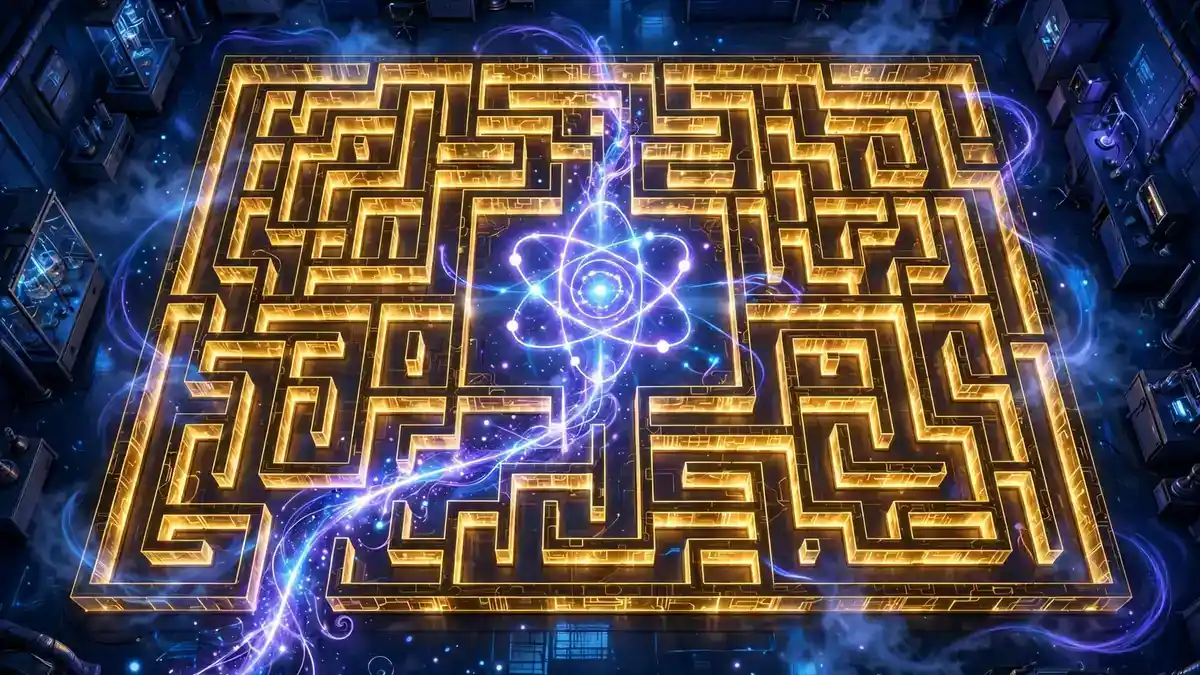
Maya stood in her kitchen at midnight, staring at a locked pantry door. She had lost the key again, naturally. Behind that door sat flour, sugar, and every spice she owned. Meanwhile, dinner guests were arriving in twenty minutes.
Imagine trying every key on a crowded ring, one by one. You would test the brass key, fail, and move on. Afterwards, you would test the silver key, fail again, and keep going. Your normal computer solves problems in exactly that patient, single-file way.
Now picture a very different helper in that kitchen. This helper somehow explores many keys at once, feeling how they interact. Eventually, the right combination almost rises to the surface on its own. That strange helper is the heart of this guide to quantum computing explained for beginners.
You do not need physics training to follow along here. Instead, you need curiosity and a little patience with weird ideas. Honestly, the weirdness is the fun part, and it is also the useful part.
What is quantum computing in simple terms?
So, what is quantum computing in simple terms that anyone can grasp? Basically, it is a new way of processing information using quantum physics. Classical computers use electrical switches that sit firmly on or off. Quantum computers, however, use tiny objects that follow stranger, softer rules.
Those tiny objects can be atoms, electrons, or engineered circuits chilled deeply. Because they obey quantum rules, they can hold richer information at once. Moreover, they can explore many possible answers together before settling down. Readers who enjoy clear explainers often start with roundups like the latest tech info from BeaconSoft, which shows how fast this field keeps moving.
Importantly, a quantum computer is not just a faster laptop. Rather, it is a different kind of machine built for different jobs. Some problems suit its style beautifully, while others suit it terribly. Understanding that difference matters far more than memorising any technical vocabulary.
Meet Maya and the maze that changed everything
Let us return to Maya, because her kitchen hides a second puzzle. Her pantry, it turns out, connects to a small maze of cupboards. Each cupboard door opens only when neighbouring doors sit in certain positions. Finding the one arrangement that unlocks everything could take her all evening.
A classical computer would map that maze corridor by corridor. It would try one route, hit a wall, and backtrack. Subsequently, it would try another route with the same stubborn patience. Large mazes would defeat that approach through sheer exhausting numbers.
Maya’s imaginary quantum helper tackles the maze very differently indeed. It spreads attention across many routes at the same time. Crucially, wrong routes can cancel each other out like opposing ripples. Right routes, meanwhile, can reinforce each other and grow stronger. That cancelling and reinforcing trick is called interference, and programmers choreograph it carefully.
Qubits vs bits: the only comparison you really need
Every explanation eventually lands on the qubits vs bits comparison. A bit is the smallest unit inside your phone or laptop. It holds exactly one value at any moment, either zero or one. Think of a light switch that clicks up or clicks down.
A qubit, by contrast, is the smallest unit inside a quantum computer. It can be prepared in a blend of zero and one. Admittedly, that sentence sounds like wordplay, yet it describes real physics. Physicists call that blend a superposition, and we will unpack it shortly.
| Feature | Classical bit | Qubit |
|---|---|---|
| Basic state | Zero or one only | A blend of zero and one |
| Helpful image | A clicked light switch | A dimmer with many settings |
| When measured | Value stays the same | Blend collapses to zero or one |
| Team behaviour | Bits work independently | Qubits can become entangled together |
| Best at | Everyday, step-by-step tasks | Certain huge, tangled problems |
Notice the measurement row in that table above. Measurement forces a qubit to commit to one answer. Consequently, programmers cannot simply peek inside mid-calculation without disturbing everything. They must design calculations that finish before anyone looks at the result.
Guides such as this Togtechify look at trending technology show how often qubits get misdescribed online. Writers frequently claim that qubits try everything and reveal everything. In reality, they explore broadly but reveal only one measured outcome. Clever algorithm design bridges that frustrating gap.
Superposition explained simply, without the spinning coin?
You have probably heard superposition compared to a spinning coin. That analogy appears everywhere, although it hides more than it reveals. A spinning coin is secretly heads or tails at every instant. A qubit in superposition is genuinely described by a blend instead.
Here is superposition explained simply through Maya’s kitchen radio. Imagine a radio dial resting between two stations at once. You hear a layered mixture, neither station clean nor fully separate. Turning the dial firmly is like measuring the qubit. Suddenly, one station locks in and the mixture disappears completely.
Admittedly, even that image is only an approximation. Quantum blends carry something extra called phase, which radios hint at. Phase decides whether overlapping possibilities reinforce or cancel each other. Therefore, superposition alone does not create quantum power by itself. Interference between phases is where the real magic actually lives.
Consider two qubits together for a moment of honest wonder. Two bits hold one of four combinations at a time. Two qubits, however, can hold a blend covering all four combinations. Adding qubits doubles that space with every single addition. Exponential growth explains both the excitement and the engineering headaches here.
Quantum entanglement explained through a pair of gloves?
Another phrase you will meet everywhere is quantum entanglement explained badly. Bad versions suggest entangled particles send instant messages across space. They do not, and physicists are quite firm about that point. No usable information travels faster than light through entanglement.
Try a humbler image involving a pair of gloves instead. Suppose one glove goes into each of two sealed boxes. Opening your box and finding a left glove tells you something. Instantly, you know the distant box holds the right glove. That shared correlation feels spooky, yet nothing travelled between the boxes.
Entanglement goes one step beyond that glove story, though. Gloves have fixed identities hidden inside their boxes all along. Entangled qubits, in contrast, lack separate fixed states before measurement. Their outcomes correlate more strongly than any hidden local story allows. Experiments have confirmed that stronger correlation repeatedly and rigorously.
Why should a beginner care about such subtle physics? Because entanglement lets qubits act as one coordinated system. Algorithms exploit those correlations to shape which answers get reinforced. Without entanglement, a quantum computer loses much of its distinctive power. Coverage of data teamwork, like Rew Technology’s work on data integration, offers a classical echo of that coordination idea.
How do quantum computers work, step by step?
Perhaps you are now wondering, how do quantum computers work in practice? The workflow starts with preparing qubits in a known state. Engineers then apply a carefully planned sequence of operations. Finally, they measure the qubits and record the outcome produced.
Most machines repeat that whole cycle many times over. Each run yields one sample from a range of possibilities. Patterns across many samples reveal the answer researchers actually want. Hence, quantum results often arrive as probabilities rather than certainties.
Hardware approaches differ considerably between research teams and companies. Some systems use superconducting circuits kept colder than deep space. Others trap individual ions using electric fields and laser light. Photonic systems, meanwhile, push particles of light through tiny channels. Each approach trades speed, stability, and manufacturing difficulty differently.
Software sits on top of that exotic hardware stack. Programmers write instructions using quantum programming languages and development kits. Those instructions then get translated into precise physical control signals. If you enjoy tool histories, the Alteryx version history guide shows how classical data tools matured through similar layers.
Quantum gates explained: the choreography behind the scenes
Classical computers build everything from simple operations called logic gates. Quantum gates explained plainly are the quantum version of that idea. A gate nudges a qubit’s blend in a precise, reversible direction. Stringing gates together creates a quantum circuit, much like choreography.
Some gates flip a qubit much like a classical NOT gate. Others rotate its phase without flipping it at all. Certain gates link two qubits so they become entangled deliberately. Designers arrange these moves so wrong answers cancel through interference. Desired answers, conversely, get amplified until measurement likely reveals them.
Think back to Maya’s maze and its many tangled routes. Each gate is like adjusting one junction inside that maze. Skilled choreography gradually makes the exit route shine brightest. Poor choreography, unfortunately, leaves every route equally dim and useless. Algorithm design is therefore closer to composing music than typing instructions.
The quantum vs classical computer difference, honestly stated
Headlines often blur the quantum vs classical computer difference beyond recognition. Classical computers excel at precise, sequential, everyday work of every kind. They run your messages, spreadsheets, games, browsers, and banking apps beautifully. Nothing about quantum research makes that enormous achievement any smaller.
Quantum computers target a narrow family of unusually structured problems. Those problems involve huge possibility spaces with patterns interference can exploit. Simulating molecules is the classic example researchers return to repeatedly. Optimisation puzzles and certain mathematical problems also fit that profile.
| Question | Classical computer | Quantum computer |
|---|---|---|
| How does it explore? | Step by step, very fast | Through interfering possibility blends |
| How reliable is it today? | Extremely reliable and cheap | Fragile and still experimental |
| What does it run well? | Almost all everyday software | A narrow set of special problems |
| Where does it live? | On desks and in pockets | Mostly in specialist laboratories |
Notice that speed alone never appears as the deciding factor. Structure matters more than raw pace in this comparison. A quantum machine can be slower per operation yet finish sooner. That happens when its approach avoids astronomical numbers of wasted steps.
Quantum supremacy meaning: what did those headlines claim?
Another headline phrase worth decoding is quantum supremacy meaning itself. The term describes a quantum device beating classical machines at one task. Crucially, that task can be artificial and practically useless. The point is demonstrating a genuine computational gap, not usefulness.
Researchers have announced such milestones, and other researchers have debated them. Classical teams often respond by improving their own algorithms afterwards. That back-and-forth is healthy science rather than a scandal. Nevertheless, supremacy at one contrived task differs hugely from general superiority.
Many specialists now prefer the gentler phrase quantum advantage instead. Advantage implies a useful task done better, faster, or cheaper. Proving durable advantage for real-world problems remains an open research challenge. Honest explainers should keep that distinction visible at all times. Roundups like Maxil Technology Solutions’ innovation overview remind readers how often breakthrough language outruns delivered results.
What is quantum computing used for in the real world?
Asking what is quantum computing used for today deserves a careful answer. Honestly, present-day uses are mostly research, experimentation, and preparation. Teams test algorithms on small, noisy machines and simulators. Companies explore whether future machines might improve their hardest calculations.
Chemistry simulation leads almost every serious list of future uses. Molecules obey quantum rules, so quantum machines may model them naturally. Better models could help researchers design medicines, catalysts, and materials. Fertilisers, batteries, and industrial chemicals all involve such molecular puzzles.
Optimisation is another frequently mentioned candidate for quantum help. Airlines, warehouses, and delivery networks all juggle enormous scheduling choices. Quantum methods might suggest better arrangements for some of those puzzles. However, classical methods are already excellent and keep improving steadily. Any quantum benefit must beat strong incumbents, not weak strawmen.
Machine learning attracts attention here as well, predictably enough. Researchers investigate whether quantum circuits can spot unusual data patterns. Results so far remain exploratory rather than decisively better. Sober assessments, such as SPS Technologies reviews and real experiences, show why evidence should outrank excitement in technology decisions.
Quantum computing examples you can actually picture
Concrete quantum computing examples help more than abstract promises do. Picture researchers modelling a small molecule involved in capturing nitrogen. Classical supercomputers struggle because electron interactions explode combinatorially. A future quantum machine might represent those interactions far more naturally.
Another example involves searching an unsorted list more efficiently. Grover’s algorithm offers a proven, moderate speedup for such searches. It will not transform everyday database use overnight, admittedly. Still, it demonstrates that quantum speedups can be mathematically real.
Factoring large numbers provides the most famous example of all. Shor’s algorithm showed that quantum machines could factor efficiently in principle. That mathematical result reshaped how governments think about encryption security. Yet running it usefully demands machines far beyond today’s fragile devices.
Weather forecasting sometimes appears in popular lists, somewhat misleadingly. Quantum methods might eventually assist particular calculations inside forecasting models. They will not magically predict storms weeks ahead with certainty. Chaos in the atmosphere limits prediction regardless of computing style.
The hard part nobody puts on posters: decoherence and quantum errors
Every honest guide must linger on decoherence and quantum errors. Qubits are exquisitely sensitive to heat, vibration, and stray electromagnetic noise. Such disturbances destroy delicate blends and correlations within tiny fractions of time. That destructive process is called decoherence, and it never takes holidays.
Imagine Maya’s radio mixture dissolving whenever someone coughs nearby. Her quantum kitchen would produce static instead of a clear station. Real laboratories fight this fragility with isolation, shielding, and extreme cooling. Even so, errors creep into calculations at stubbornly high rates.
Quantum error correction offers a principled, if demanding, escape route. It spreads one unit of information across many physical qubits. Clever checks detect errors without directly measuring the protected information itself. Unfortunately, that protection may require very large numbers of physical qubits.
Researchers call machines that achieve this protection fault-tolerant systems. Building one reliably remains the field’s central engineering challenge today. Progress is genuine, steady, and worth celebrating without exaggeration. Breakthrough headlines, by contrast, often skip the enormous distance still remaining.
Quantum computing and cryptography: should you worry?
The link between quantum computing and cryptography causes understandable anxiety. Much internet security relies on maths that classical computers find hard. In particular, factoring large numbers underpins some widely used encryption systems. Shor’s algorithm threatens those specific systems if large quantum machines arrive.
Symmetric encryption, like the kind protecting many files, fares differently. Grover’s algorithm weakens it modestly rather than breaking it outright. Doubling key lengths can counter that particular quantum effect effectively. So the popular claim that quantum destroys all encryption is false.
Governments and standards bodies are already responding to this risk. They have developed and standardised post-quantum cryptography methods for migration. Organisations with long-lived secrets should inventory their encryption carefully now. That preparation matters because attackers could store encrypted data for later. Specialists call that risk harvest now, decrypt later, quite chillingly.
For ordinary readers, panic is neither necessary nor useful today. Your bank and browser vendors will migrate systems behind the scenes. Sensible personal steps remain unchanged: updates, unique passwords, and two-factor authentication. Quantum risk changes institutional planning far more than personal habits.
Will quantum computers replace normal computers in your home?
So, will quantum computers replace normal computers on your desk? Almost certainly not, according to most researchers working in the field. Quantum machines are specialised accelerators, not general-purpose replacements for laptops. Your laptop handles text, photos, and video calls superbly already.
A likelier picture involves partnership rather than replacement at all. Classical computers will prepare problems, control quantum hardware, and interpret results. Quantum processors will tackle only the stubborn sub-problems suited to them. That hybrid pattern already shapes how researchers use today’s machines.
Cost and fragility reinforce that partnership picture for the foreseeable future. Systems needing extreme cooling will not slip into smartphones anytime soon. Access will probably arrive through cloud services hosted by specialists. You might use quantum power without ever seeing the machine itself. Broader explainers like Ubia Technologies’ look at smart solutions show how often new computing power arrives invisibly, through services.
Hype vs reality: a calm scorecard for beginners
Let us give Maya’s midnight kitchen one final honest inspection. Quantum computers are real machines that perform real calculations today. Equally, they remain noisy, small, and limited compared with breathless headlines. Both statements are true simultaneously, and holding both is essential.
Hype claims quantum will soon cure disease and solve climate change. Reality says quantum may eventually accelerate specific modelling steps within research. Those steps matter, yet medicine and climate involve far more than computation. Experiments, trials, engineering, and policy all remain stubbornly human work.
Hype also claims quantum will make all classical computing obsolete. Reality says classical computing keeps improving and handles most tasks better. Meanwhile, quantum research borrows heavily from classical control systems and software. Rather than rivals, the two traditions increasingly behave like collaborators.
Where does that leave a curious beginner watching this field? Comfortably informed, hopefully, and slightly harder to fool with headlines. You now know which questions expose exaggeration almost instantly. Ask what problem was solved, how large the machine was, and how errors were handled.
The future of quantum computing, without fortune-telling
Finally, the future of quantum computing deserves excitement without fortune-telling. Researchers expect gradual improvements in qubit quality, control, and error correction. Each improvement expands which algorithms become practical to test meaningfully. Timelines, however, remain genuinely uncertain across the entire field.
Several hardware paths may flourish, or one may dominate eventually. Software tools will likely become friendlier as the ecosystem matures. More students will learn quantum ideas earlier in their education. Cross-disciplinary teams, like those covered in Parabilis Space Technologies’ space innovation story, show how specialised fields grow through exactly such collaboration.
Maya never found her pantry key that midnight, incidentally. She improvised dinner from the fridge and fed everyone happily anyway. Her story carries the field’s best lesson for beginners. Ingenuity with imperfect tools often beats waiting for magical ones.
Quantum computing explained for beginners really comes down to that spirit. Strange physics offers a genuinely new way to choreograph possibilities. Careful engineering must still turn that choreography into dependable usefulness. Watching that happen, patiently and critically, is adventure enough for anyone.
Frequently asked questions
Can I try quantum computing without buying a machine?
Yes, several providers offer free cloud access and simulators online. Simulators run on classical computers and suit small learning circuits perfectly. Real hardware access may involve queues and strict usage limits. Nevertheless, a browser and curiosity are genuinely enough to begin.
Do I need advanced maths to understand the basics?
No, the core ideas in this guide require no equations. Superposition, entanglement, interference, and measurement all make sense through careful analogies. Deeper study eventually needs linear algebra and probability, admittedly. Beginners, meanwhile, can build strong intuition long before touching either subject.
How many qubits does a useful quantum computer need?
Nobody can give one universal number for every useful task. Qubit quality and error correction matter as much as quantity. Some tasks may help with hundreds of well-corrected logical qubits. Others may demand far more, depending on their difficulty. Headlines quoting raw qubit counts alone should therefore invite scepticism.
Is quantum computing the same thing as artificial intelligence?
No, they are entirely separate fields with different foundations. Artificial intelligence concerns software that learns patterns from data. Quantum computing concerns hardware and algorithms using quantum physics. Researchers sometimes combine them experimentally, but neither field contains the other.



